
- HOMEGROWN WORLD
- HGCREATORS
- HGEXPLORE
- HGVOICES
- HGSHOP
- CAREERS
- ABOUT US
- CONTACT US

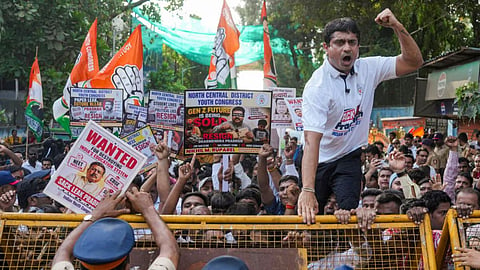
Drawing on Rabindranath Tagore’s ‘Tasher Desh’, student protests over CBSE and NEET, and India’s demographic realities, this essay examines youth resistance, political representation, and the enduring role of young people in challenging rigid systems and reimagining democracy.
In 1957, a decade after Independence, a high school student from India, Padmanabha Gopinath, participated in an international high school debate. The debate featured students from India (Gopinath), Pakistan (Amin Jan), UK (Sara Chatt), and the Philippines (Edward Dennis Normandy III) discussing the roots of cultural bias and historical prejudices. When Chatt suggested that formerly colonised nations should be grateful for British influence and democracy, Gopinath countered that India had democratic ideas — such as village panchayats — long before they were established in Britain. He famously retorted, citing ancient history, noting that democratic traditions existed when “savage Anglo-Saxons were still running about dressed in skins.”
While we can debate the merits of Gopinath’s arguments with the benefit of hindsight, his performance at the debate points to a truth beyond doubt: that Indian students have always been the best of us. From Gopinath, only a decade after independence, to Indian students Avyana Mehta, Ariana Agarwal, and Vivaan Chhawchharia, who won the Earth Prize this year, and the students protesting against discrepancies in the CBSE evaluation system and leaks in the NEET — these remarkable young students represent the country’s future.
In Rabindranath Tagore’s ‘Tasher Desh’ (The Land of Cards), a young prince arrives at a fascist state— the titular Tasher Desh — and inspires the women of the royal court to revolt against the regressive Tash regime. They sing. They dance. They laugh. And through their youthful resistance, they break down the rigid rules that dictate this imagined nation, where people are so regimented that they resemble the four suits in a deck of playing cards — forever moving in rectangular patterns and self-satisfied by the resulting lack of chaos, mistaking it for a sign of peace.
At one point in the play, when told he is strange for not adhering to the archaic rules and traditions of Tasher Desh, the young prince spontaneously breaks into a song. Yes, we’re queer, he sings: “We are the messengers of a new youth, / We are lightsome! We are crazy! We break barriers. / We are drenched in the colours of the sacred garden / We are the lightning! We make mistakes. / We jump in endless waters and struggle to the shore. / We answer the call no matter where it comes from. / In this life and death storm, we are always prepared.”
This is what it means to be young in Tasher Desh, a land where laughter is forbidden, where freedoms of speech, thoughts, and movement are frowned upon, where all aspects of life are controlled by ‘pure’ and ‘ancient’ traditions that are tantamount to truth — unchanging, unquestionable, ultimate: it means to laugh without reason, it means to dance without rhythm, it means to question the rules and rebel against the established order of the day. Today, India, sadly, resembles Tasher Desh in more ways than one.
I was still only a child when I first heard a Sunday broadcast of the 1964 All India Radio adaptation of Tasher Desh. At the time, I did not think of it as anything more than a fabulous, fairy-tale-like children’s musical about a runaway prince who washes ashore in a depressive, disciplinarian land of playing cards. At its surface, Tasher Desh is exactly that, but in many ways, it is also, at once, a biting satire on the rigid structure of India’s casteist and classist society; a prophetic imagination of a post-Fascist nation-state where the totalitarian apparatus has taken over and fused with everyday life so seamlessly that no one remembers the origin of this order, but everyone puts their blind and unwavering faith in the system; and ultimately, it is a revolutionary call to the youth to recognise what their role might be in such a society.
I am in my late-twenties now. When I think about what it means to be young in an ageing world, this is what I think about — I think about all the ways our world is hostile to young people, and all the ways young people across the world come together to resist and reform the rules and systems that govern us when they no longer represent us and our best interests. The ongoing controversy over India’s education system and particularly the country’s school education and competitive exam system is only the latest instance of this long, layered history.
Even though the youth has always been at the forefront of significant social change throughout history, the politics that control so many aspects of our lives — both private and public — have always been an old men’s game. Of course, every four or five years, rallies are staged and politicians across the spectrum fish for the youth vote by delivering boisterous speeches, preaching about our potential on the campaign trail, but these are little more than customary tips of the hat — casual afterthoughts in the larger scheme of things. Nothing ever changes. Everything remains the same.
Why is that?
Much has been said about young people’s aversion to representative politics and rising dissatisfaction with the democratic process — how younger generations are less likely to join political parties or vote in elections, yet more likely to complain about the results than older generations at the same age — and how this delegitimises concerns and opinions young people may have about the politics and the policies of governments they did not elect.
The truth is that in a country where the median age of the population is just over 30 years , the average age of MPs elected to the 18th Lok Sabha is 56 years. For female MPs, the average age is a little lower at 50 years, but this is cause of little relief considering women account for only around 14 percent of Indian MPs even though almost half of the population identify as women. In this way, then, the experience of being young in a world that is increasingly growing older and is largely governed by politicians who neither represent our interests or our aspirations, nor resemble us in their ideologies or their identities is one of hopelessness, anger, anxiety, and frustration.
And yet, when I think about the long and colourful history of youth movements, I realise that the experience of being young is also one of extraordinary hope, resolve, and resilience. Despite all the ways the cards may be stacked against them, young leaders and youth movements from all chapters of history have taken to the streets, and more recently the internet, to make their voices heard. They have come from diverse backgrounds to speak their mind and have their say on a multitude of matters that are as varied as the means used to advocate for or against them. And just like the young prince in Tasher Desh, they have sung, they have danced, they have laughed their way to resistance. The young students like Sarthak Sidhant, Nisarga Adhikary, and the young leaders of the Cockroach Janata Party represent the best of this country — for whatever its worth — and they deserve better than the country is offering them.
To learn more about the CBSE and NEET controversies, read:
Why is CBSE's evaluation system facing flak? | Explained
CBSE’s OSM Controversy Is About More Than Marks. It’s About Trust
Controversies rock crucial school-leaving exam in India
Gen Z’s anger over the NEET and CBSE crises spills into electoral politics
Paper leaks, broken dreams: NEET aspirants demand accountability
