
- HOMEGROWN WORLD
- HGCREATORS
- HGEXPLORE
- HGVOICES
- HGSHOP
- CAREERS
- ABOUT US
- CONTACT US

Known as the Warrior Queen of the Deccan, Chand Bibi was a sixteenth-century ruler who defended Ahmadnagar against the Mughal emperor Akbar. Her life offers a fascinating glimpse into how rare women rulers held political power, military leadership, and diplomatic skill in medieval South Asia.
Over four hundred years ago, a queen of the Deccan Sultanate of Ahmadnagar — one of the five influential medieval kingdoms on the Deccan Plateau — stood alone against the mighty Mughal empire and defied Akbar, the greatest of the great Mughal emperors. Her name was Chand Bibi. She was a ruler, military strategist, and diplomat; she was among the most remarkable figures of early modern India.
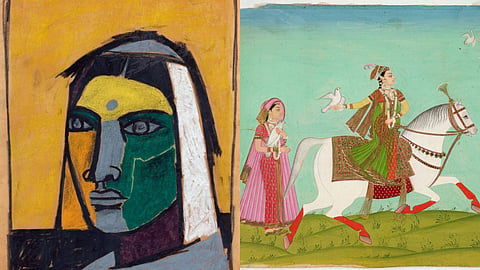
Born circa 1550 in Ahmadnagar, Chand Bibi was the daughter of Sultan Hussain Nizam Shah I. Unlike many royal women whose lives remained confined to courtly palaces, she received a remarkably broad education, which made her rare among her peers in 16th-century South Asia. Contemporary accounts describe her as a polyglot proficient in Arabic, Persian, Turkish, Marathi, and Kannada. She was also trained in music, painting, horsemanship, and statecraft. In early modern India, Chand Bibi became a Cleopatra-esque figure, inspiring miniature art and literature depicting her as a formidable horseback rider, often engaged in falconry, a popular sport of the time.
Her marriage to Ali Adil Shah I, the fifth ruler of the Bijapur Sultanate, strengthened political ties between the Deccan sultanates of Ahmadnagar and Bijapur. Following her husband’s death in 1580, she emerged as a key political figure in Bijapur, serving as regent during the minority reign of the young ruler Ibrahim Adil Shah II, her nephew by marriage. Chand Bibi’s political career was extraordinary because she acted as regent in not one but two major Deccan sultanates. After helping stabilise Bijapur amid factional struggles, she returned to Ahmadnagar, where succession disputes threatened the kingdom’s survival. Here, she acted as regent for her grandnephew, Bahadur Nizam Shah, who was still a child.
The late sixteenth century was a period of intense political turmoil in the resource-rich Deccan Plateau. At the time, the Mughal Emperor Akbar was trying to expand the mighty Mughal empire southward, bringing the independent Deccan sultanates under the imperial control of Delhi. Ahmadnagar became one of his principal targets. In 1595, Mughal forces led by Prince Murad laid siege to Ahmednagar Fort. Chand Bibi personally organized the kingdom’s defense. Accounts from the period describe her riding along the fortifications in armor, sword in hand, rallying soldiers and directing military operations. Her leadership helped repel a major Mughal assault despite the empire’s superior resources. Eventually, she negotiated a settlement that ceded the province of Berar to the Mughals while preserving Ahmadnagar’s political autonomy. The agreement bought valuable time for the kingdom and demonstrated her ability to combine military resistance with pragmatic diplomacy.
As factional rivalries within Ahmadnagar intensified, however, rumors spread that Chand Bibi intended to surrender Sultanate. In 1599 or 1600, she was killed by members of her own nobility. Shortly afterward, the Mughals captured the city. Her tragic murder only cemented her legacy as an icon of resistance. Across the Deccan, she became celebrated as ‘Chand Sultana’ and as a symbol of courage, intelligence, and political acumen. Historians increasingly recognize her as one of the most significant female rulers of early modern South Asia. Recent scholarship has also highlighted how her life challenges assumptions about gender and power in the Persianate and Deccan worlds.
From medieval and early modern miniaturists to colonial painters like Allan Stewart and modernists like M.F. Husain, Chand Bibi’s story has inspired generations of artists and poets, transforming her into a timeless archetype whose struggles continue to resonate in contemporary conversations about gender, power, and identity. Historian Sarah Waheed’s upcoming book, ‘Chand Bibi: The Lives And Legends Of A Warrior Queen’, uncovers the multilayered world of 16th-century Deccan that shaped Chand Bibi and her battles against the Mughal empire under Akbar. Through the author’s personal journey across archives, forgotten manuscripts and contested memories, crumbling forts, and Sufi shrines of the south Indian peninsula, the book explores the mysteries that continue to illuminate and obscure Chand Bibi’s life.
To learn more about Chand Bibi, read ‘Chand Bibi: The Lives And Legends Of A Warrior Queen’ by historian Sarah Waheed.
If you enjoyed reading this, here’s more from Homegrown:
The Mysore Queens Who Became The Face Of The World’s First Vaccination Campaign
From Qudsia Begum To Sultan Jahan: The Remarkable Women Who Ruled Bhopal For 107 Years
Courage, Defiance, And Sacrifice: The Life & Legacy Of Warrior Queen Rani Durgavati
