
- HOMEGROWN WORLD
- HGCREATORS
- HGEXPLORE
- HGVOICES
- HGSHOP
- CAREERS
- ABOUT US
- CONTACT US

The global rare books market is booming, driven by collectors, investors, and institutions worldwide. Yet far from the glare of international auction houses, a family-run store in South Delhi has spent nearly six decades preserving India’s literary and material heritage. Memoirs of India — run by three generations of the Jain family — is a living archive shaped by the belief that books carry lives within them.
Globally, the niche, specialised, and often opaque rare books market is currently valued at around USD 2.3 billion. According to a 2025 report by Data Intelo, the market is projected to reach USD 4.07 billion by 2033, driven by rising interest among collectors, investors, and institutions, as well as the growing digitalization of rare books trading and authentication processes.
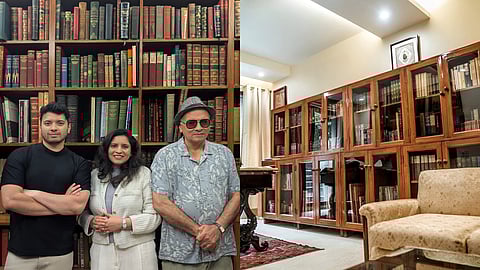
But these numbers only hint at what lies beneath: stories of long-forgotten volumes, passionate custodianship, and deep, root-like connections that span generations. Memoirs of India, a rare and antiquarian book store tucked inside a shaded enclave of South Delhi, is an embodiment of the dark, hushed allure of rare, old books. For nearly six decades, this family-run institution has been more than a marketplace — it has been a custodian of cultural memory, preserving texts that map the contours of India’s intellectual, literary, and material heritage.
The story began in 1967, when the Jain family, the store’s founders, acquired a modest set of rare books from a Parsi doctor in Delhi. What started as curiosity became a lifelong commitment to protecting the written record. Today, Memoirs of India stands as one of the most important repositories of rare and antiquarian books in South Asia — a deceptively unassuming collection of first editions, signed copies, fine bindings, and rare maps that attract collectors from across the world.
The store’s history reflects broader shifts in the rare book world: from price-driven auctions in London and New York to online platforms where buyers in Tokyo, Toronto, and Melbourne bid on volumes once confined to physical shelves. Yet what makes Memoirs of India distinct is its relational model of collecting — one where expertise, education, and mentorship matter as much as price tags. Rare book dealers play a unique role in this world: they act as caretakers of memory, preserving material memory that carry the weight of centuries of human history. Their work — cataloguing, authenticating, and restoring irreplaceable books — is painstaking and deeply rooted in trust.
These human stories underpin a market that refuses to be defined solely by numbers. In Delhi, Memoirs of India’s shelves tell stories — of empire and exploration, science and philosophy, art and architecture — that bridge eras and geographies.
Memoirs of India has partnered with cultural institutions like the Indira Gandhi Centre for the Arts and the Crafts Museum in Delhi to support exhibitions and research, expanding its mission beyond commerce. In doing so, it represents a rare blend of scholarship, custodianship, and community involvement.
Across the globe, the rare book market may still be a fraction of the broader book industry, but its cultural impact is outsized. As old memoirs, maps, and manuscripts find new homes and new readers, they continue to tell stories that matter: about who we were, who we are, and how the printed word persisted through the centuries.
Follow @memoirsofindia on Instagram to learn more, or visit memoirsofindia.com.
