
- HOMEGROWN WORLD
- HGCREATORS
- HGEXPLORE
- HGVOICES
- HGSHOP
- CAREERS
- ABOUT US
- CONTACT US

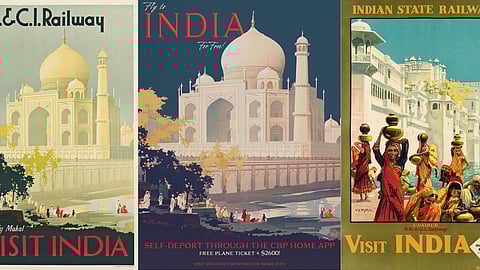
The USDHS’s ‘Project Homecoming’ uses iconic imagery of the Global South, such as the Taj Mahal, to frame deportation as a "return home". Nearly 50 years after Edward Said, Orientalism still shapes how the West sees, and shapes, the rest of the world.
Between 1924 and 1926, The Times of India Press, operated by Bennett, Coleman & Co. in Bombay, commissioned Greek-British artist William Spencer Bagdatopoulos (1888-1965) to create a series of illustrations to promote railway tourism in British India. During these two years, Bagdatopoulos traveled extensively across modern-day India, Pakistan, and Afghanistan, producing romanticized Orientalist impressions of the region.
Through The Times of India Press, Bagdatopoulos created a series of six travel posters for The Indian Railways Publicity Bureau — all with the same caption, ‘Visit India’, and the subheading, ‘Indian State Railways’, even though no such unified Indian Railways existed at the time. In addition to the six-part series, Bagdatopoulos also designed a separate poster for the BB & CI Railway in a slightly different style. It was printed by Clardigde & Co. in Bombay. Bagdatopoulos chose the Taj Mahal as the poster’s subject. This mausoleum would become the symbol of India after it was extensively restored in 1908 by the British, who had damaged the monument themselves during the Indian uprising of 1857. Last week, the US Department of Homeland Security used this illustration in an X (formerly Twitter) post promoting ‘Project Homecoming’, a self-deportation programme, offering to fly illegal immigrants to their home countries for free with an exit bonus of 2,600 US dollars.
These posters, featuring the Taj Mahal alongside postcard-ready images of China and Colombia, are not simply bureaucratic artefacts. They are aesthetic choices. And, like all aesthetics embedded in power, they reveal the persistence of Orientalism in the way the West imagines, addresses, and administers the rest of the world — and although we are using it to refer to the global majority, even the phrase “the rest of the world” is exclusionary in how it others the Global South and the non-Western nations.
When Edward Said published ‘Orientalism’ in 1978, he argued that the ‘Orient’ was not a real, coherent place but a constructed category: “...a Western style for dominating, restructuring, and having authority over the Orient.” Nearly five decades later, the DHS posters suggest precisely how intact this structure remains. The choice of the Taj Mahal — arguably one of the most overdetermined symbols of India in Western imagination — reduces a vast, internally diverse country into a singular, romanticised image of heritage and nostalgia. It is an India that exists less as a lived, political reality and more as a consumable visual shorthand.
Orientalism, as Said noted, operates through “a distribution of geopolitical awareness into aesthetic, scholarly, economic, sociological, historical, and philological texts.” In other words, it is not confined to literature or art; it permeates policy. The DHS initiative, framed as a humane alternative to deportation, is also a narrative exercise. By inviting migrants to “return home” through images that evoke timeless monuments and civilisational grandeur, it subtly recasts displacement as a kind of voluntary pilgrimage back to an essentialised origin.
But this ‘home’ is itself a fiction. It erases the complex reasons — be it economic precarity, political instability, religious persecution, or climate crises — that compel migration in the first place. More importantly, it reproduces a civilisational binary: the United States as a site of order, legality, and modern governance, and the rest of the world as a relic of cultural memory and aesthetic excess.
Said’s formulation of the Orient remains instructive here:
“The Orient was almost a European invention, and had been since antiquity a place of romance, exotic beings, haunting memories and landscapes.” The DHS posters echo this genealogy. They do not show contemporary urban India, industrial China, or politically contested Colombia. They show monuments — timeless, static, safely distant from the messy realities of the present. The same images that once drew Europe and the West to the Old World now serve to exclude the Old World from staking a claim in the West’s New World.
Orientalism continues to function not only as a mode of representation but as an instrument of governance. It shapes how policies are communicated, how subjects are addressed, and how entire populations are imagined in the Western worldview. The visual language of ‘Project Homecoming’ does more than encourage voluntary exit; it reinscribes a worldview in which the non-West remains perpetually othered as a picturesque, exotic elsewhere.
