
- HOMEGROWN WORLD
- HGCREATORS
- HGEXPLORE
- HGVOICES
- HGSHOP
- CAREERS
- ABOUT US
- CONTACT US

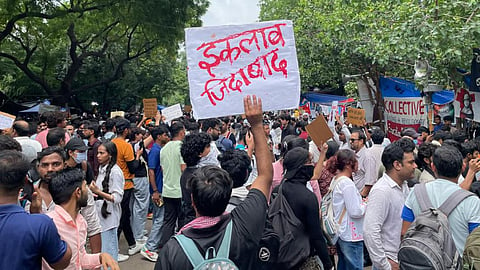
From the freedom movement and the student uprisings of the 1970s to anti-CAA demonstrations and the recent CJP protests, we trace the history of student and youth movements in India — and the enduring role of young people in challenging power and demanding political change.
To paraphrase Karl Marx, the history of all hitherto existing society is the history of youth struggles. From the freedom movement to the recent Cockroach Janta Party (CJP) protests, the history of modern India is also the history of student and youth protests against injustice, inequality, and authoritarianism, and for progressive social change.
During the Freedom struggle, young people were at the forefront of both violent revolution and the largely non-violent Swadeshi movement, which involved boycotting British goods and educational institutions. In the decades that followed, Indian youth participated extensively in the Non-Cooperation, Civil Disobedience, and Quit India movements. In the 20th century, student politics became increasingly organised to direct these movements, and student organisations such as the All India Students' Federation, the oldest student organisation in India, was founded on 12 August 1936, with support from both Jawaharlal Nehru and Muhammad Ali Jinnah. By the time India and Pakistan gained independence almost a decade later, the student as a political subject had become firmly embedded in South Asia's public life.
After 1947, however, the focus of dissent shifted. The colonial state that had given birth to revolutionary student and youth mobilisation was gone, but questions of corruption, inequality, unemployment, caste, language, and regional identity politics remained. The first major student movement in independent India took place in the 1970s. The Gujarat Navnirman Movement began in December 1973 as a localised student protest against food and hostel fee hikes at an engineering college in Ahmedabad. It soon snowballed into a massive socio-political uprising against inflation and corruption, forcing Chief Minister Chimanbhai Patel to resign and leading to the dissolution of the state assembly in early 1974.
The Navnirman Movement’s echoes reached Bihar, where Jayaprakash Narayan led the ‘sampoorna kranti’ or ‘total revolution’ against the Indira Gandhi-led Congress government. The resulting movement became one of the central forces opposing Indira Gandhi in the period preceding and during the Emergency of 1975–77. As Raghu Karnad points out in his brilliant video essay (embedded below), many of today’s detractors of student politics and protests began their political careers during the extreme student protests of the 1970s.
The decades that followed are a testament to the often turbulent nature of Indian student politics. The Assam Agitation of 1979–85 unified Assamese students around Axomiya ethnonationalism, fuelled by extreme xenophobia towards Bengali Muslims, while the implementation of the Mandal Commission recommendations in 1990 provoked widespread protests among predominantly upper-caste students opposed to caste-based reservations for historically oppressed population groups. This history proves that, no matter how much the mainstream news media insist that education must not be politicised, Indian universities have always been battlegrounds for competing ideas of caste, gender, nationalism, secularism, and social justice.
In more recent years, this history has been repeated by the 2012 protests following the Delhi gang rape which drew enormous numbers of young people into the streets. Movements surrounding the death of Dalit scholar Rohith Vemula, protests at FTII and JNU, and the nationwide demonstrations against the Citizenship (Amendment) Act transformed campuses into important centres of dissent once again. Social media has simultaneously altered how such movements are organised, allowing political outrage to move rapidly between universities, cities, digital publics, and eventually spill into the real world.
The CJP protests were only the latest in this long line of student and youth-led agitations in Indian history. Their immediate grievances may differ from those of 1905 or 1974, but the underlying questions remain the same:
Who gets heard by the state? What kind of future is available to the young? And what happens when established political institutions appear incapable of answering them?
Even though the youth has always been at the forefront of significant social change throughout history, the politics that control so many aspects of our lives — both private and public — have always been an old men’s game. Of course, every four or five years, rallies are staged and politicians across the spectrum fish for the youth vote by delivering boisterous speeches about the youth and preaching about our potential on the campaign trail, but these are little more than customary tips of the hat — casual afterthoughts in the larger scheme of things. And yet, young people from all chapters of history have taken to the streets, and more recently the internet, to make their voices heard. They have come from diverse backgrounds to speak their mind and have their say on a multitude of matters that are as varied as the means used to advocate for or against them.
India is hardly an exception here. We see this in the Sardines who stood fast against a rising tide of far right neonationalism in Italy; in the young leaders of Hong Kong’s pro-democracy movement such as Joshua Wong, Agnes Chow, and Ivan Lam; in the French youth who took to the streets of Paris in revolt to the Charles de Gaule government in May, 1968; in the Indian youth who rebelled against the British Empire during the Freedom Movement in the 1940; and in the Kashmiri youth who continue to resist the Indian State even today. We see this in the Middle Eastern youth who brought forth the Arab Spring; the American youth fighting for social justice; the young eco-activists like Greta Thunberg, Delaney Reynolds, Ghislaine Irakoze, Disha Ravi, and Xiuhtezcatl Martinez who are leaders of the Climate Action movement; or the young Indians who led the Anti-CAA-NRC movement in late 2019.
It wasn’t martyrdom or greatness they were after. It wasn’t some extraordinary and radical idea they stood up for. It was a simple thing:
Freiheit. Freedom. Liberté. Azadi. Swadheenota.
This is what they demanded for themselves; for ordinary people; for Germans, Jews, Christians, Romas, Queers, and Peoples of Colour alike; for people like you and me. And they believed in this simple, trivial, immediate everyday idea that we take for granted, with such stubbornness that they were willing to die for it. And many of them did die for it.
This stubbornness, too, is a virtue of the youth — this dogged determination to do the simple, right thing. Like Ravish Kumar said in his Magsaysay Award acceptance speech in September 2020, "Not all battles are fought for victory, some are fought to tell the world that someone was there on the battlefield."
In every corner of the world, and in every epoch of history, whenever and wherever there has been a need to stand up for the simple, right things, young people have always risen to meet the moment. Over the years, the means and mechanisms of their protests and political activism have changed to meet the needs of the moment. Hashtags have joined the ranks of slogans; cartoons and graffiti have passed the torch to memes; tweets and retweets have amplified the reach of speeches; and Facebook and Instagram posts have replaced leaflets. But the timeless, indomitable spirit of youth to stand up and fight for our rights has persisted. After all, what is the spirit of youth? To borrow from the American suffragist and activist Lavinia Dock, "Is it not the spirit of revolt, of rebellion against senseless, useless, and deadening things? And most of all, against injustice, which is, of all stupid things, the stupidest?"
