
- HOMEGROWN WORLD
- HGCREATORS
- HGEXPLORE
- HGVOICES
- HGSHOP
- CAREERS
- ABOUT US
- CONTACT US

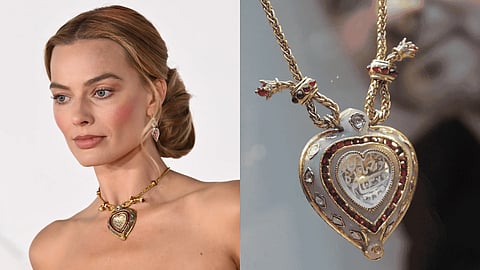
When Margot Robbie wore Nur Jahan’s necklace to the Los Angeles premiere of Emerald Fennell’s ‘Wuthering Heights’ last week, the actor reignited debates about ownership of Mughal heritage. As Sultana Begum — one of the last Mughal descendants — lives in abject poverty, India simultaneously rejects the Mughals but calls for the return of their stolen treasures. What does it really mean, then, to claim Mughal jewels without claiming the Mughals?
At the Los Angeles premiere of Emerald Fennell’s adaptation of ‘Wuthering Heights’ on 28 January 2026, Australian actor Margot Robbie accidentally stepped into a social media landmine by wearing Elizabeth Taylor’s famed 'Taj Mahal' necklace. Western entertainment reporters, naturally, responded with their usual rigour by remembering exactly one thing: Elizabeth Taylor and Richard Burton’s made-for-the-movies love story. For them, history begins and ends with the Hollywood elite, and anything before Richard Burton and Elizabeth Taylor’s Hallmark romance simply didn’t happen. Meanwhile, Indians online performed the increasingly familiar task of reminding the world that the Mughal Empire existed long before 1972.
The opulent heart-shaped pendant, mounted in jade with a custom gold, ruby, and diamond chain, bears an inscription in Nastaliq script that reads the Parsee phrase: “Love Is Everlasting”, as well as the name of Empress Nur Jahan, who was the first woman to receive the jewelry as a gift from her husband, the Mughal Emperor Jahangir. The jewels were eventually passed down to their son, Shah Jahan, who gifted them to his own wife, Mumtaz Mahal. When she passed away four years later, the Emperor commissioned the Taj Mahal as a tribute to his beloved wife. Along with sabotaging every man’s ability to give “thoughtful gifts” ever again, the monument would also lend its name to the diamond at the heart of the Nur Jahan pendant.
After the collapse of the Mughal Empire, however, the jewel disappeared into the fog of colonial extraction before resurfacing in 1971, when Cartier — the French luxury conglomerate known for “acquiring objets de désir that mysteriously travelled out of Asia and Africa in the 1880s” — purchased it from private owners. They promptly “reimagined” it and Richard Burton then bought it for Elizabeth Taylor in 1972, because love, of course, is everlasting — only if you can afford it.
In December 2011, the pendant — now known as Elizabeth Taylor’s Taj Mahal necklace — sold for $8.8 million during a larger estate sale, setting new records for Indian jewels at the time, and reminding all Indians that our heritage travels abroad more easily than most of us ever will.
Today, the Nur Jahan necklace sits at the centre of global repatriation debates, though only in the sense that everyone agrees it should be returned to its rightful home. The only problem is that nobody agrees where that rightful home is.
Cartier, to its credit, has been extremely consistent: it happily loans Indian jewels to Western celebrities but draws the line at actual Indians. In 2022, it loaned the restored Patiala Necklace to YouTuber Emma Chamberlain for the 2022 Met Gala. But when Indian singer-actor Diljit Dosanjh asked to wear it to the 2025 Met Gala, Cartier politely declined, presumably out of fear that an Indian wearing an Indian necklace might dangerously collapse the space–time continuum into itself.
But there’s an even more interesting contradiction hiding under all the diamonds and discourse. While many Indians were (rightfully) outraged that American media erased the necklace’s Mughal history — demanding the jewel’s “return to India” — there is a parallel, increasingly muscular movement within India that insists the Mughals were not Indian at all. Hindutva nationalists want Mughal jewels back, but not the people who once wore them. They want the repatriation of Mughal jewels without recognition of Mughal contributions to Indian history — like ordering biryani without meat in it.
Even as the Indian government loves to flaunt Mughal heritage to international tourists and diplomats, these brilliant far-right Hindu whatsapp university graduates continue concerted efforts to either demolish Mughal heritage or erase their association with the Mughals. In recent years, they have tried to frame Mughals as “foreign invaders”; made ahistoric, unfounded claims about the Taj Mahal’s imaginary origins as a Hindu temple; and pushed the Indian government to remove Mughal history from Indian high school textbooks.
A recent documentary about the last remaining descendant of the last Mughal emperor, Bahadur Shah Jafar, is a burning example of this hypocrisy. Directed by Saumya Sengupta, the documentary, titled ‘Lost Queen’, is a poignant portrait of Sultana Begum — the great-granddaughter-in-law of the last Mughal emperor, Bahadur Shah Zafar. Living in abject poverty in a Howrah slum, Sultana Begum has been surviving on a meagre government pension as the widow of a freedom fighter and has sought legal recognition and restitution, highlighting the plight of the forgotten Mughal descendants even as Indian prime ministers Manmohan Singh and Narendra Modi both visited Bahadur Shah Zafar’s mazar, or grave, in Rangoon (present-day Yangon, Myanmar) during diplomatic visits in 2012 and 2017 respectively.
Her predicament is also a reminder of how India’s Muslim rulers were systematically disempowered and made to suffer for their defiance of and resistance against the British Empire, even as many Hindu royals who collaborated with the British and bent the knee were rewarded during the colonial era and continue to enjoy quasi-royal status in independent India, despite the abolition of the privy purse in 1971.
What does it really mean, then, to claim Mughal jewels without claiming the Mughals? Now isn’t that the $8 million question?
