
- HOMEGROWN WORLD
- HGCREATORS
- HGEXPLORE
- HGVOICES
- HGSHOP
- CAREERS
- ABOUT US
- CONTACT US

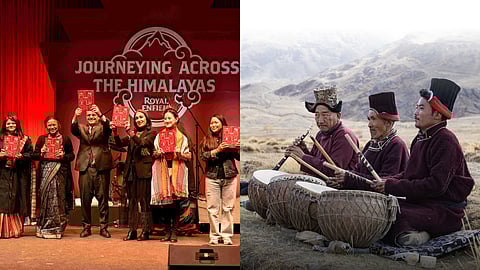
From forests and food traditions to rituals and craft, The Great Himalayan Exploration traces the fragile, living cultural heritage of India’s Eastern Himalayas. The culmination of a multi-year collaboration between Royal Enfield and UNESCO, the book documents practices now standing at the edge of ecological and cultural change.
A spiritual portal. A natural and geopolitical border. A contested homeland. The Himalayas have been many things to many peoples over the years. Since the beginning of time, these mountains have stood over us, inspiring, influencing, and shaping our lives in myriad ways. From landscapes to climate, ecology, agriculture, and ways of life, the Indian subcontinent is made by the Himalayas in more ways than one.
In 2022, Royal Enfield collaborated with the United Nations Educational, Scientific, and Cultural Organization (UNESCO) to discover, document, and promote the practices, representations, expressions, knowledge, and skills that define the Himalayan ways of life — what we collectively call intangible cultural heritage. The initiative, titled ‘The Great Himalayan Exploration’, sends rider-researchers on Royal Enfield bikes across Assam, Arunachal Pradesh, Manipur, Meghalaya, Mizoram, Nagaland, northern West Bengal, Sikkim, and Tripura to engage with communities and document living traditions as they are practised today. At the heart of this collaboration lies a shared commitment to safeguarding living legacies that are deeply rooted in landscape, community, and intergenerational knowledge.
Since then, RE rider-researchers have identified over 100 cultural practices across the Eastern Himalayas, with another 100 mapped in the Western Himalayas. As of 2025, over 100 unique practices have been documented by rider researchers travelling across these regions. ‘The Great Himalayan Exploration: The Intangible Cultural Heritage of the Eastern Himalayas’, the first publication of its kind, presents 38 of these practices, covering nature-linked traditions, craft forms, festivals, food culture, performance arts, and community rituals. Emerging from the Eastern Himalayan chapter of the initiative, the book marks the beginning of a long-term vision to build an open, accessible, and continuously evolving repository of living heritage.
At the core of this initiative is a commitment to new forms of cultural storytelling. The project does not position itself as a definitive ethnographic study, nor as a substitute for the work of subject experts. Instead, it approaches cultural heritage through the lens of exploration — grounded in lived experiences, movement, and dialogue. The aim is not methodological perfection, but balance: to protect invaluable indigenous cultural knowledge while also ensuring it remains meaningful and accessible to younger generations who will ultimately carry it forward. Through photography, film, audio, and social media storytelling by rider-researchers, ‘The Great Himalayan Exploration’ invites younger generations to engage with heritage as a living resource they can participate in, reinterpret, and even build upon.
Edited by Swati Mitra, the book contributes to the broader effort to raise awareness of living heritage and its importance today. By remaining open source, the project seeks to generate a ripple effect that extends beyond documentation, encouraging making, learning, and collaboration. The goal is to motivate young artists looking for cultural roots, designers exploring sustainable materials, or climate researchers examining community-driven resilience. When shared freely, this knowledge can foster partnerships, boost community pride, aid climate adaptation, and enhance public curiosity about the land and the people of the Himalayas.
To learn more about The Great Himalayan Exploration, visit socialmission.royalenfield.com and follow @royalenfieldsocialmission on Instagram.
If you enjoyed reading this, here’s more from Homegrown:
Gone Native: How The Trout Became A Symbol Of British Colonialism In The Himalayas
The Houdini Of The Himalayas: Meet The Indian Scientist Who Fooled The World For 30 Years
Vittorio Sella: The Mountain Photographer Who Captured The Beauty Of The Himalayas
