
- HOMEGROWN WORLD
- HGCREATORS
- HGEXPLORE
- HGVOICES
- HGSHOP
- CAREERS
- ABOUT US
- CONTACT US

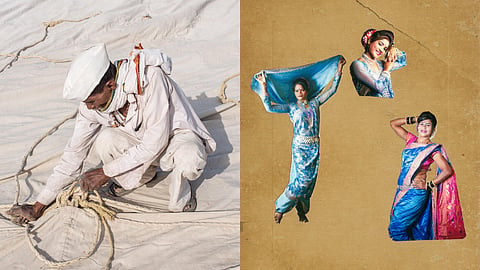
Photographer Abhishek Khedekar’s exhibition ‘Tamasha’ follows the Lokkalawant family, a travelling Tamasha troupe in Maharashtra, as it explores the realities behind India’s celebrated folk performance traditions through documentary and docufiction photography.
The show goes on. But what happens after the curtain falls, when the performer returns to a life rarely seen by society? India has long perfected the art of looking away from the artist while applauding their craft. Abhishek Khedekar’s photographic project ‘Tamasha’, opening at the Dilip Piramal Art Gallery at NCPA Mumbai on 8th May, refuses us the privilege of doing precisely that.
The exhibition documents the Lokkalawant family, a Tamasha troupe that lives and travels across Maharashtra. Khedekar, a New Delhi-based photographer who first spent six months with the family in 2016 as part of an academic assignment, returned between 2022 and 2023 to deepen his engagement. The result is a docufiction project — part documentary record, part constructed visual narrative — that reframes Tamasha as a lens on Maharashtra’s caste system, visibility, and the social contracts that govern who is celebrated and compensated.
Tamasha is one of Maharashtra’s most recognisable performing arts traditions, a form with deep roots in the Maratha countryside, historically associated with communities from the Kolhati and Mahar backgrounds. It has given Marathi popular culture some of its most enduring songs, its most expressive theatrical vocabulary, and its most beloved performers — including, at its peak, the legendary Vithabai Bhau Mang Narayangaonkar, who was eventually awarded the Sangeet Natak Akademi honour. Yet the recognition of individual genius has never translated into structural dignity for the broader community. The Tamasha performer occupies a peculiar position in the social imagination: celebrated on stage, and marginalised off it.
This contradiction is the norm across India. Folk performing arts across the subcontinent — such as Lavani, Nautanki, Theyyam, Chhau — have historically been sustained by communities that sit at the intersection of both artistic mastery and social exclusion. Their craft is claimed as regional heritage, featured in tourism brochures and cultural festivals, while the performers themselves are left to navigate economic precarity, lack of social security, and social stigmas, which make even basic civic life difficult. The celebration of the tradition, in other words, has often functioned as a substitute for the dignity of the tradition-bearers.
What Khedekar’s work attempts is a methodological answer to this problem. By blending documentary images with constructed visual narratives, he declines to simply witness. His practice represents intervention. The surrealist strain in his practice, the use of collage and archival imagery, resists the voyeuristic pull that ethnographic photography can easily fall into. The family is not only ’subjects’ in Khedekar’s story; they are participants in the construction of their own representation.
Abhishek Khedekar’s ‘Tamasha’, curated by Bharat Sikka, is on view from 8 May 2026 till 16 June 2026 at the Dilip Piramal Art Gallery at NCPA Mumbai. Learn more here.
Follow Abhishek Khedekar (@tendercoconut_) and Bharat Sikka (@bharatsikkastudio) on Instagram.
If you enjoyed reading this, here’s more from Homegrown:
‘The Loneliness Of Sticking To Your Guns’: Kira Issar’s Melancholic Image-Making Practice
A Voyage To Permanence: Inside Purandar Chaudhuri’s Trilogy Of Displacement & Urban Life
The Chandigarh Chamda Project Translates The City’s Fabric Into Fashion
