
- HOMEGROWN WORLD
- HGCREATORS
- HGEXPLORE
- HGVOICES
- HGSHOP
- CAREERS
- ABOUT US
- CONTACT US

The article looks at Unshared Childhoods, an immersive theatre project by Tanvi Shah under Jaan Theatre, which draws from the idea of a Dead Letter Office to create a space for unsent and unheard letters. It explores how the performance unfolds in intimate settings through live readings, music, and movement, framing it as a participatory exercise in empathy that uses shared listening and collective witnessing to connect strangers with different personal histories.
A Dead Letter Office is a facility within a postal system where letters go when they fail to reach anyone — mail that can’t be delivered to the addressee and can’t be returned to the sender, often because the address is incomplete or missing altogether. Inside these offices, postal workers are sometimes allowed to open letters, searching for clues that might help reroute them; if that fails, the contents are eventually destroyed or disposed of. It’s this tragic idea of messages that were meant for someone but got lost in the ether that made artist and theatre director Tanvi Shah create a space where they could find a home.
Drawing from references as varied as Alan Bennett’s use of “un”-prefixed language in The History Boys, Fantine’s “no song unsung, no wine untasted” from Les Misérables, Homi K. Bhabha’s idea of the “Third Space,” Márquez’s The Handsomest Drowned Man in the World, A. K. Ramanujan’s love poems, and performances like Letters Live, Tanvi built an experiential series that centres on unsent, unheard, and unshared letters.
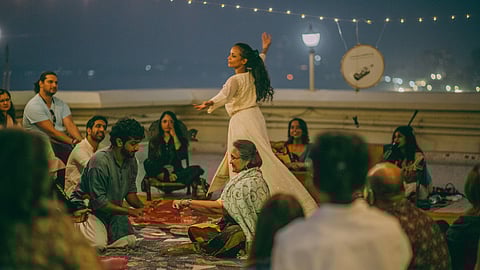
The flagship project of Jaan Theatre founded by Tanvi, Unshared Childhoods takes place as an immersive living room performance across living rooms, terraces, and other everyday spaces. In each session, a small group gathers around a handmade patchwork godhadi (a traditional, hand-stitched, and often upcycled patchwork quilt from Maharashtra, India, made by layering old sarees, dhotis, or fabric scraps), reading and listening to real unsent letters through live music and movement.
With the assumption that to love is to bear witness and to bear witness is to love, this exercise aims to ask: ‘Can we love people with whom we share no personal histories? Can the point of separation – unshared moments – become the catalyst that brings us closer together?’ The room is set up like a reimagined Dead Letter Office, where undelivered letters are opened and held collectively. Audience members step into the roles of both sender and receiver, moving through the letters together in intimate, collective theatre.
The production has taken on different formats depending on where it is staged. In Mumbai, it has appeared in private terraces in Khar and living rooms in Lokhandwala, sometimes hosted by former audience members who return as collaborators. These smaller shows typically run for about 100 minutes to 2.5 hours, with limited seating, and are led by an all-women ensemble. Outside the city, the format expands into day-long experiences. In Karjat and Uttan, for instance, the performance is part of a larger curation that includes breakfast, workshops, and meals like a banana leaf sadya, set within natural or residential spaces.
Alongside this, Jaan Theatre also runs A Potluck & A Play, a smaller participatory series designed for people outside theatre circles. One recent edition, set up as a fundraiser for Gaza, invited participants to cook from Falastin and read Sami Ibrahim’s Two Palestinians Go Dogging together. Their next shows take Unshared Childhoods to Powai, with two performances at a co-working space in Hiranandani Gardens, continuing their ongoing attempt to stage the work across different neighbourhoods in the city.
This Saturday, their next set of shows takes Unshared Childhoods to Powai, marking their first time performing in the neighbourhood. The two shows will be held at a co-working space in Hiranandani Gardens, with around 45 people being part of this theatrical experiment in empathy. “Smack in the middle of a perfectly ordinary day, I walked into a little bit of magic” is how a former audience member remembers the show.
