
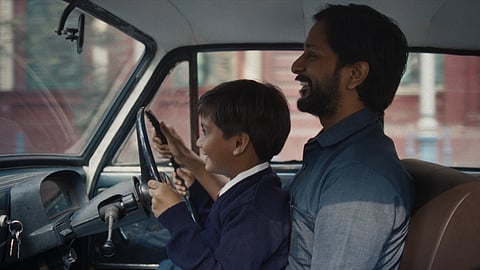
Short Film 'That Perfect Day' Unpacks The Intersection Of Class, Childhood, & Paternal Love

In ‘That Perfect Day’, filmmaker Anup Abraham Parackal returns to a childhood memory to uncover the first stirrings of class consciousness and the unspoken sacrifices fathers make. Through natural performances and a community-driven production, the film transforms a simple memory into a deeply resonant reflection on parental care, kinship, and class inequality.
In ‘That Perfect Day’, filmmaker Anup Abraham Parackal turns a childhood memory into a poignant portrait of fatherhood, class anxiety, and the fragile social worlds children inhabit. What begins as a seemingly ordinary slice-of-life narrative — ten-year-old Michael (played by Srij Bhattacharya) wanting to distribute expensive chocolates on his birthday like his classmate — expands into a nuanced study of how inequality enters a child’s consciousness long before they have the language to name it. Parackal’s achievement lies in his ability to preserve the emotional truth of a child’s perspective while layering it with the retrospective clarity of an adult who has finally learned to understand his father’s struggles to provide for his family.
For Parackal, this story originates in a memory he once dismissed as trivial — the kind of awkward moment every child experiences and quickly forgets. But returning to it as an adult, he found within it not only the first signs of class awareness but also the unspoken sacrifices his father made to shield him from the world’s inequalities. The film’s structure reflects this dichotomy: it is told through the immediacy of the child’s desire, frustration, and confusion, yet shaped by the filmmaker’s retrospective understanding of the emotional labour of parenthood. In this way, That Perfect Day becomes both an act of remembrance and a belated gesture of apology — a love letter to a father who tried to do better than his own.
In conversation with Homegrown, Parackal and Tanmay Dhanania shed light on the childhood memory that inspired ‘That Perfect Day’, the heartbreak of childhood class consciousness, and the delicate emotional world that exists between fathers and sons. Together, they reflect on how authenticity, community support, and intuitive performances shaped one of the year’s most affecting Indian short films.
‘That Perfect Day’ was inspired by your childhood memories. When you revisited those experiences as an adult, what changed for you emotionally and as a filmmaker, and how did those reflections influence the story?
Anup: As a child, when this incident occurred, I did not fully comprehend it because we do not tend to reflect. Children usually just react to situations they are thrown into, or at least that’s what I believe. The mind registers this as good or bad, but life is much more complex than right or wrong. Later in life, after we have had more experiences, we can reflect more deeply and engage with our problems.
For the first time, when I was considering making a film from it, I remember clearly trying to think this through from my father’s perspective. Being a parent is much more complex than it is perceived to be. My father had a horrible relationship with his father, and he was sure he would not make those same mistakes with his kid. Today, when I look back on all that he has done, I am sure I wanted this film to be a love letter to him as well.
This informed a lot of the choices I made for the screenplay. We tend to dismiss things we must have felt awkward about as kids when we grow up, because those problems feel so small. Film school helped, and watching films about simpler subjects actually opened my mind to thinking, “Wait, I am thinking about this wrong, there is a story here.” The problem might seem small to me as an adult, but from a child’s perspective, it is a big issue. My friend and co-writer, Arastu Zakia, was a great help in the writing process. Because of him, it also became easier to think objectively.
Class consciousness enters children’s minds through seemingly innocuous school traditions, such as sharing chocolates on birthdays. What were the challenges in capturing this moment without slipping into melodrama?
Anup: We have a wonderful professor in film school, Putul Mahmood. She has opened our minds on how to think critically when writing for films. One important point she has said many times that I always tried to keep in mind is: What would the characters do now? And not: What would I want the character to do now?
In either scenario, the choice is the writer’s, but if I follow the first piece of advice, the story or the beats do not seem forced. Of course, in theory, it sounds great and intellectual, but chances are the honesty will reflect through.
It was important that each character had agency. They needed to make their own choices. Right or wrong is not the criterion; what they feel they need to do at that moment in the story, based on their own judgment, is what matters. This is purely from a writing perspective. Sometimes actors have their own way of doing certain things, and as a director, I sometimes took that on board, which also lends a sense of realism to the scene.
And to be absolutely honest, I also got really lucky with the child actors Srij Bhattacharya (Michael) and Arfat Ali (Patrick). It was as if the camera did not exist for them. It is important to engage with them with the same respect one would show an adult; it is probably my biggest lesson in dealing with child actors.
Michael and Patrick’s friendship offers a subtle but powerful counterweight to Michael’s class anxiety, and the film’s production also reflects how community and kinship can overcome class barriers and socioeconomic limitations, as the St. Anthony’s School and St. Joseph’s Chapel communities came together to support the film. What did making this film teach you about friendship, community, and how far collectivism and community support can take independent cinema? How has this experience shaped your understanding of the joys and challenges of independent filmmaking going forward?
Anup: The story that I wrote for the budget we had (provided by our film school) is actually madness, to be honest. In what world was I so confident? I don’t know. If someone told me to make this again with the same budget, I would laugh.
We needed 40–50 extras for the church sequence for approximately one full day. We needed a classroom full of around 30 kids for two days. Bhavya Sethi and Pranay Singh Solanki, the film’s executive producers, were sure it would exceed the budget, and they were not wrong.
After three months of constant searching, we met this angel of a person, Steve Menezes (Headmaster of St. Anthony’s School, Esplanade, Kolkata). He heard the story and probably took all this burden upon himself. The classroom, the parents, and the church people were all contacted and arranged through him, and they came purely out of the joy of helping build a film and a story they connected with. They were all ready to come and be part of the film for free, just to help get it made. Each student or professor had their own version of trouble in their lives that they related to through this story. It became nostalgia, a trip down memory lane.
When the choir and the people sang, all of us on the crew just stood silently, goosebumps rising. There are moments you feel spiritual, and in that moment, the film, for the first time, felt alive.
Tanmay Dhanania did not need to be this kind to us when he decided to do this film. He gave me 14 days in total, which is usually unheard of in film school terms, given the amount of work and engagement involved. I think it also reflects his ideology towards independent cinema and his love for the craft. He could not have embodied this role better.
From the perspective of the challenges of making independent cinema, the sad reality is that making a film in this manner takes time. A lack of resources does not kill the filmmaker; it usually kills the spirit because of the time and effort it takes and the sheer wait to complete the film. That’s a far greater problem to deal with. I do not know what the solution is. There are many storytellers out there, and not everyone has the luxury I had, thanks to my access to film school and its community.
The father’s character conveys a fully developed inner emotional world despite the film’s sparse dialogue, especially in the scene when he drives away after dropping his son off at school. What guided you in shaping a character with such a vast, unspoken inner world, and what became your anchor in portraying his quiet depth?
Tanmay: The first thing that drew me to the film was Anup’s story. His father was a chauffeur who taught him how to drive, and the incident at the heart of the film actually happened to him as a child. When someone brings something so personal, it immediately moves me. I trusted that a filmmaker with that level of connection would tell the story with honesty.
The second anchor for me was meeting and workshopping with Srij, who plays Michael. We spent time together before the shoot simply bonding, and that helped us build a relationship that didn’t need much “acting”. He’s incredibly natural — so much so that, after a point, I didn’t feel like I was performing. One of the key moments in the film, the driving lesson, wasn’t planned as a scene. Srij said he wanted to learn how to drive. I showed him, the camera rolled, and the truth of that moment became part of the film. That spontaneity reflects my philosophy now: I don’t want to perform; I want to be present and let things happen.
Of course, you prepare deeply to let go like that. Spending that week with him allowed us to reach those small moments of beauty. And I’m glad that this approach resonates with a wider audience, not just with people who watch “art films.”
Playing a father also connected with me personally. Like many sons, I have a complicated but meaningful relationship with my own father, and I tried to bring that inner life into the role. Even though I never met Anup’s father, the way Anup described him and the videos I saw helped me understand a man who keeps everything inside. I’m drawn to characters built from inner work rather than outward display, and I tried to approach him with a lot of empathy.
I was also helped by the small, practical things people contributed: the driver’s uniform I wore belonged to my uncle, my mother taught me a bit of sewing for the role, and working with Ipshita, who plays my wife, grounded the family dynamic. And the children — truly — they teach you more about presence and freedom than you can teach them.
What broader questions or discussions do you hope ‘That Perfect Day’ encourages for young audiences, educators, or parents?
Anup: I never started out to make a film with that intention. But of course, it feels nice when even a few people can discuss or reflect on what the film is trying to say, and to me, that is victory.
I think I will answer this question with an actual example from my experience. So once the film was complete, I went to St. Anthony’s school to screen it for the faculty and kids. It was my way of saying thank you! After the screening, one of the teachers came up to me, and during our discussion, she said something that stuck with me and made me really elated. Her words, “Anup, thank you for making this film, and I think we as teachers will now deeply reconsider what the protocol should be when it comes to birthdays, and maybe we can encourage all parents and kids to just stick to certain normal chocolates and celebrate the occasion more than what to gift.” I could not hear anything after this. I was like, okay, my job is done.
In the end, I made this film for my father and to apologize for all the times I lied to my classmates about his job as a driver, which used to embarrass me when I was a kid. He saw the film and felt that Srij was too nice and that I was not in real life. But as usual, my father went into his room and probably had his own reflection away from my mother and me. Fathers, even when they are good, do not know how to cry normally or in front of others.
Watch the trailer of ‘That Perfect Day’ here:
If you enjoyed reading this, here’s more from Homegrown:
‘Barren Island: Born Of Fire’ Explores India’s Only Active Volcano In The Andamans
At Sundance 2026, India Embraced The Diversity Of Its Rooted Regional Narratives
