
- HOMEGROWN WORLD
- HGCREATORS
- HGEXPLORE
- HGVOICES
- HGSHOP
- CAREERS
- ABOUT US
- CONTACT US

At The Belgadia Palace in Odisha, electronic music producer Pablo Dutta transformed the percussion of Mayurbhanj Chhau into an experimental club sound, creating a dialogue between ancient martial traditions and contemporary music culture.
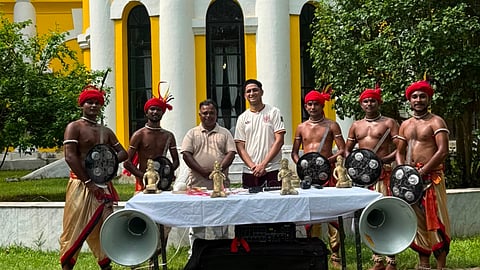
What happens when a centuries-old martial dance form meets a contemporary electronic music producer? The result looks like Kolkata-born, London-based music producer Pablo Dutta's DAW-less jam session at The Belgadia Palace in Mayurbhanj, Odisha.
In a recently released collaboration filmed at The Belgadia Palace, Dutta reimagines the sonic landscape of Mayurbhanj Chhau by adapting its underlying traditional percussion sound into the language of UK club music. The project pairs centuries-old beats with contemporary electronic production, bringing together two worlds that rarely occupy the same space. It is at once a reinvention and a continuation of Dutta's own practice, which has long existed between cultures. Raised in Kolkata and currently based in London, the Dutta has become one of the emerging names in the UK's underground electronic music scene, appearing on Mixmag's list of Top 25 Breakthrough DJs for 2025. His music, which draws equally from British bass music and West Bengal's soundsystem traditions, has found audiences through festivals including Boomtown and Sunburn, while also receiving support from BBC Radio 1, Rinse FM, and Kool FM.
"Akshita (Bhanj Deo) had seen some of my videos which I had filmed earlier in rural Bengal, and she spoke to me about how she wanted to showcase more of East Indian culture to the rest of the world, which put the both of us on the same page," Dutta told Homegrown when we reached out to him.
"The process was first to collect these samples and then sequence them in a non-traditional and experimental manner, something that a wider audience could dance to. This obviously created a certain degree of unfamiliarity with the Chhau dancers, but it was amazing to see how they adapted. We wanted to really capture that moment in a candid way, like a live performance that an audience would witness if they were actually at the Belgadia Palace," he said.
Mayurbhanj Chhau has always existed at the curious junction of movement and resistance. Unlike its masked counterparts from Seraikella in Jharkhand and Purulia in West Bengal, the Chhau tradition that evolved in the erstwhile princely state of Mayurbhanj is performed without masks, allowing dancers to emote while retaining the martial precision of the form. Its origins lie in military training: according to Akshita Bhanj Deo, the word 'Chhau' originates from 'chhauni', meaning military barracks.
After the Paika Rebellion in 1817, when the British disbanded the standing armies of Odisha's regional Gajapati kings, soldiers in Mayurbhanj transformed combat exercises into dance, preserving martial knowledge under the guise of performance. Over the centuries, the form developed into an intricate repertoire of more than a hundred choreographies and was recognised by the UNESCO as an Intangible Cultural Heritage in 2010. Yet despite this international recognition, the tradition remains precarious. India has still not accorded Chhau the status of a classical dance form, and the number of practising masters has decreased dramatically, prompting organisations like the Mayurbhanj Foundation and Project Chhauni to work towards its preservation. "There used to be hundreds of gurus keeping this alive. Today, fewer than a dozen remain. Project Chhauni and the Mayurbhanj Foundation are fighting to change that," Akshita said.
Dutta took the percussion sound of traditional Chhau music as the foundation of the composition itself, restructuring traditional beats into new patterns while retaining their sonic identity and intensity. The resulting soundtrack challenges both electronic music listeners and practitioners of the dance form to inhabit new territory together.
As the number of Chhau masters continues to decline, experiments like this are unlikely to replace the rigorous transmission of the tradition from guru to disciple. They can, however, expand the contexts in which the form is seen and heard. In bringing together martial dance, palace courtyards, and the sonic vocabulary of contemporary club culture, Pablo Dutta and the Mayurbhanj Foundation offer a reminder that cultural traditions endure by finding new audiences and willing to move with them.
Follow @pablodutta, @abhanjdeo, @projectchhauni, @thegreateasternepicschhau and @themayurbhanjfoundation on Instagram.
