
- HOMEGROWN WORLD
- HGCREATORS
- HGEXPLORE
- HGVOICES
- HGSHOP
- CAREERS
- ABOUT US
- CONTACT US
In a social media landscape dominated by fast cuts and overstimulating visuals, Archit Agarwal’s digital presence offers a rare, deliberate pause. Transitioning from managing leadership communications at Swiggy to building 'Life of Simple Treats' and his supper club, 'The LOST Table', Archit has mastered the art of unhurried storytelling. In this interview, he shares the visual philosophy behind his first-person cooking videos, the reality of hosting strangers in a domestic kitchen, and why resisting the pressure to scale commercial operations is the ultimate creative choice.
I’ve been following Archit Agarwal’s content for three years now. In a social media landscape full of loud voiceovers, fast cuts, and overstimulating editing, his videos always feel like a breath of fresh air.
What makes Archit’s platform so interesting is the experience he brings to the table — literally. He managed leadership communications and content strategy at Swiggy, right at the centre of India’s fast-paced food delivery tech ecosystem. Yet, off-clock, he and his wife Natasha were building 'Life of Simple Treats' and their supper club, 'The LOST Table', centred around deliberate technique, friction, and an unhurried approach to cooking.
Funnily enough, Archit apologised multiple times for 'talking too much,' when in fact he had no idea how appreciative I was of how generous and detailed he was with his answers. Having recently left corporate tech to focus full-time on his independent work, he sat with me to break down his design philosophy, the realities of cooking at home, and why keeping his supper club small is such a deliberate design choice.
Transitioning from an app that measures food in 20-minute delivery windows to a personal brand built around thoughtful, multi-step preparation might seem like a contradiction, but Archit views his time at Swiggy as the launchpad for his independent voice. Being at the center of how internet culture and memes spread across India showed him the power of content creation — and inspired him to pivot from shaping corporate messaging to building a personal platform.
He also doesn't see fast-paced and unhurried content as inherent enemies. In his view, the speed of a video is simply defined by who it's made for.
"The pace of content is defined by the audience that it's made for," he says. "There is an audience for almost everything on the internet; the real challenge is just how you find that audience, and how they find you."
As someone who relies on convenience apps as much as the next person, I’ve always wondered why so many of us spend our free time transfixed by videos of people cooking from scratch. When I brought up this paradox, Archit admitted it’s something he thinks about often.
"Food is one of the few things that connects absolutely everyone," he explains. "When I first started cooking, it felt like the closest thing to magic. You take ingredients that have completely different shapes, colours, textures, and flavours, and through heat, time, and technique, you turn them into something entirely new. I think there's something fascinating about watching that transformation happen."
Even as a creator focused on intentional cooking, he remains realistic about modern attention spans. Over time, even his videos have trimmed down to 40 or 45 seconds, making him all the more appreciative of an audience still willing to sit and watch a pan simmer for 30 seconds while he talks about pasta.
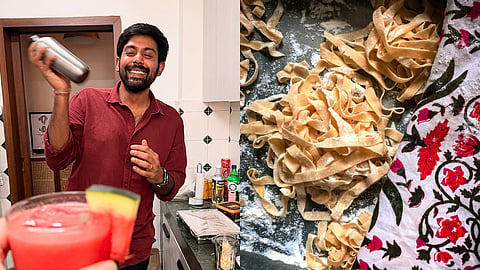
That signature clean look on his feed isn’t a solo operation. Archit is quick to credit his wife, Natasha — who comes from a video production background — for shaping the visual identity of Life of Simple Treats. Her experience allowed them to build a system focused on framing food cleanly, staying with a shot, and letting the process unfold naturally without reliance on aggressive editing techniques.
Rather than filming from the outside looking in, they deliberately shoot from a first-person perspective so viewers see the pan exactly as the cook sees it. His audio design is just as deliberate. Rather than running through rapid-fire recipe instructions, his voiceovers are paced like stories, heavily inspired by classic video formats from Bon Appétit and early BuzzFeed Tasty, as well as radio storytelling from creators like Roman Mars on '99% Invisible'.
Having spent time in kitchen environments myself, I’m always curious about the friction between professional culinary rules and the reality of cooking at home. Archit was quick to point out how easy it is to fall into the trap of over-decorating a plate just for the camera.
"There is a lot of really beautiful food being served today, but sometimes the visual idea becomes stronger than the actual dish. We don't automatically reach for microgreens or decorative elements just to make a plate look 'refined.' Presentation should support the food, not become more important than the food itself."
Adapting to a domestic kitchen also meant learning to respect everyday gas stoves, which lack the intense heat output of commercial restaurant burners. Instead of forcing high-heat restaurant techniques at home, he adapts by working in smaller batches and allowing ingredients more time to develop naturally.

When I asked him what he eats when the cameras are off and he’s too exhausted to film, he pointed to a quick, high-protein chicken and cucumber salad he and Natasha make during the monsoon. But his ultimate comfort food remains classic arhar dal chawal with sukhe aloo — a warm, familiar staple from his upbringing that was one of the first things he learnt to cook.
And while The LOST Table looks completely seamless on Instagram, hosting live dining events at home always comes with a few unpredictable moments behind the scenes.
Just recently, while testing a lemongrass and gingerade for an upcoming menu, they attempted to make a lemongrass salt for the rim. But when the salt mixture stayed overly damp, Archit popped it under the broiler for a quick flash dry, only to get distracted for three minutes. Thick black smoke ended up billowing through the kitchen. They ventilated the room, ditched the salt, and served the drink as is — leaving the guests completely oblivious to the brief panic in the back.
"We had to quickly ventilate the entire kitchen before guests arrived," he recalls, laughing, "In the end, we served the drink without the lemongrass salt and nobody guessed a thing."
Inviting ten complete strangers into your private home for a dinner party requires a lot of social awareness. Archit and Natasha act as the anchors of the evening, actively managing the energy in the room from the moment guests step inside.
Because energy naturally dips when a course is served and they step away to plate the next dish, they’ve even built custom conversation games and prompts to keep people engaged. By the third course, however, the initial stiffness usually melts away, as guests realise they are opting into a shared community experience rather than a standard restaurant meal.
Despite having over 2,000 people on their private email waitlist for The LOST Table, Archit and Natasha have resisted constant pressure from peers and family to open a commercial restaurant.
For them, hosting four seatings a month is the maximum they can manage while preserving the quality and intimacy of the experience. Instead of expanding physical seating, growth means experimenting with new event formats — like curated singles mixers, family-style Diwali baithaks, or hosting workshops for aspiring supper club hosts. Keeping the guest count capped at around eight people ensures that the table shares one collective conversation rather than fracturing into isolated groups.
To close out our chat, I asked him about the biggest misconception people have about building an independent presence online. True to form, he offered advice that felt grounded in day-to-day reality. He emphasises that creators shouldn't feel trapped by the idea of defining a strict identity right at the start.
"You can start by talking about anything you genuinely understand and find interesting. As you continue creating and getting feedback, you figure out what resonates. You find your niche through the process of creating — you don't need to have it completely figured out on day one."
Watching Archit’s journey makes it obvious why his platform resonates with so many people. In an online world obsessed with moving faster, he proves that taking your time is always worth it.
If you enjoyed reading this, here's more from Homegrown:
Primitive Is A New Restaurant With A Menu Built Around Indian Open-Flame Cooking
The Ōle Project Is Documenting Karnataka's Forgotten Flavours
Nadoo Brings The Full Diversity Of South Indian Cuisine To New Delhi
