
- HOMEGROWN WORLD
- HGCREATORS
- HGEXPLORE
- HGVOICES
- HGSHOP
- CAREERS
- ABOUT US
- CONTACT US
A new graphic novel adaptation of C.S. Chellappa’s 1949 Tamil classic 'Vaadivaasal' reimagines the intense man-versus-bull revenge saga at the heart of Jallikattu, bringing its themes of rural pride, caste, masculinity, and resistance into a bold visual storytelling format.
A man sets out to avenge his father’s death at the hands of the untamed bull. The setting is riveting. It’s all the more surprising that this revenge saga was written by a Gandhian.
Jallikattu, the ancient Tamil bull-taming sport, referenced in Sangam-era texts over two millennia old, carries in it a microcosm of social relations. Tamil modern literary pioneer C.S. Chellappa translated this microcosm to fiction in his 1949 novella 'Vaadivaasal,' the first major modern work of Tamil fiction built entirely around the sport.
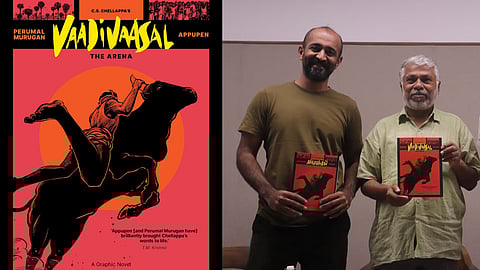
A story best told in motion, Booker Prize-nominated author Perumal Murugan and artist Appupen (George Mathen) have transformed the novella into an engrossing graphic adaptation that brings it to a new set of readers. This is also the first time that a work in Tamil literature has been adapted into a graphic novel.
'Vaadi-vaasal' is the narrow gateway through which the bull is released into the arena. The tamer must hold the bull's hump or horns for as long as possible, or maneuver it down. There is often a reward, sometimes gold, tied between its horns. The bull must be subdued with hands and body weight alone. 'Vaadivaasal' follows Pichi, a young man who seeks to tame the zamindar's undefeated prize bull, Kaari, as an act of revenge for his father's death.
With regards to the artwork, you feel like soaking in every panel as Appupen’s intricate art sets mid-20th century rural Tamil Nadu in motion. You sense the bull charging or even the drums pulsating off the page. The build-up to Kaari's entrance has a cinematic quality of the grand introductions of South Indian films.
Writer Perumal Murugan had worked with Chellappa himself as an editor, and having seen the sport across half a century, he was able to explain the drama of the event in detail to Appuppen.
Appuppen also relied on photographs taken of Jallikattu during the 50s by Chellappa himself. This was essential as today’s jallikattu is quite different. For instance, bulls running into the audience are absent today, due to the presence of physical barriers.
Man versus animal conflict has been the mainstay of many a work of art. C.S. Chellappa has often been compared to Hemingway for his spare prose and his preoccupation with endurance and dignity under pressure. However, Chellappa published Vaadivaasal in 1949, some years before Hemingway published 'The Old Man and the Sea' in 1952. Both works circle around a lone man's battle against a powerful, indifferent force of nature and the limits of masculinity. But where Hemingway's Santiago confronts the sea in relative isolation from social structure, Chellappa's Pichi is embedded in a web of feudalism and social honour that shapes every decision he makes.
Being a Rajini fan, I remember watching 'Murattu Kaalai', Rajinikanth’s 1980 film, which begins with the protagonist taming the bull and gaining honour, followed by a land dispute. On the surface, it was just about the ‘good’ landowning farmer not wishing to sell his ancestral land to the big zamindar.
In practice, bull ownership in jallikattu is concentrated among dominant intermediary castes with historical ties to agricultural land. Taming them brings in social consequences. In that vein, the graphic novel also shows this in who sits where, who bows while speaking, who owns the bulls and so on. Many elements in the story subtly depict the power relations at play. Like the grandiose chair of the zamindar being positioned more prominently than the seats reserved for the Sub-Collector and Superintendent of Police.
Vaadivaasal continues to remain ever relevant today. The 2017 pro-Jallikattu protests that paralysed Tamil Nadu were an assertion of cultural identity and proved how deeply the sport is socially embedded. The graphic novel enters this landscape, peeling back the romanticism to expose the skeleton underneath. Jallikattu allows men to be more than what their social conditions allow. The ending is ruminative, “It’s over if an animal’s pride is hurt. It’s over even if a man’s pride is hurt”.
You can buy Vaadivaasal here.
If you enjoyed reading this, here’s more from Homegrown:
What Can’t Be Streamed: The Tactile Legacy Of Coshish’s 'Firdous'
Why Is A High School In Hungary Named After Dr Ambedkar?
A 'Punk Iftaar' Is Making Space For Muslim & South Asian Identity In Hardcore Punk

