
- HOMEGROWN WORLD
- HGCREATORS
- HGEXPLORE
- HGVOICES
- HGSHOP
- CAREERS
- ABOUT US
- CONTACT US
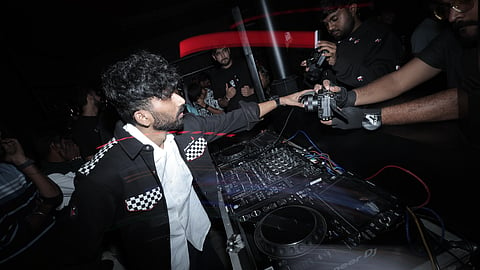
Operating as C4GE, Mumbai producer S. Ganesh Murthi translates the physical friction, infrastructural failures, and daily velocity of Indian megacities into raw jungle, grime, and drum & bass. From zero-budget tracks picked up by UKF to a 25-artist nationwide bass compilation, his work rejects commercial club shortcuts to build an uncompromised underground ecosystem from the ground up.
Under the moniker C4GE, Mumbai producer S. Ganesh Murthi makes drum and bass, jungle, and grime that reflect the movement of his city. The metallic clash of local trains, the steady hum of traffic jams, and the friction of millions squeezing through public transport flow directly into his music.
Growing up in a slum situated directly along a major highway shaped his outlook early. Living right on the edge of blistering traffic meant witnessing road trauma, vehicle accidents, and heavy trucks occasionally plowing into fragile homes. "Those raw, volatile events left a permanent imprint on my psyche," he says. "They represent a fundamental part of this dark, claustrophobic phase of my life, where danger and volatility were daily norms rather than abstract concepts. That lived environment directly shapes the audio architecture of my production".
After losing his father in 2006, he saw his mother single-handedly hold the household together by taking on domestic work, cooking for families, and gathering scrap off the streets to sell. Observing her resolve through those years gave him a relentless work ethic. "Through every dark visual and difficult period, my mother remains my biggest anchor and inspiration," he shares. "Her strength through those years gives me the backing to convert that history into art rather than letting it overwhelm me".
That drive carried straight into digital audio workstations, yielding his breakthrough track ‘Slice of Life’. Written during the pandemic, inspired by the slice-of-life genre of cinema, the track came out of a deliberate creative challenge. Constructed using free software plugins and sample packs loaded into REAPER, he tried testing how far zero-budget tools could take him.
The route to release came through unexpected channels. After an initial label found the track ill-fitted for their roster, the owner passed it to Marissa (Pyxis), head of Beats In Mind / Headsbass. She placed it on a 20-track charity compilation raising funds for flood relief in Pakistan. Global channel UKF picked up the compilation, marking the first time an Indian producer was featured on the platform.
That initial feature opened the door to further releases on the channel; over the next two years, he released two follow-ups, culminating in ‘Chennai’ — a collaboration with Pyxis blending traditional Indian instrumentation with Western production styles.
His work tracks two sides of urban life. The EP Birds Are Meant to Fly channels the aspirational identity of Mumbai, capturing the city as a space where people chase goals and realise potential.
Conditioned Silence turns toward systemic breakdown. "The title directly references how citizens are socialised to endure infrastructure failures, extreme overcrowding, and daily exhaustion without complaint," he notes. "Society often repackages these systemic hardships under catchphrases like the 'Spirit of Mumbai' or the 'resilience of the people.' In reality, glorifying endurance excuses inaction and conditions us to stay quiet about unacceptable living conditions".
That theme crosses state lines. Collaborating with Bengaluru producer Hellkity, he crafted ‘Rush Hour’ out of shared frustration with urban neglect. The core narrative stems from a brutal commute. Stuck on a local train during monsoon rains for two hours between stations with windows pulled down to block out torrential rain, he sat drenched in sweat carrying two heavy laptops. That standstill captured systemic failure, which the duo translated into sound.
Sub-bass acts as political commentary on ‘Anushasan,’ a track created with Krantinaari that blends grime patterns with guitar riffs played by Aryaman Singh, who also directed the music video. The track opened after an unexpected phone call. Krantinaari picked up his contact info through Bamboy, called him out of nowhere saying "Yo, I need beats," and sent over raw phone vocals. The intro features a live marching snare cadence.
Having played side drum in his school marching band, Ganesh drafted the rhythm in his DAW before recording it live. He called in long-time collaborator Paul Mendes, who brought drummer Elton to track the live snare pass at Paul’s house.
For Ganesh, sub-bass serves as a direct mirror of class dynamics, "It physically represents the underground," he states. "In the audio frequency spectrum, sub-bass exists at the very bottom, just as working-class communities exist at the foundational base of our social structure bearing the weight of systemic problems while decision-makers operate in the upper registers. In electronic music, the weight doesn't come from high-frequency polish; it comes from the low-end register that you feel in your chest".
Navigating local venues means dealing with structural hurdles. Club promoters regularly push "Bollywood Tech," commercial open-format sets, or short-course DJs jumping across genres in a single set. Original producers get sidelined under claims of budget limits, while international headliners receive full financial backing, flights, and top-tier rates.
Historically, the purpose of a DJ was to act as an educator and tastemaker, introducing dance floors to unreleased dubplates and hidden gems. Today, the commercial scene has inverted this expectation, with DJs selecting tracks trending on social media to cater to immediate familiarity.
This financial gap hits home for Khabardar, a grime collective comprising five MCs and two producers — Ganesh and Dr. Deep. Promoters routinely refuse performance fees or travel logistics for a multi-member domestic crew, making full-crew stage shows tough to book.
Hardware limits add another barrier. Venue sound systems across India remain tuned for mid-range and high-frequency projection, leaving the subterranean end of the spectrum underpowered or muddy. Venues struggle to reproduce the low-end frequencies engineered on studio monitors. Spaces like antiSOCIAL in Mumbai handle low-end extension better than venues like Khar Social, which push mid and high frequencies. Without dedicated, community-led sound system rigs, sub-heavy tracks hit club hardware limits.
Support from local peers helped shape his early direction. Producer Bamboy mentored him starting in 2017, introducing him to local electronic music culture, booking him on his Lowend Therapy platform, and introducing him to the artists who formed Khabardar.
Sean from Noizbleed provided vital mixing advice and sound design feedback during the creation of ‘Slice of Life’, sharpening his technical execution.
Composition for Ganesh starts with narrative. He holds an archive of over 600 voice notes containing drum ideas, alongside written journals documenting observations from public transport, street conversations, and daily struggles. These entries turn into visual scenes before he opens his DAW, giving tracks cinematic progression over simple club loops. While dark themes dictate his drum and bass output, he documents moments of balance for an upcoming ambient project aimed at exploring lighter textures.
Getting shut out of club lineups did not stop his output. Taking a full year away from restrictive promoter networks, he put together a 25-track drum and bass album featuring 25 artists from across India. Halfway complete and targeted for release in early 2027, the album builds an independent network for local bass producers.
By building infrastructure alongside his peers, Ganesh continues to carve out space for uncompromised sound. His work captures the weight of Indian megacities, documenting survival, system friction, and concrete realities through low frequencies.
