
- HOMEGROWN WORLD
- HGCREATORS
- HGEXPLORE
- HGVOICES
- HGSHOP
- CAREERS
- ABOUT US
- CONTACT US

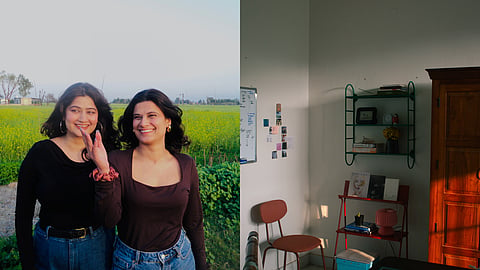
Samka House, founded by sisters Bhavneet and Mankirat in the industrial town of Phagwara, reimagines small-town Punjab as a fertile ground for serious artistic practice. Working across spatial design, photography, writing and archives, they document changing landscapes, collaborate with local institutions and confront social barriers, proving that meaningful creative ecosystems can grow far from metropolitan centres.
A specific pastoral vision comes to mind when we think of small-town India. This is especially true for Punjab — a land of sprawling rice paddies and blooming yellow mustard fields in the popular imagination thanks to 90s Bollywood films. As someone who grew up in and around Kolkata, Bengaluru, and Mumbai, I am guilty of this assumption too. Until recently, I believed that anyone ambitious must eventually leave India’s smaller towns. I was reminded how unfounded that notion is when I came across Mankirat Kaur, co-founder of Samka House, a multidisciplinary design and research studio and publishing house based in Phagwara, Punjab, through Open Call India.
“Phagwara is not found on the map of Punjab, let alone India,” Mankirat says. “From Amritsar to Jalandhar, we go straight to Ludhiana, and cities like Phagwara, Goraya, and Phillaur become transitional points in between. Growing up, we were constantly asked, ‘Where is Phagwara?’ People rarely know the city we come from, so explaining that we’re from a city near Jalandhar, on the way to Amritsar, has become a familiar script.”
Founded and run by Mankirat and her sister Bhavneet, the design, research, and publishing studio works across art, design, and literature, bringing together spatial practice, photography, writing, archival and material research, exhibitions, learning programmes, and photo-walks in Phagwara and Chandigarh. Its name is an acronym for ‘Space and Material Knowledge Anomaly’; the studio’s underlying proposition is that knowledge, culture, and artistic possibility need not be geographically concentrated.
In 2024, the sisters started Samka House when life brought them back to Phagwara after years apart. “There is a lack of artistic third spaces (in Punjab). Art education is still discouraged and is viewed solely as a mere hobby. People in Punjab struggle to understand the complex nature of art, design, and literature. And the ones who are keen seek to go elsewhere for better infrastructure,” Mankirat says. “Through Samka House, we aim to bridge the gap by creating momentum amongst our peers and the surrounding community. At the very least, consider artistic ventures as a possibility. We imagine a thriving creative infrastructure supporting writers, designers and all kinds of artists in Punjab.”
“We grew up with the notion ingrained in our psyche that nothing worthwhile exists here—ithe kuch nai rakhia,” Bhavneet says. “On the contrary, we experienced intellectual rigour and creative encouragement right here in this city, in our home. This conundrum became very loud, and we decided to challenge it. After all, we exist in this environment, and if we claim a sense of belonging, then we can also influence it.”
Samka House currently exists as a home studio in the sisters’ ancestral home built in the Eighties. “By naming our studio after it, we are paying homage to our lineage, where we discovered our love for knowledge and the zest to go for whatever we want, where we learned that even in the middle of nowhere, you are everywhere.”
Samka House works at the intersection of art, design and literature. Bhavneet, as a spatial designer, artist and researcher, brings her exploration of the relationship between space and the body, ancestral memory and colonial modernity; and Mankirat — as a poet, writer, and photographer whose practice explores mental health, feminism, existentialism, the self and language — draws on psychology and philosophy to inform her work. At Samka House, their shared academic interest serves as common ground, combining image-making, writing, embodied knowledge, archival and material research, and cultural theory. They approach their work through socio-political and autoethnographic lenses, asking fundamental questions about knowledge, reality and its limits.
“We both come from two opposing yet complementary ends of the creative spectrum, and we meet in the middle,” they say. Their closeness as sisters is integral to the practice: a shared history creates a deep-rooted connection, while their different disciplines offer diverse ways into the work. “In the words of the poet P. B. Shelley: we are reason and imagination in tandem,” they say. “The fact that we are sisters adds to the charm — we have a natural synchrony that comes from growing up with and through each other. The many branches of our practice create different entry points and contact zones; there is something for everyone. We want to remain accessible while staying expansive in our practice. Samka House is our vessel.”
As older buildings are demolished and reconstructed to accommodate contemporary aesthetics across Punjab, one of Samka House’s ongoing projects is documenting the rapidly changing landscape through photography. Their images serve as an archive of the spaces, architecture and everyday life that shaped their childhood, preserving places that may soon disappear. “By photographing my home, my city, its falling buildings, everyday life of people, I try to make my city, with me, visible,” Mankirat says. “Photography becomes a vessel that I know best, as publishing and image lead at Samka House.”
Samka House’s work in Phagwara has revealed a willingness among local institutions to engage with creative practices, however unfamiliar or experimental. Working with Ramgarhia Group of Institutions, an almost century-old educational institution, the sisters have found support that is beyond transactional and truly collaborative — with organisations offering their resources, time, and attention to emerging practices. But the process has also exposed a vocabulary gap. The sisters have been mistaken for event managers, printers, branding consultants, or simply “kudiyan” (girls) doing art and craft. This gap has pushed them to rethink how they communicate their work and challenge assumptions about where art can exist. Instead of competing for space within an established cultural ecosystem, they see an opportunity to build through Samka House in this gap. Their local collaborators have become both their “biggest critics” and “highest motivation”, they say, reinforcing their belief that art should exist beyond metropolitan centres.
“Everyone is convinced there is nothing worthwhile here, so no one looks around or tries to create something new. But we have met so many young adults with inquisitive minds who are actively seeking accessible opportunities while choosing to stay with their families, whether by need or choice. We have also met many capable women looking for rigorous opportunities to build their skills and creative circles,” they say. “We have observed that most women are interested in or active in the arts, yet their lives are often shaped by limited mobility, free time, financial independence and spaces to speak and connect. How can an artistic environment exist under these conditions, and why would anyone encourage it? This is not unique to Punjab but a reality across India and South Asia. Any meaningful expansion of the South Asian art scene must ensure that women get their due.”
“Samka House is not just our venture; it is a generational artistic ethic passed down to us. It is named after the house where multiple generations of our family lived, and now defines us as artists and as a space. Artistic life needs mobility, visibility and solitude. Without the agency of time, money and action, how can artistic businesses and spaces exist?” they say. “We believe art should exist in the remotest places and in metropolitan centres, in parallel. Everyone deserves art.”
Follow @_samka_house_ on Instagram or visit samkahouse.com to learn more.
If you enjoyed reading this, here’s more from Homegrown:
A Bengaluru Design Studio Is Bringing Indigenous Innovation To Contemporary Homes
From Composition To Photo Essays: Attend An Online Workshop Exploring Visual Storytelling
Studio In Grey Is Building A 3rd Space For Independent Film, Music, & Art In Indore
