
- HOMEGROWN WORLD
- HGCREATORS
- HGEXPLORE
- HGVOICES
- HGSHOP
- CAREERS
- ABOUT US
- CONTACT US

Queer South Asian literature has transformed dramatically over the past three decades. From coming-of-age classics like 'Funny Boy' and 'Swimming in the Monsoon Sea' to contemporary works such as 'The Devourers, A People’s History of Heaven', and 'Walk Like a Girl', these 12 books offer powerful explorations of identity, desire, migration, family, gender, and belonging across South Asia and its diaspora.
For much of the twentieth century, queer lives existed at the peripheries of South Asian literature, relegated to comic relief or mysterious interlocutors, hinted at in subtext, hidden beneath euphemism, or invisibilised altogether by modernist morality and social conservatism. This was not representative of the region’s social fabric. South Asia has always been home to rich traditions of gender and sexual nonconformity, from the genderfluid voices of Rekhti poetry and the radical writings of Ismat Chughtai to the lived histories of hijra, khwaja sira, and other queer communities across the subcontinent.
Over the last three decades, however, a remarkable body of literature has emerged that places queer South Asian experiences at its centre. These books move far beyond narratives of coming out or social acceptance. They explore desire and loneliness, migration and displacement, caste and class, faith and family, political violence and collective memory. Their protagonists include teenage boys discovering first love in Colombo, transgender activists fighting for dignity in India, Pakistani-American girls navigating queer desire in Queens, and shape-shifting creatures traversing centuries of South Asian history.
Together, these books reveal the extraordinary diversity of queer life across South Asia and its diaspora. Tender, defiant, tragic, joyful, and deeply human, they challenge conventional assumptions about identity while imagining new possibilities for belonging as queer individuals. Whether you’re new to South Asian queer literature or looking to expand your reading list, these twelve books offer an essential introduction to some of the most compelling queer voices from South Asia and beyond:
A landmark of Sri Lankan and South Asian queer literature, Shyam Selvadurai’s ‘Funny Boy’ is set in Colombo against the mounting political tensions of 1970s and 1980s Sri Lanka, culminating in the 1983 Black July riots. The novel follows Arjie, an adolescent young boy negotiating his homosexuality. Told through six interconnected stories, the novel traces Arjie’s journey of self-discovery alongside his country’s violent descent into civil conflict, culminating in the tragic 1983 Black July riots. Selvadurai masterfully intertwines the private struggles of family dynamics, societal expectations, and forbidden desire with the public realities of ethnic warfare, offering a tender, nuanced exploration of belonging, difference, and survival in a fracturing world.
Set on the fictional Caribbean island of Lantanacam, this lush, Gothic novel centres on Mala Ramchandin, an eccentric, elderly woman ostracised by her community and haunted by a childhood of horrific abuse. Her story unravels through Tyler, a compassionate, gender-nonconforming nurse who forms a deep connection with Mala in a rehabilitation home. Drawing heavily on magic realism, Mootoo weaves a profound meditation on memory, healing, trauma, and companionship in ‘Cereus Blooms at Night’. The novel celebrates queer desire, chosen families, and alternative kinship networks, centring the lives of those marginalised by rigid social norms.
One of India’s earliest English novels about openly gay characters, R. Raj Rao’s ‘The Boyfriend’ follows Yudi, an educated, middle-class journalist navigating Mumbai’s underground gay subculture. Yudi falls intensely for Milind, a young, working-class Dalit youth, sparking a volatile relationship fractured by severe class divisions and entrenched caste prejudices. Set against the real-world backdrop of the 1992–1993 Bombay riots, Rao uses social realism and sharp political commentary to expose urban inequality. The novel provides an uncompromising look at gay desire, power imbalances, and the complex reality of queer survival in urban India.
Shyam Selvadurai’s second entry on this list (and for good reason!), ‘Swimming in the Monsoon Sea’, follows fourteen-year-old Amrith as he is sent to live with his Auntie Bundle and Uncle Lucky after his mother’s death. Amrith’s holiday plans seem unpromising: he wants to appear in his school’s production of Shakespeare’s ‘Othello’. Then, like an unexpected monsoon, his cousin Niresh arrives from Canada, and Amrith’s ordered life is storm-tossed. He finds himself falling in love with the Canadian boy. Othello, with its powerful theme of disastrous jealousy, provides the backdrop to the drama in which Amrith finds himself immersed.
Originally written in Marathi, Sachin Kundalkar’s innovative novel explores the devastating, transformative nature of desire within a traditional Indian household in Pune. The story is split into two distinct, haunting soliloquies by a brother, Tanay, and his sister, Anuja, who unknowingly fall in love with the exact same enigmatic paying guest renting a room in their family home. When the guest abruptly disappears, both siblings are left to process their grief, longing, and broken hearts. Kundalkar delivers a poetic, deeply introspective look at queer and heterosexual awakenings, individualism, and emotional alienation. ‘Cobalt Blue’ was adapted into a film of the same name in 2022.
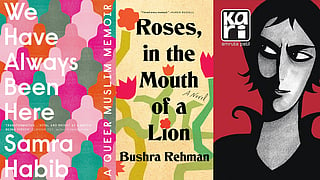
India’s first graphic novel featuring a lesbian protagonist, Amruta Patil’s visually stunning ‘Kari’ follows Kari, a young queer woman navigating heartbreak and survival in a surreal, pollution-choked Mumbai, dubbed “Smog City” in the book. After a failed double suicide pact leaves her separated from her lover, Ruth, Kari works at a soul-crushing ad agency, living in a cramped apartment with safety-net friendships. Patil’s evocative text and dark, atmospheric artwork together create a deeply atmospheric interior portrait of loneliness, corporate disillusionment, and the resilience required to carve out an authentic queer existence in urban India.
‘Revathi: A Life in Trans Activism’ (2016) is the vital, deeply moving sequel to A. Revathi’s landmark 2010 autobiography, ‘The Truth About Me’. While her first book focused heavily on her personal journey of self-discovery, escaping her natal home, and surviving within the intersex hijra community, the sequel shifts its lens to her formidable career as a public intellectual, community leader, and human rights defender.
Blending dark fantasy, folklore, and historical fiction, Indrapramit Das’s ‘The Devourers’ begins in modern-day Kolkata when Alok, a college professor, meets a stranger who claims to be a shapeshifter. The narrative quickly spreads across centuries, travelling back to Mughal-era India to follow gender-fluid werewolves and shapeshifters. Das uses the frameworks of speculative fiction to interrogate identity, body-swapping, and the fluid boundaries of gender and sexuality. The result is a richly imaginative, visceral examination of trauma, otherness, and ancient queer desire.
Set in Heaven, a vibrant, claustrophobic slum in Bangalore, Mathangi Subramanian’s lyrical novel follows five fiercely loyal teenage girls as they fight to protect their homes from government bulldozers. Subramanian weaves a beautiful tapestry of intersectional solidarity, highlighting two explicitly queer characters: Rukshana, a lesbian daughter of a headscarf-wearing union leader, and Joy, a young transgender girl supported unconditionally by her mother. Rather than focusing solely on poverty, the book celebrates female community and queer acceptance, demonstrating how collective joy and fierce, chosen sisterhood can defy oppressive societal forces.
Samra Habib’s brilliant, award-winning memoir charts her journey toward reconciling her faith with her sexuality. Beginning with her childhood in Pakistan, where her family faced persecution as Ahmadi Muslims, Habib recounts fleeing to Canada as a refugee. In her new home, she faces the trials of a forced teenage marriage, racism, and intense familial expectations. Through photography, art, and activism, Habib gradually unpacks her identity, eventually finding a safe, affirming community of queer Muslims. Written with striking candour, it is a powerful story of migration, healing, and self-assertion.
Set in 1980s Corona, Queens, this evocative coming-of-age novel follows Razia Mirza, a Pakistani-American girl growing up in a tight-knit, traditional Muslim immigrant community. Razia’s childhood is filled with strict cultural expectations, street games, and deep faith, but as she enters a prestigious Manhattan high school, her worldview expands. When she develops a passionate, secret romance with her rebellious classmate, Angela, Razia is forced to navigate the painful rift between her community’s rigid definitions of propriety and her own queer desires, beautifully capturing the nuances of diasporic belonging.
In Prabal Gurung’s deeply personal memoir, the celebrated South Asian fashion designer reflects on his childhood in Nepal and India, reclaiming an insult once hurled at him for his nonconforming gender identity. Gurung details his close relationship with his mother, navigating his queer identity while studying fashion in New Delhi, and his mercurial rise in the cutthroat global fashion industry. Blending intimate personal memoir with sharp cultural commentary, ‘Walk Like a Girl’ positions fashion as a powerful platform for political advocacy, showing how Gurung turned his perceived vulnerabilities into activism.
