
- HOMEGROWN WORLD
- HGCREATORS
- HGEXPLORE
- HGVOICES
- HGSHOP
- CAREERS
- ABOUT US
- CONTACT US

Released in 1980, Satyajit Ray’s ‘Hirak Rajar Deshe’ remains one of Indian cinema’s most incisive political allegories. Through a fantastical kingdom ruled by a ruthless monarch, Ray explores the dangers of propaganda, anti-intellectualism, worker exploitation, and blind obedience — themes that continue to resonate even today.
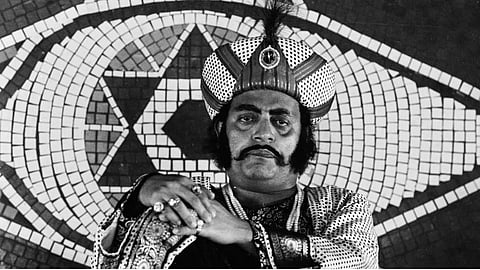
A kingdom ruled by a tyrant. A ruler obsessed with mindless obedience. A brainwashed population. Four decades ago, Satyajit Ray used fantasy and satire to expose the mechanics of totalitarianism in ‘Hirak Rajar Deshe’ (1980) — the Kingdom of Diamonds. At first glance, ‘Hirak Rajar Deshe’ might seem like a children’s film full of fantastical elements like magic shoes that teleport you to wherever your mind desires, ‘magaj dholai jantra’ or a brain-washing machine, and songs that mesmerise listeners. But look closer, and you will find an allegory about anti-intellectualism, worker exploitation, and totalitarianism hiding in plain sight.
A sequel to ‘Goopy Gyne Bagha Byne’ (1969), the film follows Goopy (Tapan Chatterjee) and Bagha (Rabi Ghosh) on an adventure to ‘Hirak Rajya’, a kingdom known for its diamond mines, when they are invited to the royal gala for their musical talents. Ruled by the titular Hirak Raja (Utpal Dutt), who rules through iron-fisted tyranny, the kingdom’s people starve and suffer while untold riches fill the King’s coffers. All the ministers are sycophants, and all who dissent are taken to the ‘Jantar-Mantar’ — a magic laboratory — where they are turned into mindless drones using the brain-washing machine. The only dissident left in this land is Udayan Pandit (Soumitra Chattopadhyay), a teacher whom the King sees as a threat to his regime. When the King shuts down his school and orders the burning of all his books, Udayan becomes a fugitive leading the rebellion against his rule.
As Goopy and Bagha arrive in Hirak Rajya and find themselves in the middle of this rebellion, Ray creates one of Indian cinema’s sharpest political allegories — a timeless warning against totalitarianism, propaganda, anti-intellectualism, and the suppression of critical thinking, as well as the dangers of systems designed to produce mindless obedience.
More than four decades after its release, ‘Hirak Rajar Deshe’ remains startlingly relevant because it speaks to the culture of hero worship, anti-intellectualism, lack of critical thinking, and deference to power — be it in the form of paternalistic, patriarchal family structures, or authoritarian modes of governance — which continues to dominate Indian society. Released in 1980 during a period still marked by the aftermath of the Emergency, Ray’s satire was rooted in its own political moment. But the social realities Ray calls out and satirises in the film are not specific to any single government or era.
In fact, some of Ray’s critiques are more relevant now than they were back then in the most literal sense: the film’s climactic scene of toppling the King’s statue is one that any Indian citizen who has ever paid attention to certain Indian politicians’ obsession with statues will find hard to overlook. The sycophancy of ministers, the absolute obsequiousness of the newsmedia, the exploitation of workers, the rank anti-intellectualism of shutting down schools, burning or banning books, censorship, brain-washing through a continuous broadcasting of propaganda — all of these are issues Indian democracy is struggling with at this moment.
The enduring power of ‘Hirak Rajar Deshe’ lies in the fact that it speaks to all of these issues. As student and youth-led protests over exam paper leaks and the lack of accountability and transparency in Indian higher education rage across the country, ‘Hirak Rajar Deshe’ remains a reminder that education is never simply about comptetitve examinations or employment — it is about creating citizens capable of questioning power and toppling tyrants when necessary.
Watch Satyajit Ray’s ‘Hirak Rajar Deshe’ on YouTube.
If you enjoyed reading this, here’s more from Homegrown:
Sonam Wangchuk, Ken-Betwa, & The Unequal Politics Of Protest & Solidarity In India
Mahanagar: Revisiting Satyajit Ray’s Intimate Portrait Of A Working Woman In The Big City
How The Qawwali Became Indian Cinema’s Most Enduring Ode To A Secular Nation
