
- HOMEGROWN WORLD
- HGCREATORS
- HGEXPLORE
- HGVOICES
- HGSHOP
- CAREERS
- ABOUT US
- CONTACT US

The national attention surrounding Sonam Wangchuk's hunger strike over the NEET paper leak has reignited conversations about democratic protest, government accountability and the failures of India's examination system. This article uses that moment to ask a broader question about visibility itself, examining why some protests become national causes while others — led by Adivasi communities, environmental activists and regional movements fighting displacement, ecological destruction and constitutional rights — struggle to enter the public imagination
For the past few weeks, Sonam Wangchuk has been at the centre of one of India's biggest public conversations. The engineer, education reformer and environmental activist began an indefinite hunger strike at Delhi's Jantar Mantar on June 28, demanding accountability for repeated examination paper leaks, especially the NEET scandal. He has called for the resignation of Union Education Minister Dharmendra Pradhan and wider reforms to India's examination system, arguing that millions of students have been let down by institutional failures.
As the days passed, students, teachers, activists and opposition leaders gathered around his protest. Social media amplified updates on his health, while political leaders, including Rahul Gandhi, publicly extended their support. Doctors warned that his condition was deteriorating after more than twenty days without food. On July 18, Delhi Police removed Wangchuk from the protest site and admitted him to Safdarjung Hospital, saying the decision followed medical advice and court directions. His supporters described the move as forced, while his wife approached the Delhi High Court seeking his transfer to another hospital over concerns about transparency surrounding his treatment. Through all of this, the central demands of the protest have received little response from the government.
The country has been watching Wangchuk's hunger strike closely. News channels, newspapers and social media have followed every update. His protest has become part of the national conversation, and rightly so. It speaks to the anxieties of millions of students and families who have watched repeated examination scandals shake their faith in one of the country's most important institutions.
But not every hunger strike reaches this kind of audience. More than a decade ago, Arundhati Roy spoke about the limits of non-violent protest for communities living far from public attention. "Non-violence is a piece of theatre. You need an audience," she said while discussing the lives of Adivasi communities facing violence in remote forests. It was an observation about visibility as much as a protest. A hunger strike carries moral force because people witness it, show solidarity, and turn it into a collective movement. But when none of those things exists, the protest often remains confined to the people living through it.
India has seen this before. In 2018, environmental scientist G.D. Agrawal, later known as Swami Sanand, began another indefinite fast to protect the Ganga. A former IIT Kanpur professor and one of the country's leading experts on river conservation, he demanded stronger legal protection for the river, ecological flow in dam projects and action against destructive mining. He continued his fast for 111 days before dying in October that year. His death briefly entered the news cycle, but the public conversation around his demands faded quickly. One of India's most respected river scientists gave his life to the cause he had spent decades working on, yet his protest never became a sustained national movement.
Irom Sharmila's fast against the Armed Forces (Special Powers) Act is another example. Beginning in 2000 after the Malom massacre in Manipur, she refused food for sixteen years, making it one of the longest hunger strikes in history. Authorities repeatedly arrested her and force-fed her through a nasal tube while charging her with attempted suicide. Outside the Northeast, however, her protest struggled to occupy the national imagination for long stretches. The extraordinary length of her fast did not guarantee equal public attention.
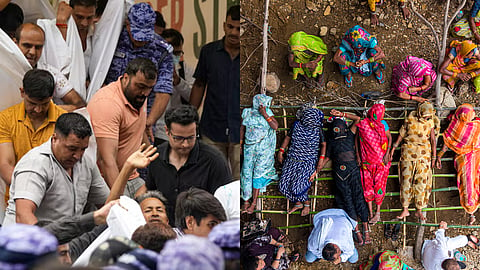
For weeks, Adivasi communities in Panna and Chhatarpur districts have been protesting against the Ken-Betwa River Linking Project, one of India's largest river-linking schemes. The project promises irrigation, drinking water and development across Bundelkhand. For thousands of families living in its path, however, it also means submerged villages, lost forests and displacement from lands they have lived on for generations.
The protesters include Gond and other tribal communities, farmers and forest-dependent families whose homes fall within areas expected to be affected by the project. They argue that the rehabilitation plans remain inadequate, consent procedures have been flawed, and forest rights have not been properly recognised. Their concerns extend beyond compensation as well. The forests provide livelihoods, food, medicinal plants and cultural spaces tied to generations of community life. Rivers are woven into everyday existence in ways that cannot be measured through relocation packages.
The demonstrations themselves have been striking. Villagers stood waist-deep in the river. Some wore nooses around their necks. Others staged symbolic funeral rituals to express what displacement would mean for them. After nearly two weeks of continuous protest, police cleared the protest site and removed demonstrators. Outside the affected districts, the movement has struggled to command the same sustained attention that many protests in major cities receive.
The point of speaking about the difference between these movements isn’t to contest the legitimacy of one cause over another. It’s to highlight the gaping crack between classes and the way their issues manifest in the national imagination. This is about the difference between a protest at Jantar Mantar, the heart of the capital, where journalists, politicians, lawyers and civil society groups are already present, vs a protest unfolding along a river or inside a forest, often depending on a handful of local reporters, independent journalists, and activists to carry its story beyond the region, who are sometimes actively stopped from doing their jobs and bringing these stories of corruption, violence, and the transgressions against human rights to light. Many of these struggles involve the same constitutional rights concerns but rarely garner the same levels of outrage.
Of course, Sonam Wangchuk's hunger strike deserves the attention it has received. Public engagement with democratic protest is essential, and the harrowing realisation we’re all coming to about the apathy of this government is an invaluable refresher of the kind of country we live in. The conversation around his fast, however, also offers an opportunity to ask a larger question.
What does it say about us that it took a movement speaking directly to the aspirations of students and the middle class for the country to stop and give a fuck?
Perhaps the more uncomfortable question is this: if a government can dismiss the concerns of communities fighting to protect their forests, rivers and homes for years, should any of us expect to be treated differently when our turn comes? The indifference shown towards Sonam Wangchuk's demands has unsettled many people because it has entered spaces that feel familiar to them. Yet there are communities across India that have been asking similar questions for decades, often without cameras, public campaigns or sustained national attention. Their struggles have long raised difficult questions about displacement, constitutional rights and the value placed on certain lives over others.
Maybe this moment is an opportunity to examine our own relationship with visibility. Whose causes do we recognise as our own? At what point does someone else's fight become a national concern? The rude awakenings we, as the public, seem to be having over the apathy of the government is largely a reflection of our own apathy and selective outrage. Again, as a fatigued feminist countering all kinds of male apologia, I am well aware of how ignorant and futile whataboutism is. That is not what we're trying to do. This is just a gentle reminder, as the fire reaches our own backyard, to keep in mind in all our glorious outrage, all those who have been standing in the smoke all along.
