
- HOMEGROWN WORLD
- HGCREATORS
- HGEXPLORE
- HGVOICES
- HGSHOP
- CAREERS
- ABOUT US
- CONTACT US
Western and jazz music in India emerged from racist 19th-century blackface minstrel shows, African American musicians performing in the early 20th century through CIA-backed Cold War cultural diplomacy programs that brought Duke Ellington, Louis Armstrong, and Dave Brubeck to Indian stages. This musical exchange profoundly influenced Goan Catholic musicians like Chris Perry and Lorna Cordeiro, who not only became the backbone of Bombay's film music industry, bringing Western harmonic sensibilities, jazz chord progressions, and sophisticated orchestration to create Bollywood's distinctive fusion sound while simultaneously revolutionizing Konkani regional pop music in the 1960s-70s.
I've been writing and making videos for some time now, mostly interviews with independent musicians, alongside research interviews. By the grace of the non-existent Flying Spaghetti Monster, I’ve been trying to read and explore musical subcultures beyond my direct progressive rock and metal niches, and even leave the house more frequently. (But no, I still don't want to commute to the office all days a week. Looking at you, Indian IT companies.)
With the Bangalore Lit Fest approaching, I wondered if I could interview some authors. That's when I discovered Naresh Fernandes, author of the brilliant Taj Mahal Foxtrot: The Story of Bombay's Jazz Age, who was scheduled to appear at BLF. His work explores the origins of jazz in Bombay and India, Western music's influence, and the Goan Catholic musicians who pioneered this scene. It was fascinating to discover that not only the Western sounds in Bollywood music, but also the jazz-pop-inflected Konkani music I grew up with, had such a rich and colourful history.
Unfortunately for me and countless others, the massive IndiGo flight disruptions cancelled appearances by several authors I'd hoped to catch, including Naresh. What follows draws heavily from Naresh Fernandes's excellent research.
Roots In Black America & Minstrel Shows
Musicologist Howard Goodall notes in The Story of Music that rock 'n' roll essentially emerged from swing-era jazz. Interestingly, in the 1950s and early '60s, jazz was considered music for cool dudes, while rock 'n' roll was music for teenagers. Much like how rock is now viewed as "serious" music while pop and hip-hop (often rooted in gospel, soul, and R&B) not too far back were seen as juvenile and are still labeled as "mass" entertainment. Cultural hierarchies do shift over time.
Jazz originated in New Orleans in the late 19th and early 20th centuries, emerging from African American communities, particularly from the convergence of blues, brass band traditions, and work songs. While initially marginalized as "ghetto music" by white mainstream society, jazz became one of America's most influential cultural exports.
However, India's first exposure to American musical culture didn't come from Black jazz musicians. It came from white traveling minstrel troupes performing blackface shows in the mid and late 19th century. Groups like The Christy Minstrel and the New York Serenaders in blackface makeup, caricaturing and performing African American music, were the first to perform jazz and minstrel performances in South Asia. You also had these deeply racist performances featuring white performers like Dave Carson, who donned brownface caricaturing Indians, which got popular among white and elite audiences in India.

Finally, by the 1920s and '30s, we had actual African American jazz groups and musicians like Leon Abbey and trumpeteer Cricket Smith, who began performing in India, particularly at elite venues like the Taj Mahal Hotel in Bombay, where the hotel's famous ballroom (Foxtrot, which Fernandes's book title references) became a hub for jazz.
CIA 'Jazz Ambassadors'
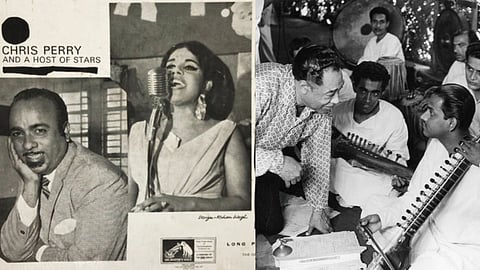
During the Cold War, the U.S. government launched cultural diplomacy programs sending jazz legends like Duke Ellington (who toured India in 1963), Louis Armstrong, and Dave Brubeck as "Jazz Ambassadors”. These tours often secretly funded by the CIA and led by the US State Department, aimed to counter Soviet cultural influence and present America as a racially progressive and culturally sophisticated nation, despite ongoing civil rights struggles at home.
All these performances brought Black American musical innovation to Indian audiences and created opportunities for cross-cultural musical exchange. Among the communities that were mostly influenced by this cultural meeting of worlds was a generation of primarily Goan Catholic musicians from working-class backgrounds. Goa's unique history under Portuguese colonial rule had created a community with deep familiarity with Western musical traditions, harmony, and notation, making them ideally positioned to absorb and adapt jazz influences.
Indian musicians interacted directly with American jazz masters, learning techniques and building networks that would shape Indian popular music for decades. Musicians like Chic Chocolate, Frank Fernand, Chris Perry, and numerous others formed the backbone of Bombay's film music industry. They worked as session musicians and arrangers for legendary music directors including R.D. Burman, Laxmikant-Pyarelal, Kalyanji-Anandji, and S.D. Burman. These Goan musicians brought Western harmonic sensibilities, jazz chord progressions, brass and saxophone arrangements, and sophisticated orchestration techniques to Hindi film music. Their contributions gave Bollywood its distinctive sound; a fusion of Indian classical and folk traditions with Western jazz, swing, and pop influences.
Of particular note is Chris Perry, who was able to reinvent Indian regional music from these influences. As an arranger and songwriter, he reinvented Konkani pop through harmonically rich, rhythmically modern compositions that became standards, especially the songs he wrote and arranged for his protégé Lorna Cordeiro. Perry also extended this modern Konkani sound into cinema with the film Buierantlo Munis, and worked with major playback singers like Mohammed Rafi and Asha Bhosle to help them sing in Konkani.
After being shaped by everything from colonial racist performance traditions to Cold War cultural diplomacy involving the creative labour of African American and Goan working musicians, Indian popular music emerged as a deeply cosmopolitan form.
Despite its somewhat sketchy journey into India, jazz fundamentally transformed Indian music, influencing everything from Bollywood scores to Konkani pop. In that sense, the story of Indian jazz should be remembered not only as a side-note in film music history but as a site of both cultural renewal and remaking.
If you enjoyed reading this, here’s more from Homegrown:
Beedi Wars: How The Humble Beedi Sparked Decades Of Bloody Conflict In Kerala & Karnataka
A 'Punk Iftaar' Is Making Space For Muslim & South Asian Identity In Hardcore Punk
Why Is A High School In Hungary Named After Dr Ambedkar?
Hand, Letter, Form: The Many Lives & Afterlives Of Indian Typography
