
- HOMEGROWN WORLD
- HGCREATORS
- HGEXPLORE
- HGVOICES
- HGSHOP
- CAREERS
- ABOUT US
- CONTACT US

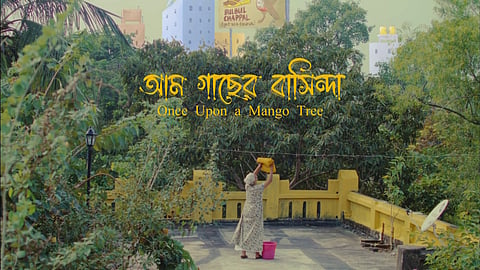
In ‘Once Upon A Mango Tree’, filmmaker Sambit Dattachaudhuri uses a family’s dilemma over a mango tree threatened by Bengal’s worsening cyclones to explore grief, ecological interconnectedness, and the enduring wisdom of Bengali folklore.
In Sambit Dattachaudhuri’s ‘Once Upon A Mango Tree’ (Aam Gaachher Bashinda), a seemingly ordinary domestic dilemma transforms into a meditation on memory, ecology, and interspecies coexistence when a man in his early thirties returns to Kolkata following his father’s death during the COVID-19 pandemic. At home after many years, he finds himself confronting responsibilities that extend beyond inheritance and household chores: chief among them is a towering mango tree in the family backyard, which his ageing mother fears may collapse during the increasingly severe cyclones that now shape life in the Bengal delta.
At first glance, the film appears to revolve around a practical question: should the tree be cut down, trimmed, or preserved? Dattachaudhuri transforms this choice into something far more profound. As Arijit struggles to decide, two fantastic talking birds — Byangoma and Byangomi — living in the tree reveal themselves to him as strange figures linked to his late father, blurring the boundary between memory, fantasy, and the natural world.
Environmental concerns in eastern India are no longer abstract, remote possibilities of future climate catastrophes. They are very much the present. Cyclones such as Amphan, Fani, and Yaas have reshaped the collective consciousness across West Bengal and Bangladesh, making the fear of falling trees and damaged homes a lived reality across the region. In ‘Once Upon A Mango Tree’, Dattachaudhuri examines how ecological anxiety has entered the intimate sphere of family life in the Bengal delta. In his telling, the mango tree is a site where familial grief, climate risk, and modes of attachment intersect.
The film’s premise mirrors contemporary ecological thought, particularly the idea that humans do not exist separately from nature but within networks of reciprocal dependence, as seen through its fabulist lens. Environmental philosopher Timothy Morton describes such entanglements as “ecological interconnectedness” — a limitless, intertwined web of relations that connect all living beings, inorganic objects, and even synthetic materials — while post-humanist thinkers have challenged the assumption that human lives occupy the centre of all narratives. Dattachaudhuri’s story touches on these ideas through its insistence that the mango tree is not merely an object or piece of property but a habitat. The birds are not symbolic presences at the periphery of human life; they are co-inhabitants whose lives are inseparable from the family’s own.
There is also a distinctly Bengali sensibility at work throughout the film’s 20-minute runtime. Bengali literature and cinema have long blurred the boundaries between realism and the fantastic, from folk tales and bedtime stories such as ‘Thakurmar Jhuli’ — a collection of Bengali fables written by Dakshinaranjan Mitra Majumder which Dattachaudhuri credits as an inspiration for the short film — to the magical realism of Akhteruzzaman Elias and other Bengali writers from more recent times. The appearance of the folkloric talking birds Byangoma and Byangomi, who traditionally guide travellers towards wisdom, evokes ancestral presences through fabulist memory-making. Their presence suggests that the answers to contemporary crises may not lie in technological solutions alone, but in recovering old ways of relating to land, animals, and inherited histories. ‘Once Upon A Mango Tree’ belongs to a growing body of South Asian cinema that explores ecological questions through intimate, personal stories grounded in South Asian folkloric horror and fantasy frameworks, such as ‘Hawa’ and ‘Moshari’, instead of larger-than-life Western cinematic spectacle, as in ‘2012’, ‘The Day After Tomorrow’, or natural disaster movies such as ‘Twisters’ and ‘Into The Storm’.
Dattachaudhuri poses a deceptively simple question: what do we owe the non-human lives that share our world? The answer the filmmaker reaches at the end of this modern fable is neither sentimental nor prescriptive. It suggests that grief, remembrance, and ecological custodianship are deeply intertwined. The mango tree’s fate is a reflection on how we choose to live with nature (or not!) — and with the unseen, more-than-human actors who share this ecology with us.
‘আম গাছের বাসিন্দা’ (Once Upon a Mango Tree) premiered at the 23rd Indian Film Festival 2026 on 26 July 2026. Follow @sambitdc on Instagram.
If you enjoyed reading this, here’s more from Homegrown:
The Fable: Ram Reddy’s Latest Film Unravels A Burning Ecological Mystery In The Himalayas
Ashish Shah’s ‘Chaap’ Is An Experimental Short Film Blurring Folklore & Reality In Jaipur
ALT EFF’s Environmental Film Fund Wants Stories From India’s Most Overlooked Regions
