
- HOMEGROWN WORLD
- HGCREATORS
- HGEXPLORE
- HGVOICES
- HGSHOP
- CAREERS
- ABOUT US
- CONTACT US

Jogesh Dutta, the “Charlie Chaplin of the Indian stage”, survived the Partition to become India’s pioneering mime artist. His approach to mukabhinaya, or silent acting, revived ancient performance traditions and transformed silent acting into a powerful form of social commentary.
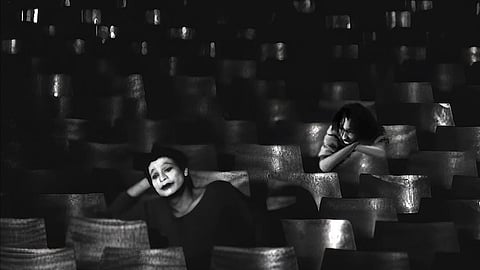
On an August evening in 2009, a packed auditorium at Rabindra Sadan in Kolkata fell into a heavy, reverent hush. On stage, an elderly man in a white shirt and trousers slowly laid down his wig and costume. Ever faithful to his vocation, He did not utter a single word. He did not have to. For over 50 years, Jogesh Dutta — known affectionately as the 'Charlie Chaplin of the Indian stage' and the 'Poet of Silence' — had spoken volumes without voicing a single syllable.
The profound silence in Dutta’s art reflected the noise and chaos of his early life. Born in 1935 in Faridpur, now in Bangladesh, the Partition of India in 1947 displaced his family from their ancestral land. Only 12 years old at the time, he found himself on the busy platforms of Sealdah Railway Station in Kolkata — a refugee lost amid displacement before he fully understood what it meant. His parents passed away soon after, and Dutta spent his teenage years doing menial jobs to make a living. It was during these years of invisibility that Dutta began to observe people. He watched the subtle body language of customers, the tired posture of labourers, and the stolen glances of lovers.
“While observing the couples, I realised that though I couldn’t hear their words, from their body language alone, I could tell which of them were married to each other, or not married, or even adulterous,” Dutta said in a 2021 interview to GetBengal. “So I thought, why not try and portray emotions and actions without speaking?”
And so, Dutta began his lifelong love affair with the ancient art of mime. Inspired by Charlie Chaplin’s silent films, he hurried to a friend’s house to practise in front of a dressing table mirror. In 1956, he performed his first act: a woman dressing in front of a mirror. It was an instant success.
While Western mime, popularised by the French performer Marcel Marceau, focuses heavily on abstract illusion like walking against the wind or the invisible box, Dutta’s style was distinctly Indian. He grounded his art in the ancient Indian concept of ‘Angika Abhinaya’ or body-acting, a key component of the Natya Shastra.
Traditional Indian forms like Kathakali utilise complex mudras or hand gestures and silent facial expressions to tell epic religious stories, usually accompanied by classical music and percussion instruments. Dutta stripped away the religious connotations and the vocal accompaniment. He retained the rigorous facial control and stylised gestures of Kathakali but applied them to secular, everyday life in India. Unlike the ethereal, often abstract French mime, Dutta’s mime was earthy and socially conscious. It was mukabhinaya, or ‘silent acting’, that an Indian labourer or a rural farmer could instantly recognise.
Dutta’s acts were often biting social commentaries that gave visibility to the marginalised — people much like the young refugee boy he once was at Sealdah station. One of his most popular acts, ‘The Thief’, was a hilarious but empathetic look at a thief's desperate attempts to survive, humanising the individual behind the 'criminal'. Similarly, ‘Unemployed Youth’ captured the frustration and stagnation of India’s educated jobless generation, and ‘The Exploited Labourer’ used the physical strain of the mimetic form to depict the crushing weight of manual labour.
Dutta’s influence extended far beyond his own performances. In 1975, he established the Jogesh Mime Academy, an institution affiliated with Rabindra Bharati University. This was a watershed moment, moving mime from a filler act in variety shows to a serious dramatic and academic discipline. His work also paved the way for later institutions like the Indian Mime Theatre and the National Mime Institute, founded by his protégé Padma Shri Niranjan Goswami, which continues to teach the art of mime based on Dutta’s approach. His pioneering body of work continues to inspire generations of actors and audiences alike. Dutta is now 90 years old and lives in Kolkata.
Watch a documentary about Jogesh Dutta’s life and legacy here:
