
- HOMEGROWN WORLD
- HGCREATORS
- HGEXPLORE
- HGVOICES
- HGSHOP
- CAREERS
- ABOUT US
- CONTACT US

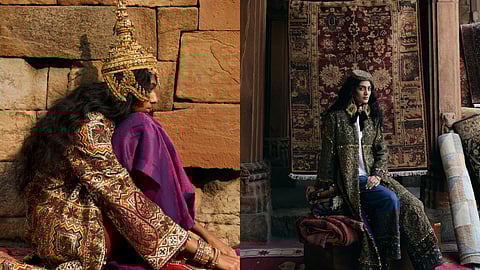
Last Sunday at an exclusive preview at The Leela Palace, Mayyur Girotra introduced ‘The Collectables’, a deeply personal collection that transforms rare Indian textiles into heirloom pieces while spotlighting the artisans and weavers behind the country’s celebrated textile traditions.
Have you ever looked at an old photograph and wondered why everyone looked better in the past?
Ever since I acquired a copy of Steve McCurry’s ‘India’, I often go through the pages and look at McCurry’s photographs of ordinary Indians in the 1970s. Yes, his Western gaze is obvious, but the sheer beauty on display in these photographs — especially the ones he made in Rajasthan — is unmissable. There is a heft to how clothes hang on people, how they flutter in the wind, and drape over ordinary bodies in extraordinary ways. And it occurs to me that everyone looks so much better in old photographs because they are wearing clothes that were very likely made for them, made with care, and made to be worn for a long time, passed through generations. Often, these were clothes that were made by local weavers and tailors, following hyperlocal, artisanal techniques, and informed by the sartorial requirements of the region where they were made, giving them a cultural specificity that modern, ready-to-wear clothing lacks. What happened to those weighted, embroidered, and ornamented textiles that once defined Indian sartorialism?
Last Sunday in New Delhi, I finally found some answers at the preview of ‘The Collectables’, a collection of heirloom pieces made from rare and historic Indian textiles by couturier Mayyur Girotra. A self-taught designer, Girotra’s work sits at the intersection of Indian textile heritage and contemporary luxury occasionwear. His path to fashion was circuitous — a student of hospitality and commerce in London, he spent nearly a decade in wealth management in Dubai before returning to his passion for textiles. Girotra designs as much by instinct as by research; his work is grounded in the indigenous weaves, embroideries, and textile techniques of the Indian subcontinent, from patan patola and phulkari to ikat and kalamkari. His eponymous label, launched in 2009, is known for its bespoke bridal and occasion wear, gender-fluid lines, and luxury prêt offerings.
‘The Collectables’ is perhaps Girotra’s most personal collection yet. It is, in his own framing, a journey from within. Built on rare and historic textiles — old Kutch weaves, ikats, kanchipuram, and bandhanis from across west and south India — it is the result of years of obsessive, deeply personal search for and discovery of India’s textile heritage. Wherever Girotra travels, he says, his first instinct is to look for the textile markets, the weavers, the distance between the city and the villages where the real work happens. It is an instinct that has, over time, coalesced into something more than curiosity.
The moment that crystallised this most recently came during a visit to Kanchipuram, Girotra says. Standing in the heat, watching a weaver at work on the very fabric that would eventually be sold as luxury, he found himself at a loss. “I was stepping out, I was sweating, and I myself also didn’t know what I wanted for him,” he admits. What he did know was this: the weaver is the mother of this craft. The Kanchipuram saree, worn at weddings and inherited across generations, celebrated as the apex of Indian textile artistry, its existence, and its continued survival, depends entirely on a man whose labour is chronically undervalued by the very market that profits from his mastery.
“This is the luxury of India, real couture, and the man who is making it is the one who is sweating in a workshop,” Girotra says. “What about this weaver? He is the mother of this craft. When I sell these pieces, I am not just selling the garment, I am selling the process behind it. I want to ensure that the value reaches the artisans and their families, because we cannot allow these traditions to disappear. We don’t want the next generation to feel afraid of picking up those tools or sitting at the loom because they believe it cannot offer them a dignified life.”
This is the contradiction that Girotra hopes to address, however incrementally, with ‘The Collectables’. He works with women near Jaipur and Jodhpur, with traditional weavers and artisan communities across west and south India — people who have long occupied the productive heart of Indian luxury while remaining at its financial margins. Girotra is honest about the scale of what he’s attempting.
“These are very small steps,” he says, “but even if I can make a difference in ten families and weavers, it is going to help them.” The modesty of that ambition is, paradoxically, its most radical quality in an industry prone to grand declarations.
The preview was followed by Shahi Iftaar at the historic Jama Masjid in Old Delhi. As I made my way through the crowd of the faithful, past the merchandise and sharbat shops of Meena Bazar, through a narrow alley that is usually locked, to the Shahjahan terrace — also usually inaccessible to the public — I kept thinking about the contradictions that drive contemporary luxury. The congregation of believers in the courtyard below; the delegates and diplomats and the tastemakers, among whom I found myself, on the terrace above; the resplendent, intricate, extremely beautiful bridal and occasionwear pieces that Girotra has become reknowned for; and the weavers, tailors, and artisans, who make them — we are all small cogs in the much larger machine of this world that is finally making the right noises about transparency, accountability, and responsibility at the high end. Mayyur Girotra, as it turns out, has been asking these questions for nearly two decades. With ‘The Collectables’, he’s only just decided to say it out loud.
Follow @mayyurgirotracouture on Instagram.
If you enjoyed reading this, here’s more from Homegrown:
How péro’s Latest Capsule Collection Personifies The Beauty Of “Working Backwards”
Padani Kandagama x Rkive City Brought Sri Lankan Influences To The Paris Fashion Week Season
How November Noon Is Rewriting The Notion Of Banarasi Weaves With Each New Collection
