
- HOMEGROWN WORLD
- HGCREATORS
- HGEXPLORE
- HGVOICES
- HGSHOP
- CAREERS
- ABOUT US
- CONTACT US
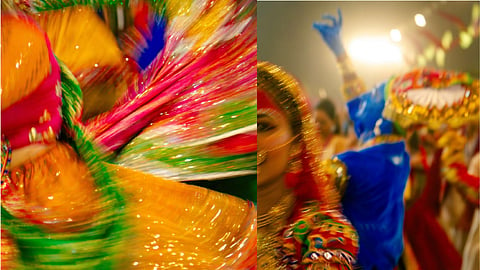
The Heritage Garba at Lukshmi Vilas Palace in Baroda, led by Radhika Raje, blends grandeur and inclusivity, welcoming LGBTQI+ communities. Photographer Rashi Ganeriwal captures its essence through motion and blur, showcasing the festival's vibrant pulse and immersive experience.
Every October, the grounds of Lukshmi Vilas Palace in Baroda fill with tens of thousands of people. Over nine nights, they turn together beneath the lights, feet keeping a constant and steady rhythm that is probably older than any of them. The Heritage Garba, backed by the royal family of Baroda, is a festival of immense scale and spectacle. Under the vision of Radhika Raje, the Queen of Baroda, it preserves the palace’s grandeur and heritage while making room for an inclusive Garba that welcomes LGBTQI+ communities.
Photographer Rashi Ganeriwal has been returning to this place for years now with a camera in hand. Her latest series, 'A Love Letter to Baroda', is the result of that devotion.
Her early frames, she says, documented what she could see: colour, movement, thousands of bodies turning. But a festival this large is difficult to be seen as a whole, because Garba never sits still for a portrait. It is a thing in constant motion, made of noise and texture with its own collective pulse. Over time, her pictures shifted from showing what Garba looks like to remember what it felt like to be inside it, feeling the thump of hundreds of bodies moving to the same beat, clapping, laughing and twirling.

In her words, “The blur is not an accident. It is the body that keeps time.” Skirts become visions of orange and purple. Dancers mix into streaks of light. The eye can’t settle on a single face, and that becomes the point. What the photographs instead capture is the very the sensation of being swept up, of the self loosening its grip, because that's what that experience feels like when you're in it.
”I'm fascinated by people who become completely immersed in an experience, who give themselves over to it so entirely that everything else seems to fall away," she explains. "There's a kind of freedom in that which I find myself returning to both as a photographer and as a person.”
Ganeriwal’s work is a reminder that what matters most about Garba cannot be preserved in the usual sense. It can only be gestured toward, through motion, blur, and colour. 'A Love Letter to Baroda' closes on a modest, moving note: “These photographs hold what I could not leave behind.”
Follow Rashi Ganeriwal here.
