
- HOMEGROWN WORLD
- HGCREATORS
- HGEXPLORE
- HGVOICES
- HGSHOP
- CAREERS
- ABOUT US
- CONTACT US

Homegrown looks at photographer Kushagra Anand’s 'Here, Not Here', a photobook shaped by his experiences of isolation, displacement and moving between Meerut and London during the pandemic. The interview also explores how he found photography, his time studying at London College of Communication, his relationship with home and family, and how the pandemic changed the way he sees and photographs everyday life.
When Meerut-born artist Kushagra Anand, whose practice moves between photography and filmmaking, was 17, he was already taking a camera into Sunburn concerts and photographing anything and everything he could find. His first lens-based experiments had started much earlier, with the 0.7MP camera on his iPod, alongside an interest in painting and music. He eventually studied mechanical engineering, though he “could never find my home there,” and later quit a corporate job he found himself bored with to begin his commercial photography practice in New Delhi.
Photography had gradually become the medium Anand felt most at home with, sitting somewhere between curiosity and excitement. His commercial career, however, left little room for artistic expression. That changed when he moved to London to study photography at London College of Communication in 2020, at the height of the pandemic. What he had imagined as a way to step away from the hyper-commercial studio and advertising environment became a period of frequent lockdowns, isolation and an unexpected shift in how he looked at the world.
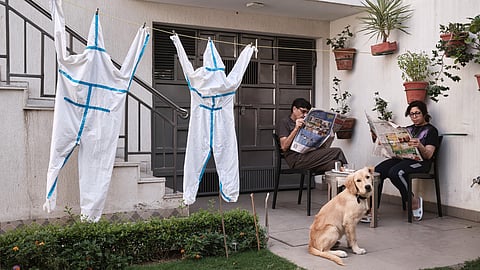
That period eventually became the foundation for 'Here, Not Here', a 160-page visual journal made from photographs Anand took between Meerut and London from 2020 to 2022. The book brings together domestic photographs from both places, scans of his handwritten diaries and media headlines from the pandemic, placing the three layers beside one another to trace the psychological experience of being displaced, isolated and perpetually in transit.
Anand was offered a place to study photography at London College of Communication in 2020, which he saw as a welcome change after spending time in a hyper-commercial studio and advertising environment. Being an international student right in the middle of the pandemic slowly formed his documentary eye. “The act of letting go started when I inherited my father’s analog camera, and slowly started finding why I really started when I did,” he shares. Whilst I did explore the city, it made me photographically reserved, as I was continuously in lockdowns and the medium felt atrocious as I saw on any and every media channel. Being away from home and his family, especially knowing they were on the frontline, was tough at a time when he needed company.
“I also didn’t want to post any of the photographs at the time as it felt I was contributing to the inhumanity,” he says. When he eventually returned to Meerut, he landed in another lockdown, this time during India’s April 2021 restrictions. Photography became a way to get out of his studio room in London or his house in Meerut and document the people and places around him. “It was only in 2024 that I noticed a story form and coherence within all the photographs I had made, and never edited out,” he notes.
Anand’s parents are dentists, and when they restarted their practice a few weeks after lockdown restrictions were lifted, their clinic continued to operate from the lower ground floor of his family home in Meerut. “I would see them practising in full PPE kits and come back upstairs drenched in sweat. The only soul to interact with was my Golden Retriever puppy, Jhumroo,” he recalls.
When Anand later returned to London, isolation pushed him into an “eerie, but almost dreamlike state.” He spent that time going through more than 50 influential photography books and began to feel as though he was in a locked room, watching his own life unfold like a movie. Flying repeatedly between India and London, amid the constant travel advisories, only deepened his sense of being in perpetual transit and furthered the dissociation.
His journal entry from 28 March 2021 reads, “What does the world want from me? I just want to go out and make some photographs. Why do I feel so emotionally paralysed?” Anand describes the resulting depersonalisation as calming amid extreme mental exhaustion and sensory overload, but he knew that wasn’t normal. “Even when I look at the photographs now, they feel as if I’m looking at myself experiencing life,” he shares. The sequence in his photobook is intended to create a similar dystopian narrative: “where everything looks calm and functional at first glance, but something distressing lies underneath.”
As much as we’ve all seemed to move on and forget about the pandemic, it has unquestionably changed us. “An invisible psychological baggage has been brought into everyone’s lives,” Anand muses. “The loneliness, quietness and the only friend in my isolation being my camera made me far more attuned to the quiet, private human realities hidden behind everyday routines and is also influencing my future work.”
As 'Here, Not Here' nears completion, the book has also become a way for Anand to let go of the psychological state that defined his 20s. “In my case, it was photographs of home, both as I was in the UK and in India. I could just not decide what home really was and at times, I still don’t,” he shares. “One thing I really value is my quiet time, which often leads to the same question: ‘How did we really get here?’”
Follow Anand here.
If you enjoyed reading this, here's more from Homegrown:
“Every Photographer Is A Predator”: Soham Gupta On Photography, Power, & ‘Desi Boys’
Sutirtha Chatterjee’s ‘A New World’: Will We Ever Stop Stealing From Our Own People?
‘Before You See The Scar’ Challenges The Gaze We Direct Towards Acid Attack Survivors
