
- HOMEGROWN WORLD
- HGCREATORS
- HGEXPLORE
- HGVOICES
- HGSHOP
- CAREERS
- ABOUT US
- CONTACT US
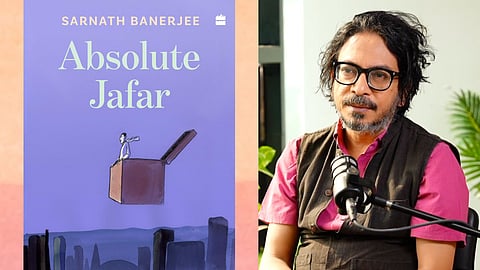
Absolute Jafar is the sixth graphic novel by Indian artist and writer Sarnath Banerjee, published by HarperCollins India. Set across Delhi, Karachi and Berlin, it follows Brighu Sen and his family through immigration, bureaucracy and the textures of everyday urban life. Blending memoir, reportage and fiction, the book draws on folk mythology, magic realism and urban observation to construct a loosely episodic narrative spanning roughly two decades.
The aftertaste of 'Absolute Jafar' lingers long after you shut the book. The purple tome that is this graphic novel can’t help but evoke a sense of deep poignancy. Sarnath Banerjee's compulsive urban wanderer from his debut 2004 graphic novel 'Corridor' is back, older now. The postmodern Ibn Batuta, who once drifted through Connaught Place's secondhand bookstalls, now confronts the abiding concerns of midlife.
Brighu is perennially 'bechain': restless, walking across wherever he lives, whether it be Delhi, Karachi, or Berlin. The highly autobiographical graphic novel unfolds as a chain of mostly chronological scenes. Spliced with detours in the mundane, with quieter incursions of magic realism folded in. Visually, the book moves between monochrome and other chapters open out into splendid watercolour. Switching between these modes sets the book’s rhythm — moments of colour arrive when a memory or a flight into the imaginary sharpen.
The first half of Absolute Jafar follows Brighu’s relationship with Mahrukh Zaidi, an artist from Karachi. While there is no breaking of hand-pumps here, this Indo-Pak love story inspires years of odysseys in the annals of Indian bureaucracy. The pair concede themselves to the perils of keeping a relationship alive across two countries. India and Pakistan's relations change with the seasons and only worsen over time. Eventually, they move to Berlin, and the book takes its title from their son, Jafar, born there.

Detours Into The Imaginary
What Banerjee taps into is humour-laden, magic-realist imagery from the mundane, the absurd, and sometimes life’s deeper reflections. At one point, Brighu’s struggle with paperwork is threaded with the figure of Dariya Shah Hazrat Khizr, also known as Jhule Lal, the patron saint of Sindhi Hindus and Muslims. He appears only when you have given up on seeing him, riding his fish, gliding on water. Sivaraman, the government official who he waits on, flickers in and out of the frame as a secular counterpart to this apparition.
Another instance is the Jinncyclopedia chapter, whose rich imagery is a joy to soak in. Brighu, now in Berlin, trying to get Jafar to sleep, tells a bedtime story about a parallel Karachi. Here, the police run a Paranormal Division to keep tabs on the jinns, supernatural beings residing among civilians. Inspector Ali, permanently poolside, relies on Sumo Jinn as his native informer. This jinn is a being formed from the talcum-powder residue on the necks of Calcutta minibus commuters, the dried sediment mixed with rosewater and distilled through chanting. Sumo carries Abbas, a harmonium from Bowbazar, whose bellows fire darts when you pump them.
Brighu notes that Inspector Ali has learnt the colonial lesson well. The easiest way to control a population is to use another “native”. Banerjee cuts to a near-photographic drawing of an airport border sign. 'EU Passports' on one side; 'All Other Passports' on the other. In the panel, you recognise Suella Braverman, the anti‑immigration, Indian‑origin British politician whose public rhetoric has targeted migrants and asylum seekers.
A Critical Imagination Deficit
Sarnath Banerjee’s work as a visual artist has included the Gallery of Losers billboards for the 2012 London Olympics, fellowships at Princeton and MIT, the co-founding of the publishing house Phantomville, and a MacArthur. In talks and interviews, Sarnath Banerjee has argued that the Indian middle class suffers from what he calls a "critical imagination deficit". His installation under that name appeared at the 13th Berlin Biennale in 2025.
People are satisfied with facts, statistics, and news headlines, and can “survive without a story”, so they never have to imagine other lives in depth. A parent raising a child in Berlin often has no imaginative grasp of what it is to raise a child in Gaza or Palestine. Absolute Jafar smuggles politics into folk tales and conversations, doing so in his observational style, sitting somewhere between a personal sketchbook and migrant chronicle.
Banerjee has described the book as “...a history of the emotions of living in a particular period," roughly the last two decades. In many interviews, he has refused the label of nostalgia. Nostalgia tends to flatten and romanticise the past, which can be conservative. “I am anti‑nostalgia because nostalgia hides a lot of darkness”, he says in an interview with Anurag Minus Verma.
There is a discomfort in Brighu that the book does not quite let him off the hook for. He is politically literate, ironically attuned to bureaucracy and border, fluent in his own complicities, and his characteristic mode remains the walk away rather than the intervention. He reads a room with precision and hesitates to disturb it. Through him, Banerjee draws a recognisable type, the Indian middle-class educated male caught between critique and complicity, capable of analysing every absurdity of his world while staying steadily implicated in it. Banerjee neither punishes Brighu for this nor redeems him from it. The bedtime stories he spins for Jafar work as part rescue mission, part alibi for retreat, and the book lets both readings sit side by side. What you take from Absolute Jafar depends on which Brighu you are willing to recognise in yourself.
The perennial migrant keeps walking through, with home being where the shopping list is. What stays is less of a singlular revelation than the way small, throwaway moments quietly accumulate into a life suspended between places. Banerjee lets memories, jokes, and bedtime stories pile up to make sense of the present as it keeps subliming into the past at every moment. You close the book with the sense of how these years have actually felt, in all their drift, whimsy, and quiet melancholy.
