
- HOMEGROWN WORLD
- HGCREATORS
- HGEXPLORE
- HGVOICES
- HGSHOP
- CAREERS
- ABOUT US
- CONTACT US
Kerala’s tourist and private buses have quietly turned into minor celebrities, where college kids, families, and workers build entire trips around vehicles with signature looks, viral reels, and loyal fan circles, even as a stricter rulebook and nervous government officials begin to test how far this neon-soaked scene can keep stretching the limits of the road.
Pikachu Holidays
Shravan, my nephew, uses CapCut to edit bus reels. “The edit app of Insta doesn’t have good transitions,” he tells me, slightly offended that I even suggested using it. When he’s free, he joins trips as part of Pikachu Holidays, a tourist bus, in Kerala, part worker and part in-house videographer and editor.
My way into this world arrived silently on my phone through a reel he sent me. A bus flies through on a two-lane road. Colourful LEDs wash over the cabin. Mammootty delivers a punch dialogue perfectly timed to the cut. The whole thing looked like a sigma edit applied to transport. More reels followed, each one treating the bus as a celebrity with slo-mo hero shots and fan edits. Some videos had fan clubs cheering them on, dancing at chassis delivery events.
Owners often spend over lakhs on graphics and custom branding. “Clients are usually families or college students who want buses with a viral presence and big social media following,” says Shravan. For these tourist buses, visibility and engagement have turned bookings into a pure numbers game. The more the following, the more the trips.

Menaces On Wheels?
Interiors turned into dance floors. Flexible LED strips, multi-colour lights, and high-power audio systems with multiple boosters and subwoofers. This isn’t a discotheque but the average Kerala “tourist” bus.
But if you had followed Malayalam news, these same buses had gathered a different kind of attention. Government officials and the Kerala High Court spoke of driver distraction, safety concerns, essentially branding the buses as “manaces on wheels”.
In 2022, after a fatal crash in Palakkad's Vadakkencherry, the state ordered all tourist buses registered in Kerala to remove their colours and repaint them white. Tourist bus groups like the green-coloured Pikachu Holidays, based in Thiruvananthapuram with a healthy follower count and a steady stream of reels from college and family trips, kept their graphics but repainted everything in white. Some operators found a workaround. They shifted to All India Tourist Permits or re‑registered vehicles in neighbouring Karnataka, with students boarding at the state border.
Taj Mahal
Around 2017–18, Shravan says, the private bus scene began to change as operators started adding ever more extravagant features. One bus called Taj Mahal was the first to introduce the “rain disco inside the bus”, a gimmick that seems to have disappeared later. Another bus followed with a “fully glass floor, DJ glass floor”, turning the vehicle into a moving nightclub.
Other operators tried to keep up. Shravan recalls how ‘Oneness’ installed expensive Kicker subwoofers, “one subwoofer is 1 lakh rupees” and later even a fully pixelated name board. Eye-grabbing graphics became the way through which a bus could stand out. A newer bus, Devanand, celebrated the arrival of its chassis with food, something Shravan insists no one had ever done for a bus chassis delivery before.
That's Bussin
Jerry works with CamberGangz, a modified cars club. He spends weekends on a circuit of college auto shows across Kanyakumari, Nagercoil, Coimbatore, Bangalore, and other places in Kerala. He owns three cars, two of which he uses for these. There’s no dearth of visual or sonic extravaganza. Some of these have Banger Kit modules, which create loud musical pops and bangs from the exhaust, while others have flame kits, literally spitting fire.
Over the years, Kerala has gained fame for its modified cars and motor culture. Modified hatchbacks, slammed sedans at college festivals, and monster trucks have all garnered attention. When I ask him to compare cars and buses, he answers without hesitation. “Nowadays, buses are getting more fans than cars”. “Popular automobile influencers like Babs, AR Shiva, and the Flying Squirrel are jumping into the bus field now.”
Private tourist bus fleets like Shiva, Khaleefa, Zero Expeditions, and Oneness have gathered a massive number of social media followers in the hundreds of thousands. Abin Babu Abraham, widely known as Motographer Babs, the biggest automobile influencer in Kerala, with over a million Instagram followers, owns several cars and a garage. He has helped fix Kerala in the imagination as a place where ordinary people treat vehicles as creative projects. When even Abin starts building buses, it is a sign that, in Kerala’s custom‑vehicle imagination, the action seems to be shifting from cars to buses.
The Tusker
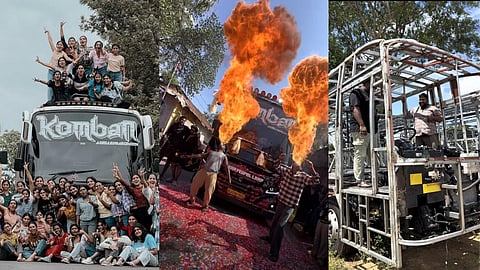
The mood was jubilant as the 'Kaliyan 2.0' chassis rolled out for the Komban Holidays fleet, turning its delivery into one of Kerala’s largest such events, with a sea of fans in attendance. The crowd of supporters and the line of fleet vehicles swelled so much that they all but shut down the road to the showroom grounds
Deepu Sankar is the undisputed king of the “jungle” so to speak. The fleet has buses with names such as Dawood and Aghori that appear across Instagram, YouTube vlogs, and fan pages. Among followers, the story circulates that Deepu wanted an elephant when he was young and that his father refused. Komban, which means tusker, is a delayed answer to that childhood desire.
“I know Deepu from the old TikTok days,” Jerry says. “We had a group with all the automobile TikTokers, and that’s how I knew him, before he became known as the owner of Komban.”
Even the largest of the tourist bus operators has run into controversies. In 2022, the Kerala High Court opened a suo motu case after a video showed firecrackers being burst on the roof of a Komban bus and the vehicle catching fire before a college tour. The court ordered a government report and used the footage as proof of risk. Later, a Komban bus carrying students was stopped in Chikkamagaluru, Karnataka, after locals objected to its bright lights and graphics endangering other road users. The bus was allowed to continue only after eye‑catching graphics at the front were covered with cello tape.
In a livestream, Deepu defended the tourist bus community. “This industry is not just about metal and machines; it supports thousands of families. When a bus is grounded, a household slips into poverty.” Deepu argued that the appeal of tourist buses lies precisely in their immersive ambience, saying young passengers and students actively choose vehicles with dramatic lighting and powerful sound systems, and that operators would lose their customer base if they stripped those features away. He accused officials of “hunting operators like criminals” over lights and sound while ignoring systemic road‑safety failures and the poor condition of state‑run buses.
The Hustle
Behind the reels and the shows, there is a more ordinary layer of work. Unlike tourist buses, life on the other long-route private buses that run between cities like Thiruvananthapuram and Bangalore isn’t as fun. These are not the named tourist buses of college reels but regular private services on tight schedules.
Owners often sit in the front seat next to the driver watching the road and the clock. “If you lift your foot off the accelerator, they start shouting,” he says. Buses are particular about being punctual, as reviews affect reputation. Buses don’t wait for late travellers. I’ve missed enough Trivandrum buses to know.
Shravan talks about a friend who owns a small bus in Kerala and works as a driver in Chennai to earn faster for modifications. Every extra shift becomes a little more money for lights, sound, or bodywork that might push his own bus up the informal ranking of popular choices.
Many of the young men in this space view tourist buses as a way to escape that constant pressure. They want to own a bus with a name and a specific look and to turn that bus into a known brand for weddings and college trips. The path to that dream runs through years of work on ordinary routes or smaller vehicles.
Women At the Wheel
The bus and motor ecosystem in Kerala, like a lot of spaces, is dominated by men. There appears to be a certain masculine appeal to it; a need to perform machismo. But at the same time, this is a space for bonding and culture. Women show up frequently in the audience, in the reels, dancing outside buses, or filming themselves inside glowing cabins. However, women bus owners or drivers are scarcely visible. Despite their small numbers, they exist. Among them are Achudeva, who owns Deva Holidays, and Jalaja Ratheesh, who runs Puthettu Travel and also owns and drives her own truck. These women operate in a space where their presence alone marks a deviation from the status quo.
Among race car drivers, Shilpa Surendran, better known as Chippu LCGirl, is a teacher who owns an LC80 Land Cruiser, a garage, and a small collection of vintage cars. She runs ‘Boois Garage’, competes in autocross, and performs stunts. "Normally, girls don't own vintage cars because they're too expensive. Here I haven't seen any girls owning a vintage car," she tells me. For Shilpa, motorsport gives her confidence, makes her feel invincible.
She estimates that Kerala has under ten women drivers who compete consistently. “I drive only a stock car in every event. I have also won first position, but mostly I get second position because there are ladies who compete that show up with a 25‑lakh‑build Polo”.
Her LC80 now sits squarely in the crosshairs of the same enforcement culture that has gone after tourist buses. Customs officials have placed the SUV under scrutiny along with dozens of other imported vehicles, and she is still waiting for the department to clear its paperwork. “I have submitted all the documents, but still I’m waiting.” Her reading of why this keeps happening is direct. "These people just don't encourage automobile culture."
For people involved in this subculture, it’s another turn at the crossroads of aspiration, hustle, and earnest cultural expression. Earlier this year, the Kerala government revoked the white colour rule. Tourist buses could return to their colours and graphics. For now, white has become the signature style of tourist buses, and it seems it will continue to be so. It remains to be seen whether the Wild West of Kerala's tourist bus subculture will survive the goliath that is state oversight and bureaucracy.
If you enjoyed reading this, here's more from Homegrown:
The Down Troddence Is Reimagining Indian Metal As A Site Of Real Political Resistance
How Blackface and CIA 'Jazz Ambassadors' Influenced 20th Century Homegrown Music & Culture
Beedi Wars: How The Humble Beedi Sparked Decades Of Bloody Conflict In Kerala & Karnataka
Blood In The Open Skies: The Murder That Grounded India’s First Private Airline
