
- HOMEGROWN WORLD
- HGCREATORS
- HGEXPLORE
- HGVOICES
- HGSHOP
- CAREERS
- ABOUT US
- CONTACT US
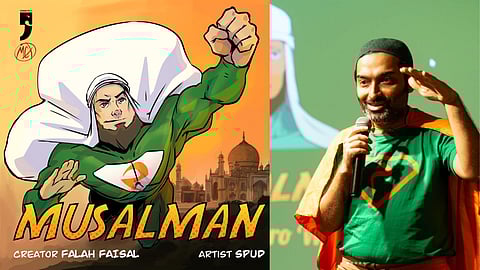
Musalman is a satirical Indian superhero universe created by Bengaluru-based comic writer, filmmaker and comedian Falah Faisal. At its centre is Musalman, a non‑violent Muslim superhero whose main 'power' is humour, using jokes, wordplay and sharp dialogue to take on hate, propaganda, and everyday absurdity rather than relying on brute force. The character and his world now appear in a collected graphic novel published by Yoda Press, bringing together several of the short comic stories Faisal has been making over the past few years.
For comic book writer Falah Faisal, the road to Musalman begins in a warehouse off Bengaluru's Infantry Road. Gotham Comics, which reprinted DC and Marvel for Indian readers, kept a godown there where he could spend afternoons reading stacks of Mad, Superman, Batman, and X‑Men for pocket change. "What else was I going to grow up to be if not a comic book writer?" he says. Years later, a running joke about a friend nicknamed 'Muslim Clark Kent' sparked an idea:
What would a Muslim Superman look like in this India, particularly within this current media landscape?
I first encountered Musalman, Falah Faisal's no-holds-barred superhero creation, a few years ago online. The comics combined intelligent humour and sharp political references while balancing witty satire with absurdity. Musalman is a caped superhero marked with the Arabic letter م (meem), who wears orange underwear on the outside, and (non-violently) fights not just crime but social injustice and everyday bigotry. Faisal has crafted a spectrum of ingenious characters, such as Badass Begum and Starwoman, among others, while antagonists include Tana Shah, Chairman Mouse, and Arnab Cowswamy. He moves through a landscape of moral policing, hate campaigns, and news-cycle hysteria that looks much like our own.
Now, the entire origin story and early arcs have been collected in a new graphic novel from Yoda Press, finally putting this world between covers on an actual bookshelf.
The Sword of Tipu Sultan
His earliest comics, ‘Musalman and Trade Center’ and ‘Musalman vs Romeo Squad’ began as six-panel gags on Islamophobia and moral policing, appearing sporadically online between 2017 and 2020.
Faisal has worked as a journalist with outlets like Bangalore Mirror and as a writer with TVF, alongside a run of short films and documentaries. As a filmmaker, his socio‑political commentary shows up in shorts like the satirical Rang De Basanti 2: Tipu's Revenge and more serious documentaries on Jignesh Mevani’s Una Dalit dignity march and the CAA–NRC protests in Bengaluru.
“You always hear people say, ‘A film like Rang De Basanti couldn’t be made today, Amar Akbar Anthony couldn’t be made today.’ Let me make one and prove you wrong”, he says. Tipu Sultan was a childhood hero for him, having played him in fancy‑dress competitions. “Now I’m watching the same system try to recast him as a villain.” For him, Tipu is “one of the first true nationalists, an Indian king who actually took on the British, and that’s the guy we’ve chosen to demonise.”
A turning point was documenting the CAA–NRC protests. “Before that, he was just an offensive, edgy character; after that, I understood who he was for, and who he was defending.”
Ahimsa
Written during the first lockdown, from March to about June 2020, and illustrated over the next year, the series was first serialised online as a webcomic on Instagram and the Bakarmax website, which is how most readers, including me, first stumbled into Musalman’s world. “I went into my room and wrote 'Musalman vs Coronavirus', which was the real birth of Musalman as a comic-book narrative,” he says.
During the last ten nights of Ramadan, fasting by day and on his balcony with friends in the evenings, the entire origin arc arrived in one burst. He narrated the full story and sat down over the next couple of days to write what would become a 116-page script. "What I wrote in two days took my illustrator one and a half years to draw," he exclaims.
“I wanted to flip this constant media hate and create a Muslim superhero who is actually an inspirational, hopeful figure instead of another stereotype,” he explains. Falah’s Musalman is a non-violent “Gandhian” superhero. While he has superpowers, he doesn’t mostly engage in physical combat. He smokes with his adversaries and tries to let conversations spiral down to truces.
"Do you even have an option to be violent?" Falah asks, "The state has the monopoly on violence, and anyone who fights back gets called anti-national or Naxal."
Marvel Fatigue
Offline, the book's journey has been as improvised as its hero. Early issues were printed in tiny 5x5 square booklets at a small shop run by two brothers, Asgar and Noor. Falah sold them at comic fests and more often in the smoking sections of Bengaluru pubs. Over four years, more than a thousand copies of the self-published zines have travelled this way.
Among contemporary Indian comics, he looks up to Appupen, Orijit Sen, and Sanitary Panels, among others. In fact, when he wanted to create Musalman, he went directly to Appupen, who then put him in touch with his first illustrator.
“Musalman is my way of deconstructing the superhero genre," says Falah. "He lives in a world where Marvel and DC exist, and he’s aware enough to lie about his origin story before telling you the real one.” In a meta‑sequence, Musalman deliberately tells fake origin stories because he knows he lives in a world where Batman, Superman, and Marvel movies are part of everyday culture. The book is also filled with formal nods to Bill Hicks and South Park, who he is strongly influenced by.
Films like 'Captain America: Civil War', he argues, are propaganda for the status quo, in which the "good" pushes the status quo and glorifies the military-industrial complex. At the same time, he is shaped by the 1980s shift toward graphic novels for adults, such as 'Watchmen', 'The Dark Knight Returns', and Alan Moore's 'Promethea'. There is also a history of superheroes functioning as political allegories. The X-Men were long read as a metaphor for the Civil Rights Movement, with Professor X and Magneto reflecting the differing philosophies of Martin Luther King Jr. and Malcolm X. On the other hand, Superman, created by two young Jewish Americans, has often been read as an ideal immigrant fantasy.
What about fears of being attacked by the (sometimes not) online mob? “One of my shields is that I perform in English.” That being said, he says he would love to see the comic translated into Urdu and Hindi, and if a film ever gets made, he is clear that it will be in Dakhni.
Laughter As Survival
Somewhere behind Musalman's mix of anger and absurdity sits a day Falah calls his "best writing workshop". A visit to a prominent socio-cultural organisation's campus in Nagpur spiralled into detention and questioning by agencies. At the time, he remembered a line that has stayed with him from Larry Charles’s documentary 'The Dangerous World of Comedy':
"If you are ever detained, make them laugh."
“My only job as a comedian was to make them laugh enough to let me go.” He kept the room laughing, showing his YouTube documentaries. The new graphic novel carries a similar jester’s instinct, with a superhero who keeps nudging at the world around him until it has no choice but to laugh along.
If you enjoyed reading this, here's more from Homegrown:
The Down Troddence Is Reimagining Indian Metal As A Site Of Real Political Resistance
How Blackface and CIA 'Jazz Ambassadors' Influenced 20th Century Homegrown Music & Culture
Beedi Wars: How The Humble Beedi Sparked Decades Of Bloody Conflict In Kerala & Karnataka

