
- HOMEGROWN WORLD
- HGCREATORS
- HGEXPLORE
- HGVOICES
- HGSHOP
- CAREERS
- ABOUT US
- CONTACT US

'Before You See the Scar' is a visual art project by artist Monica Dhaka and Delhi's Brave Souls Foundation that explores how acid attack survivors continue to navigate stigma, judgement and social exclusion long after the violence itself. Through abstract photography, portraiture and survivor testimonies, the exhibition shifts attention away from trauma alone and towards the identities, aspirations, and everyday lives of the women behind the scars, questioning the ways society chooses to see them.
Acid attacks remain one of the most horrific forms of gender-based violence in India, and they rarely happen in isolation. They are deeply tied to misogyny, male entitlement, and the urge to punish women for making their own choices. Many survivors are attacked after refusing a marriage proposal, rejecting a relationship, resisting domestic violence, or speaking up against dowry demands. The violence is intended to leave a permanent mark, but the punishment doesn't end with the attack. Survivors continue to face relentless judgement, intrusive stares, whispered conversations, and a society that often sees the scars before it sees the person. That everyday gaze becomes another form of violence, reducing women to a single traumatic moment instead of allowing them to exist as complete individuals with lives, ambitions, relationships, and identities of their own.
It is this way of looking that visual artist Monica Dhaka confronts in 'Before You See the Scar', a photographic and mixed-media installation created in collaboration with acid attack survivors from Delhi's Brave Souls Foundation. Instead of documenting violence itself, the project examines the social responses, the assumptions people carry, and the ways survivors continue to be defined by a single aspect of their lives.
The project was developed alongside the Brave Souls Foundation, a Delhi-based organisation founded by acid attack survivor Shaheen Malik. Having experienced this violence herself, Malik established the foundation in 2021 to address the many gaps that survivors continue to face even after emergency medical treatment. Through its shelter home, Apna Ghar, Brave Souls Foundation provides comprehensive support that extends far beyond surgeries. Survivors receive medical interventions, psychological trauma therapy, legal aid, vocational skill development, and long-term emotional support as they rebuild their lives. A former advisor at the Delhi Commission for Women, Malik has spent years advocating for survivors, and through the foundation has helped hundreds of women access surgeries, secure compensation, and find the emotional resilience needed to reclaim their independence and dignity.
For Monica, those conversations became the heart of the work. "Talking to the survivors was the best part of making this visual art project. I spoke to 18 acid attack survivors, and although their stories were very painful to hear, they welcomed me into their lives so openly," she shares. "One thing that stayed with me was how we, as a society, make them feel every day. They are called 'bechar', (meaning helpless) and are often treated like outcasts. It made me realise how easily many of us step outside and live our lives without thinking twice, while for them, even going out can mean being stared at or judged."
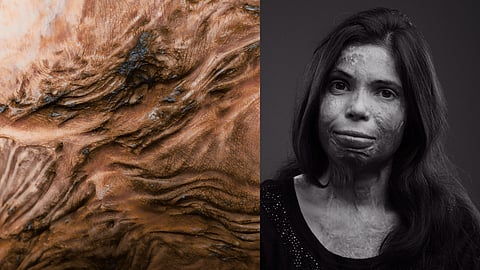
Before You See the Scar has two interconnected parts. The first begins with extreme close-up photographs of burnt and scarred skin. Monica mirrors, repeats, and digitally manipulates these fragments into eight abstract photographic works titled 'The First Look'. The compositions, almost geological in formation, make a cerebral imagery of the shape of hatred itself, carrying the resentment, anger, and entitlement that fuelled the attacks.
Alongside these abstract works are six photographs from the 'Skin Landscape' series. These images remain largely untouched, with only subtle colour correction applied to the original close-up photographs of scarred skin. Stripped of obvious context, they appear almost like vast landscapes, valleys, cliffs, or shifting terrains. They ask viewers to spend time identifying what they are seeing, encouraging a slower encounter with the image and, by extension, with the person whose body it belongs to.
The second half of the installation shifts away from fragments and returns to the women themselves. Eight black-and-white portraits present survivors with their names, expressions, personalities, and stories. Beside every portrait is a text shaped from Monica’s interviews, built around what each woman wants people to know about her life. The writing speaks about families, work, aspirations, and everyday experiences, restoring dimensions that are often erased when someone is viewed only through the lens of trauma. Together, the portraits and texts create space for each woman to define herself on her own terms.
An Indian-born visual artist working between Mumbai and London, Monica completed her Master's in Television at the University of the Arts London in 2023, where she developed a research-led practice rooted in lived experiences and real communities. Photography forms the foundation of her work, but she also works with moving image, fabric printing, juxtaposition, repetition, mirroring, and digital image manipulation to build layered visual narratives. Her projects explore identity, belonging, community, and gender-based discrimination, often focusing on people whose lives are shaped by stereotypes, exclusion, or misunderstanding.
Through 'Before You See the Scar', Monica questions both the perception of acid attack survivors and the political nature of the shame that’s been imposed on the perpetrator's account. By bringing together abstraction, portraiture, and the voices of the women themselves, the project asks viewers to reconsider that first instinct and recognise the lives, identities, and futures that did and will exist beyond the violence.
