
- HOMEGROWN WORLD
- HGCREATORS
- HGEXPLORE
- HGVOICES
- HGSHOP
- CAREERS
- ABOUT US
- CONTACT US

London-based Photographer Sutirtha Chatterjee’s ‘A New World’ examines Rajarhat New Town’s transformation from wetlands and farmlands into Kolkata’s premier satellite city. The project explores the implications of land acquisition, ecological destruction, caste privilege, and the enduring colonial logics embedded within India’s urban development.
At the north-eastern edge of greater Kolkata, Rajarhat Newtown — officially ‘Jyoti Basu Nagar’, named after West Bengal’s longest serving Chief Minister from the Communist Party of India (Marxist) — rises from what once used to be swamps, farmlands, and grazing fields. In 2019, photographer Sutirtha Chatterjee visited the area to look for an apartment for his parents — a visit which became the point of departure for his project ‘A New World’ (2019-2026).
“Something about the place felt quite dystopian,” Sutirtha told me when we spoke about the project earlier this month. “If you walked along the Biswa Bangla Sarani (the main thoroughfare that runs through Rajarhat Newtown), you’d find vast open areas and wheat fields on one side. And on the other side, there are huge buildings and the Mother’s Wax Museum, which is a crazy place in itself. There’s a jarring contrast. On one hand there are luxury properties only very few people can afford, and on the other there are these pockets where people farm and fish. I felt curious about the history of the place.”
In 1995, the then communist government of West Bengal used the colonial-era Land Acquisition Act of 1894 to acquire large tracts of Rajarhat’s agricultural land, wetlands, and waterbodies — among the most fertile in West Bengal — to make way for a planned satellite township. By May 1999, landowners began receiving eviction notices, and many farmers who resisted the acquisition faced intimidation, coercion, and state violence as they fought to hold on to their homes, livelihoods, and ancestral lands.
Today, Rajarhat Newtown has transformed into one of West Bengal’s most prominent real estate and IT hubs, with glass towers, gated communities, and infrastructure projects replacing much of its agrarian landscape. Its transformation reflects a broader Indian “development” story — defined by the promises of gentrification and economic growth, but also by questions of displacement, dispossession, and who are these “new” cities for.
“I remember one incident that stood out clearly,” Sutirtha said. “I was walking near the Shapoorji Pallonji Complex, when I saw a gathering. Something was going on. I couldn’t make sense of it, so I approached them and asked what was happening. They said their cows had been taken away by the police. They’d grazed their cattle there for years, but the land was now protected because developers wanted to build on it. The cows had strayed into a restricted zone and were seized. It felt like such a fascinating story to me at the time — comical and weird at once.”
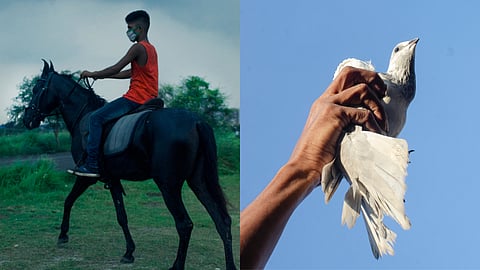
‘A New World’ critically examines this contested landscape through the lived experiences of Rajarhat’s original residents — their memories of fear, loss, resistance, hope, and grief. Shaped by conversations with those who witnessed and endured the region’s transformation, the photoseries reflects on Rajarhat’s history through visual metaphors that trace the inseparable histories of violence, displacement, and gentrification embedded within its changing geography. Although the project began as a documentary in 2019, it has changed direction significantly since then.
“I was reading post-colonial theorist Homi Bhabha's work, and I realised that the development of New Town reproduces colonial ideas of progress through land acquisition and ecological destruction,” Sutirtha wrote in an email after our conversation. “The transformation that followed is both social and environmental. Thirty years later, those who benefit most from New Town’s redevelopment are the affluent, predominantly Savarna Indians like myself.”
Sutirtha complicates dominant narratives of colonialism and development by examining how structures of power are reproduced within postcolonial India. The project looks beyond the familiar framework of Indians as subjects of colonial exploitation, asking how caste and class privilege shape participation in processes of dispossession. As a Savarna, middle-class beneficiary of Rajarhat’s urban transformation, Sutirtha positions himself within the history he is documenting. By tracing how colonial-era laws like the Land Acquisition Act of 1894 were used by a postcolonial “communist” state government to acquire land, the body of work reveals how colonial ideas of progress, extraction, and ownership continue to influence urbanisation in contemporary India.
“In the UK, Indians are often understood through the homogenous framework of racial marginalisation, especially within the fine arts,” Sutirtha said when I asked how he reconciles with the implications of showing this body of work in London, a former imperial capital. “This strategically hides the hierarchies that exist within our own groups. Conversations about colonialism and climate justice rarely acknowledge how privileged Savarna groups within postcolonial societies are actively complicit in dispossession. I hope to bring nuance to these conversations.”
‘A New World’ asks viewers to recognise that colonial modes of extraction did not disappear with Independence; they were inherited, adapted, and reproduced by postcolonial states and their beneficiaries. At Rajarhat, that inheritance remains visible everywhere — if one looks: in the roads built over wetlands, in luxury towers looming large over land that used to be rice paddies, and in the strange, liminal coexistence of these two worlds occupying the same landscape — one sold as the future, and the other refusing to disappear.
About the artist:
Sutirtha Chatterjee is a visual artist and educator, presently based in the UK. His work explores themes of home, belonging and care using collaborative and participatory methods. Chatterjee has worked across India, the U.A.E., and the UK. He holds a Master's in Photography from the London College of Communication, University of the Arts London.
Follow @isutirtha on Instagram.
‘A New World’ by Sutirtha Chatterjee will show at the Copland Gallery, London, from August 20 to 23, 2026.
