
- HOMEGROWN WORLD
- HGCREATORS
- HGEXPLORE
- HGVOICES
- HGSHOP
- CAREERS
- ABOUT US
- CONTACT US

In his new exhibition at Experimenter Outpost inside Alipore Museum, Rathin Barman excavates Bengal Partition memory through concrete, reclaimed wood, and the decaying architecture of north Kolkata.
The 1947 Partition of Bengal — the second and more catastrophic of its two partitions, following the first in 1905 — displaced an estimated ten million people. Unlike the more viscerally documented violence of the Partition of Punjab, Bengal’s refugee crisis took place in slower, more protracted waves. But the tragedy of it was the same: families from the erstwhile East Pakistan crossed the newly drawn border with trunks carrying what remained of their lives in the other country — gods, gold, and insurmountable grief — the tangible detritus of uprooted lineages. In West Bengal, they settled in the old north Kolkata neighbourhoods, in the cramped spaces among the grand, crumbling colonial mansions — known as bonedi bari — which belonged to the city’s founding families. Over time, these neighbourhoods, originally inhabited by a landed gentry that no longer existed, became layered settlements as refugee families and, later, migrant workers from Bihar, Odisha, and Northeast India settled in their crevices. The city absorbed them all.
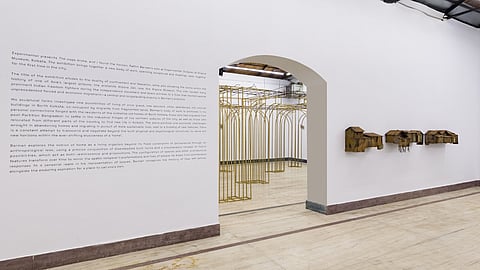
This is the world Rathin Barman has excavated in his ongoing exhibition, ‘The cage broke, and I found the horizon’, currently on view at the recently-opened Experimenter Outpost at the Alipore Museum — housed within the grounds of what was once one of Asia’s largest colonial detention centres. Formerly known as the Alipore Jail, the prison once held freedom fighters like Aurobindo Ghosh, Subhas Chandra Bose, Jawaharlal Nehru, C.R. Das, and countless others who dreamed of a free India, only for that freedom, when it finally arrived in 1947, to leave the country cut open and bleeding.
Barman’s sculptural works — made with cast concrete forms, mild steel sheets welded with reclaimed wood from demolished buildings — carry the texture of material memory. They embody the urban decay of these structures in limbo. Works like ‘Restructured Living Space I’ speak to structures now suspended in a state of perpetual decay — neither inhabited nor abandoned. The exhibition room, tellingly, functions as a cage in its own right: a physical manifestation of being locked inside memory and aspiration simultaneously, unable to fully break free from either.
On 9 April 2026, the exhibition formed the backdrop for a performance by seven dancers from the Continew Collective who responded directly to the stories embedded in Barman’s artworks — recreating some, imagining others, and giving bodies to the grief that language struggles to contain. As Paramita Saha, choreographer of the performance, noted in conversation, this is fundamentally a show about ambiguous loss: “The grief is there, the longing is there, but you don’t really know what the loss is.”
At its heart, this idea of ambiguous loss extends far beyond the phantom pain of Partition. Climate anxiety, political uncertainty, the erosion of any stable sense of rootedness — the exhibition implicates the precarious present in its archaeology of the past. The children who played through the night in those overcrowded north Kolkata rooms because there was no space to sleep remember it as fun. That ambiguous, dichotomous reframing is the register in which Barman’s practice exists.
The horizon that appears in the title of this exhibition is not a metaphor for optimism so much as a phenomenological condition — always ahead of us, always conditioning how we move, or what we move towards, but never quite reachable. The cage that broke was a country. The horizon Barman imagines in his works is, perhaps, the only home that displacement ultimately offers: a perpetual negotiation with arrival.
‘The cage broke, and I found the horizon’ is on view at the Experimenter Outpost at Alipore Museum, Kolkata, until June 14, 2026.
Follow @experimenterkol on Instagram.
