
- HOMEGROWN WORLD
- HGCREATORS
- HGEXPLORE
- HGVOICES
- HGSHOP
- CAREERS
- ABOUT US
- CONTACT US

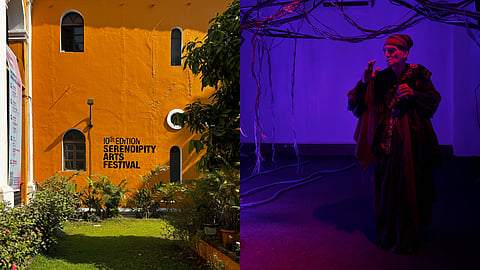
Arriving at the 10th Serendipity Arts Festival with a mental checklist felt inevitable and wrong. This article reflects on cultural overload, spectacle, and what large-scale arts festivals risk losing as they grow.
I arrived at the 10th edition of the Serendipity Arts Festival with a familiar, if slightly guilty impulse: a mental checklist. While the Festival took place across Panjim, Goa, over ten days from December 12 to 21, 2025, I was only going to be there for four days. There was simply so much to see and so little time. Like many visitors to large-scale arts festivals, I felt the pressure to see everything, to make the most of my time. It is an understandable impulse at a time when cultural experiences are increasingly framed through the fear of missing out — quantified by Instagram stories, snaps, and the impulse to be seen in the right places at the right time with the right people. Yet, if my time in Goa gave me clarity about anything, it was that this approach is fundamentally flawed and misconstrues what art festivals are truly capable of achieving.
A decade in, Serendipity’s achievement lies not just in its scale but in its continued effort to create a platform for artists and curators where attention, care, and curiosity can coexist with ambition. Even as the festival remains ephemeral, the questions it raises — about how we connect, look, listen, and remember — endure well beyond its duration.
Arts festivals like Serendipity are, by design, fleeting. This ephemerality is both their power and their pitfall. They risk disappearing into the oblivion of irrelevance as the urge to treat them as momentary spectacles rather than transformative intellectual experiences can be overwhelming. Since its inaugural edition in 2016, Serendipity has grown into a cultural juggernaut: spanning dozens of venues, parallel programming, simultaneous openings, and a city-wide scale that challenges you to keep up. The festival’s ambition is undeniable, but so is its central contradiction. In trying to be everything — archive, spectacle, platform, pedagogy — it risks reproducing the very conditions that has come to define Late Capitalism.
This tension is not unique to Serendipity. It is endemic to virtually all arts festivals today, which increasingly mirror the fallacy of Late Capitalism: of the tyranny of choice; of abundance and scarcity at the same time. The result is a familiar behavioural loop. Audiences are reduced to consumers. We come, we see, we post, we move on. Even the most well-intentioned among us — writers, artists, curators included — fall into the trap of treating these festivals as a checklist: must-see exhibitions, headline performances, the Caravaggio, the culinary programme, the art park, and the barge.
The curators of Serendipity’s milestone 10th edition seemed acutely aware of this risk. Many of its strongest exhibits actively resisted the allure of spectacle, legibility, and consumption.
The culinary programme was exceptionally strong this year. Projects such as Chef Prahlad Sukhtankar’s ‘Salt’ and Chef Thomas Zacharias and The Locavore’s ‘What Does Loss Taste Like?’ were conceptually rigorous, if at times to the point of cognitive dissonance. They demanded time, patience, and a willingness to sit with the absence of ingredients, of smells, of practices, of entire possible futures.
Exhibitions like ‘Displacement’, curated by Rahaab Allana, and ‘Not a Shore, Neither a Ship, but the Sea itself’, curated by Sahil Naik, foregrounded migration, exile, and the human cost of geopolitical violence. Its works asked viewers to slow down, to confront image-making as an ethical act, and to engage with the possibility of an internationalism that spans ancient maritime worlds, colonisation, and modernity, contributing to our complex geopolitical zeitgeist.
Curated by Mumbai-based writer and curator Veeranganakumari Solanki, ‘Barge’ built on three earlier SAF projects: Future Landing (speculative environments), Synaesthetic Notations (cross-sensory translation), and A Haptic Score (touch-based perception). Each project explored how the body receives and interprets sensory information, a line of inquiry that continued aboard a barge.Veeranganakumari Solanki’s floating sound-responsive installation, simply called the ‘Barge’, stood out as one of the most thoughtful curatorial gesture at the festival. It centred on absence, listening and imagination, demanding surrender from its audience — of certainty, interpretation and time. Despite this, its novelty was undeniable. Drawing from three previous Serendipity Arts Festival exhibitions — ‘Future Landing’, ‘Synaesthetic Notations’ and ‘A Haptic Score’ — the ‘Barge’ placed the audience at the forefront, encouraging participation and close encounters.
The much-publicised presentation of Caravaggio’s 'Magdalene in Ecstasy' crystallised the festival’s contradictions at its starkest. Displayed on its own in an otherwise blacked-out room in the Old Directorate of Accounts building, the Caravaggio was almost akin to a holy relic. On one hand, it was an extraordinary curatorial achievement and an extraordinary act of cultural access, placing a canonical work of Western art history in dialogue with contemporary practices and local audiences outside a traditional museum setting. On the other, its presence threatened to become a cultural trump card — the thing you had to see. Yet for those willing to spend time with it, the painting’s intensity offered a counterpoint to the surrounding frenzy, insisting on Caravaggio’s radical inwardness and the historical and spiritual complexity of Magdalene in Ecstasy.
Despite its tensions and contradictions, I believe Serendipity’s 10th edition stood out precisely because it exposed the fault lines of contemporary cultural production. Serendipity’s achievement lies less in seamless execution than in its sheer willingness to hold onto its ostensible contradictions. It is both generous and overwhelming; rigorous and occasionally diffuse. Its best moments are not always the most spectacular ones, but the encounters that continue to linger, forcing reflection days or weeks later.
The urge to treat the festival as a checklist is an understandable, even logical impulse. But this year, the Serendipity Arts Festival made me think about another mode of engagement: one that accepts partiality, values attention over coverage, and understands art as something that extends beyond the dates on a cultural calendar. Even if the festival is fleeting, the experiences it platforms do not have to be. As the festival enters the next decade in its life-cycle, Serendipity’s challenge is not simply to grow bigger, but to continue creating conditions where its depth can survive its scale — as it always has.
Follow @serendipityartsfestival and @serendipityartsfoundation on Instagram to learn more.
If you enjoyed reading this, here’s more from Homegrown:
A City In Conversation: Homegrown Guide To The 6th Kochi Muziris Biennale
The Absolut Blue Trail Brought A New Language Of Colour & Consciousness To Echoes Of Earth 2025
In ‘Of Land, River, And Body’, Ashfika Rahman Builds An Archive Against Erasure
