
- HOMEGROWN WORLD
- HGCREATORS
- HGEXPLORE
- HGVOICES
- HGSHOP
- CAREERS
- ABOUT US
- CONTACT US

Shashank Walia’s ‘Birds in the Dark’ explores caste, class, sexuality, and land politics in rural Punjab through interconnected stories of resistance and solidarity. Shot in black-and-white, the film’s visual language and meditative pacing highlight the struggles and resilience of marginalised communities, offering a poignant reflection on freedom and collective action.
A bounty hunter falls in love with the man he is charged to apprehend. A landless Dalit farmer leads a peasant movement to reclaim the land that rightfully belongs to her community. A pregnant woman attempts to die by suicide but finds solace in religion and solidarity within her community after she is assaulted. A Kashmiri man mistaken for a criminal struggles to find his way home. All these threads come together in ‘Hanere De Panchi’ (Birds in the Dark) — a social drama written, directed, and shot in splendid black-and-white by Shashank Walia.
Set in the forests and farmlands of rural Punjab, the Walia’s slow, meditative debut feature lingers in the interstices. An ambitious examination of caste, class, sexuality, and the politics of land ownership in India’s agrarian societies, Birds in the Dark is an attempt to understand what it means to be free when the structures that govern one’s life are so deeply entrenched that even the possibility of imagining another way of life becomes an act of resistance.
The story takes place along three axes, each examining one aspect of life in Punjab, and eventually converges like rivers. The film opens with Jagtar (Harwinder Singh Aujla), a police informer-slash-bounty hunter, taking Amir (Shahnawaz Bhat), a Kashmiri Muslim man, into custody. As the two travel through forests and mountains, their relationship gradually moves beyond the boundaries of captor and captive. When Jagtar eventually returns to his village, he must confront the deeply entrenched caste system, economic precarity, and a complicated relationship with Raman (Navdeep Bajwa), a former lover from a landowning family.
Running parallel to Jagtar’s story are the intertwined storylines of Dilraj (Mauli Singh) and Rinku (Sapna Das), two Dalit farmhands. While Dilraj is struggling to organise landless workers to reclaim control over the village’s common land, Rinku is struggling to come to terms with the trauma of a hinted-at sexual assault. Walia argues that these seemingly disparate experiences of marginalisation are connected by the unequal distribution of power, and that working-class solidarity is the only way out.
Over the film’s almost two-and-a-half-hour runtime, he makes his case, drawing on the real-world history of Dalit communities in Punjab organising to reclaim their share of village common land, lending its political concerns a specificity often missing from cinematic treatments of caste. The film finds considerable force in its final act, when Dilraj’s efforts begin to take shape as a collective movement. Her determination to challenge the caste and power hierarchy of landownership becomes a statement about the possibilities of political solidarity. Here, Walia goes beyond the identitarian idea that solidarity requires people to share identical experiences of oppression. He argues that solidarity emerges from recognising the connections and similarities between their struggles.
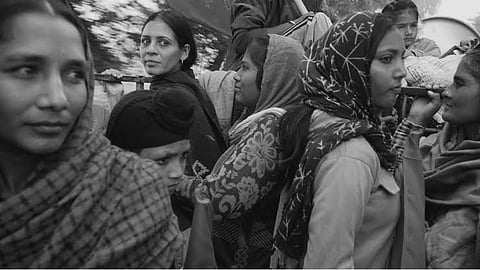
Walia’s background as a cinematographer is evident in the film’s visual language. Shot entirely in black and white, Birds in the Dark reveals itself through carefully composed frames, lingering wide shots of Punjab’s breathtaking landscape, and an understated soundscape that binds everything together. The monochromatic imagery lends the film a certain timelessness while drawing attention to the details of working-class life: the routine of agricultural labour, the intimacy of shared domestic spaces, and the vastness of pastoral Punjab. At its best, this visual restraint lets moments of tenderness and resistance take on extraordinary emotional weight.
Sometimes, however, the film’s deliberately slow pacing and elliptical storytelling choices make its various strands bleed into one another and muddy the water. But Walia appears less inclined to offer easy answers than to ask what freedom might finally look like for people who have been historically kept unfree. While the film occasionally falters under the weight of its narrative ambitions, Walia’s insistence on bringing queer desire, caste emancipation, and the struggle for landownership in pastoral Punjab into the same frame adds to a growing canon of smaller independent and regional films that are both politically urgent and cinematically refreshing.
‘Birds in the Dark’ was awarded the Songwon Vision Audience Award at the 2026 Busan International Film Festival and premiered in India at the 2026 Dharamshala International Film Festival. Follow @birdsinthedark on Instagram to learn more.