
- HOMEGROWN WORLD
- HGCREATORS
- HGEXPLORE
- HGVOICES
- HGSHOP
- CAREERS
- ABOUT US
- CONTACT US
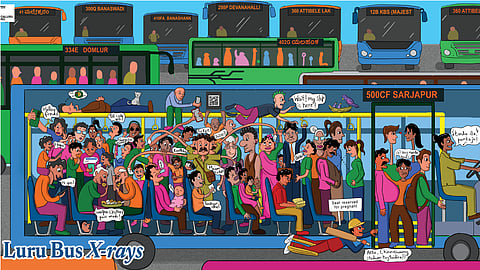
Created for Greenpeace India's Imaginarium Exhibition, Shubhang Ojha's 'Luru Bus X-Rays' transforms Bengaluru's BMTC buses into a vibrant portrait of the city itself. Inspired by conversations with Bangalore Bus Reads and residents across the city, the artwork captures the humour, chaos, diversity, and community found on everyday bus journeys while advocating for stronger investment in public transport and people-centred urban planning.
If you truly want to know a city, use its public transport. You'll come across people of every colour that make up the rainbow a city represents. To encapsulate the vibrant city of Bengaluru, artist Shubhang Ojha created Luru Bus X-Rays — a peek inside the very backbone of the city's transport system: the BMTC bus. Used by nearly 5 million people every day, Bengaluru's bus system connects the sprawling city, enabling people to move from one corner to the other.
The piece was made for Greenpeace India's Imaginarium Exhibition, held under the Greenpeace Bangalore Rising campaign. Greenpeace, an organisation that works to confront environmental problems and develop solutions, spoke to Bengaluru residents across the city's various localities about their most cherished memories of the city, a response to its massive concretisation. To showcase these imaginations and memories, Greenpeace put together the Imaginarium Exhibition, highlighting what people actually wanted and missed, and how different this was from what policymakers typically consider while planning infrastructure. Luru Bus X-Rays was part of this exhibition.
The piece grew out of Ojha's experience at one of the theatre-based workshops held as part of the Greenpeace Rising campaign. These workshops, called Imaginariums, were run in collaboration with Bangalore Bus Reads, an initiative started by Sahana Srikanth in which the group meets every other weekend to take a bus ride and read a book, before regrouping at a park to discuss what they've read. While putting together the artwork for the exhibition, Ojha spoke with Sahana about capturing the joy and importance of Bengaluru's bus ecosystem and his experience riding one — a conversation that ultimately led to Luru Bus X-Rays.
After deliberating over the structure of the piece, they chose to show a horizontal view of the bus, almost like a cross-section into the organ that is the BMTC bus. Every corner and character of the bus feels like someone you've seen in passing on a bus ride — from a conductor singing "Pankaja" (the eternal Kannada banger) to people packed in the back of the bus like sardines, gasping for air. And of course, there's the conductor, the kingpin of any Bengaluru bus: a man who somehow manages to make sure that everybody on that bus has paid for their ticket. "And I guess the larger idea is to try to imply that what you're seeing here is the reality of every single bus across the city. And all these buses are such lively places,' says Ojha.
The illustration points to the importance of civic government bodies putting money into public transport and infrastructure that will make a city healthier and easier to navigate — instead of funnelling money into projects like the tunnel road, which will cut through Lalbagh Botanical Garden, one of the city's most vital green lungs. The "car-centric" mindset so evident in the way our municipalities allocate funds can be seen even in this project. And Luru Bus X-Rays tries to highlight how a focus on bettering our public transport could mean fewer people taking out their cars. As Ojha puts it: "The bus, and even the metro life, is so rich and so fun, and they've become such an integral part of day-to-day life. Why not just work on improving them and expanding them? Because so many people already use that, and they are so central to the city's day-to-day functioning."
Follow Ojha and Greenpeace India on Instagram.
If you enjoyed reading this, here's more from Homegrown:
Beyond The Mat: 'Grip, Hold, Pin' Reframes Wrestling As An Art Form
Abhishek Chaudhary's Movie Posters Feel Like Inside Jokes For Cinephiles
How Radhika Chitalia Transformed Her Late Father’s Passport Into A Work Of Art
