
- HOMEGROWN WORLD
- HGCREATORS
- HGEXPLORE
- HGVOICES
- HGSHOP
- CAREERS
- ABOUT US
- CONTACT US
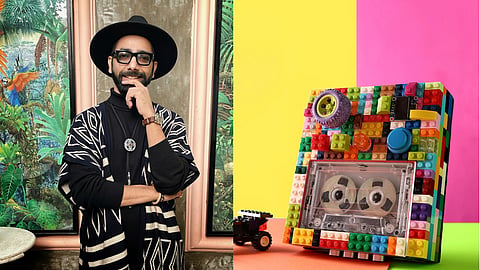
DJ, maker, and creative technologist Navendu has built a career at the intersection of music, engineering, and curiosity. Beginning with a homemade MIDI controller housed in a Domino's pizza box, his work has evolved into a collection of custom-built instruments inspired by childhood nostalgia, retro gaming, cassette culture, and industrial design. From Skittles-themed controllers and Game Boy-inspired devices to a DJ system designed for visually impaired musicians, Navendu's creations prioritize joy, accessibility, and human connection.
Most DJs spend their careers learning how to master the equipment placed in front of them. Navendu Malik looked at the same equipment and wondered if he could build something better. That instinct: to open things up, understand how they work, and reimagine them entirely, has shaped nearly every aspect of his creative life. Long before audiences knew him for controllers disguised as pizza boxes, Game Boys, suitcases, or even Skittles-inspired candy machines, he was simply a curious kid fascinated by the mechanics hidden beneath everyday objects.
“I've always wanted to know what was going on inside,” he says. Whether it was a gadget, a camera, or a music device, his first instinct was never just to use it, but to understand it.

Growing up in Delhi, Navendu was surrounded by influences that quietly pulled him toward both technology and music. His father, an engineer with a habit of repairing things around the house, exposed him to electronics and mechanics. His maternal uncle ran a video-editing studio in an era before digital workflows became commonplace. Meanwhile, a family home filled with cassettes, cameras, and computers introduced him to photography, video editing, and audio production almost simultaneously.
When he began DJing in the mid-2000s, he was entirely self-taught. What started as experimentation with audio-editing software during the gap between his Class 10 examinations and results quickly evolved into a serious pursuit. By 2007, he was playing paid gigs. Back then, DJing was still heavily dependent on CDs. DJs carried hundreds of discs to performances, painstakingly organising music collections for every possible crowd. When laptop-based DJing arrived, it simplified the logistics but introduced another problem: the interaction felt disconnected. “For me, pressing buttons on a laptop wasn't DJing,” he says.
Looking for a solution, he discovered MIDI controllers, customisable devices that allow DJs to control software through physical buttons and shortcuts. The problem was cost. The controller he wanted was priced far beyond what he could justify asking his parents to buy. So he did what would then become a recurring pattern throughout his career: he built his own.
After researching how commercial controllers worked, Navendu realised they relied on surprisingly simple electronics. Using the circuitry from a wired gaming controller, a free HID-to-MIDI conversion program, and a handful of arcade-style buttons, he assembled his first controller. The housing came from an unlikely source: a Domino's pizza box. This improvisation worked and more importantly, other people loved it. At gigs, audiences were fascinated by the colourful cardboard contraption sitting beside the mixer.
Navendu believes that technology doesn't have to look intimidating to work. Many music devices, he believes, are designed with an almost industrial seriousness. Black surfaces, grey buttons, and technical interfaces often create distance between audiences and the creative process. His now-famous Skittles controller emerged from that thinking.
Originally conceived while he was recovering from a serious accident that left him on bed rest for months, the controller was designed to bridge DJ software, live performance tools, and hardware instruments in a single device. Early prototypes looked, in his words, like "Soviet missile-launch systems". Then he stumbled across brightly coloured buttons that resembled candy. The solution was immediate. Instead of creating something intimidating, he leaned fully into nostalgia and playfulness. The result looked less like professional music equipment and more like a toy chest brought to life. “I wanted it to bring out the child in people,” he explains.
That idea, that artists remain artists because they preserve a sense of childhood curiosity, runs through much of his work. Controllers inspired by Game Boys, Mario, Pokémon, and vintage suitcases all reflect a belief that technology should spark delight before it demonstrates capability.
Navendu spends countless hours designing circuitry, programming microcontrollers, soldering components, and teaching himself software such as Blender and Fusion 360. One controller, built inside a vintage VIP suitcase during lockdown, contains over 5,000 solder points and took months of disciplined daily work.
Among his most ambitious ongoing projects is a DJ controller and software ecosystem designed specifically for visually impaired musicians. The concept replaces visual interfaces with tactile navigation, Braille labels, haptic feedback, and refreshable Braille displays that communicate information usually conveyed through screens. The project requires him to rethink design from an entirely different perspective. “I literally had to think like a person who cannot see,” he says. Navendu wants visually impaired users to navigate playlists, effects, loops, and timing information without relying on sighted assistance.
Alongside that project, he's developing controllers inspired by everything from nuclear reactor control panels to cassette culture. One ongoing performance project, titled 'Past Perfect', revolves around mixing music using cassette tapes. The process is painstaking where every tape must be calibrated individually, accounting for differences in magnetic sensitivity and recording characteristics. Yet that's precisely what interests him.
For Navendu, every project begins with these questions:
How does this work?
Can it work differently?
Can it make someone smile?
Those questions have led him from radio remixes and nightclub booths to pizza-box controllers, nostalgic gaming consoles, accessibility-focused instruments, and experimental hardware that seems to exist somewhere between engineering, design, and art. And while each invention looks radically different from the last, they're all connected by the same belief: technology is at its most powerful when it feels human. In Navendu's world, innovation doesn't always have to be bout making machines more complicated, it can also be about making them more joyful.
Follow Navendu Malik on Instagram here.
If you enjoyed this, here's more from Homegrown:
Janisht Joshi’s Builds A Visual World Across Five Music Videos For His EP 'Talkhiyaan'
'Housewives' Is Shaping A Future That Centres Women Across South Asian Electronic Music
We Spoke To 4 Homegrown Artists About The Resurgence Of 'DAWless' Electronic Music
