
- HOMEGROWN WORLD
- HGCREATORS
- HGEXPLORE
- HGVOICES
- HGSHOP
- CAREERS
- ABOUT US
- CONTACT US
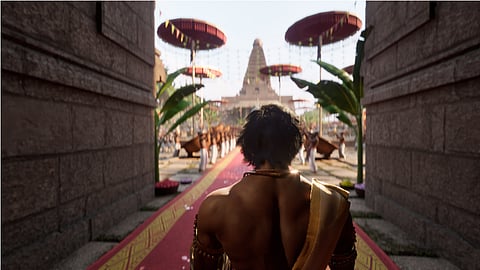
The article examines 'Son of Thanjai, Ayelet Studio’s action-adventure game set in 11th-century South India, which centres King Rajendra Chola and the cultural, architectural, and maritime legacy of the Chola dynasty. This piece reflects on how video games function as powerful modes of storytelling and why representation within them matters.
When I was younger, I wasn’t really allowed to play video games. My parents didn’t see them as “educational” enough and more as a mode of distraction than anything else. And honestly, it wasn’t something I ever felt strongly enough about to rebel against.
Years later, though, I read a book called 'Tomorrow, and Tomorrow, and Tomorrow', by Gabrielle Zevin, a novel about two best friends making video games together. That book made me introspect and realise the importance play had in my life: the joy of being able to share space with your peers and be so fully immersed in an imaginative world. For me, that world existed through playing make-believe at home; for so many others, it was through games like Assassin’s Creed.
Video games are modes of storytelling, which is why representation within them matters. There is something incredibly powerful about being able to play through avatars you relate to and resonate with, whose histories you share, and whose language and voice do not feel alien.

Which is why Ayelet Studio’s action-adventure video game, set in 11th-century South India, stands apart. The game places King Rajendra Chola, the first Indian king to lead overseas military expeditions, as its protagonist. He wields a Surulvaal, a whip-like sword used in the South Indian martial art of Kalarippayattu. The game paints the world of the Cholas, drawing from their distinctive Dravidian architectural styles, sprawling temple cities, and maritime power. Ruling over vast regions of South India and Sri Lanka, the Chola dynasty presided over what is often regarded as a ‘Golden Age’ of Tamil art and culture, an era the game seeks to bring to life not merely as history, but as an immersive, playable world.
This kind of representation matters precisely because South India has so often been flattened, distorted, or exoticised in mainstream popular culture, particularly in Bollywood, where the region is frequently reduced to caricature or an aesthetic. Like the movie, Param Sundari, reduces South Indians to visual punchlines, as though everyday life here involves casually climbing coconut trees between conversations. (We don’t.)
It is expanding what we allow games to be and whose histories we consider worthy of play, challenging the long-held idea that epic storytelling must borrow from familiar Western mythologies or flatten complex cultures into easily digestible tropes. Instead, Son of Thanjai treats history as something to be inhabited inviting players into this world of the Cholas. The game makes the case that play can be both imaginative and rooted, entertaining and rigorous, and that when storytelling is handled with care, it has the power to reshape how we see the past, and ourselves within it.
'Son of Thanjai' is scheduled to be released sometime this year. Watch the teaser for the game here.
If you enjoyed reading this, here's more from Homegrown:
'Silkgrove': An Indian Solarpunk Video Game That Places Restoration At The Centre Of Play
Mukti: A Pathbreaking Indian Video Game Exploring The Grim Reality Of Human Trafficking
The Questionable, Bizzare, & Interesting Ways Popular Video Games Have Portrayed India
