
The Photographer Who Refused To Conform: In Conversation With Pranoy Sarkar

A Delhi-based photographer and creative director Pranoy Sarkar reflects on two decades of image-making, where story precedes sketch and AI is used only as a communicative tool. He rejects a fixed signature style, instead favouring minimalism, symmetry and what he calls “whimsical reality”, while insisting on physical builds, film photography and Indian craft traditions to keep his work rooted in the real.
Pranoy Sarkar has spent nearly two decades building images from scratch. The Delhi-based photographer and creative director, who studied Communication Design at the National Institute of Fashion Technology (NIFT), began as a travel photographer in the mid-2000s before restlessness pushed him toward fashion and editorial projects. Since then, he has shot campaigns for Rajesh Pratap Singh, Diet Paratha, Cord, Rawmango, Gaurav Gupta, Obeetee, AMPM, Payal Khandwala, among leading Indian designers and brands while also directing documentary and art projects rooted in India’s landscapes and craft traditions. In conversation with Homegrown earlier this week, Sarkar spoke about how generative AI has entered his process without changing what he makes and why he makes images, why he thinks photography and AI will exist in parallel, and why he has spent years resisting the idea of a signature visual style.
You’ve spoken before about how much you sketch while conceptualising a campaign. Is that still central to your process? How has generative AI changed which tools you use to visualise now?
Sketching isn’t where I start anymore. The first step is always the story. Once I know which elements I want to bring together and how they should unfold, I move to sketching, mostly to understand it myself or to explain the idea to a client. My sketches are rough pencil drawings, nothing polished, and I usually need to annotate them afterwards because I forget what each element means. I’ll point to a painting from a book, describe a scene I can’t find a reference for, and build the idea piece by piece until it comes together as a single frame people can imagine.
I was never enthusiastic about generative AI. But recently I ran into a concept so complicated that no reference existed, which made it hard to brief the art team that eventually built the polished 3D visualisations. So I started generating small fragments myself. They weren’t accurate, maybe fifty or sixty per cent close to what I meant, but when you’re starting from zero reference, that’s a significant jump. It helped me communicate an idea. That’s the extent of what it does for me.
Photographers seem split between treating AI as a new creative tool and seeing it as a threat. Where do you stand on this?
I don’t dismiss the medium, because I don’t think it exists to replace photography. It does something of its own and can communicate certain ideas faster than other methods can. I once spent an entire day with a painter, describing a concept until he had produced something close to what I wanted. With AI, a similar result now takes half an hour. That’s the only real difference. It hasn’t changed what I end up making or interfered with my thinking.
The actual risk is when people start using these platforms to think for them, rather than to execute an idea they already have. These tools work from existing data and existing references, so if your thinking happens inside them, you’re really just recombining what already exists. That stops you from producing anything genuinely your own, and that’s a real problem.
Early photography went through a Pictorialist phase, when photographers leaned into painterly manipulation partly in response to the documentary nature of the medium. As AI-generated images become more realistic, do you think photographers will lean toward more surreal or pictorial approaches?
I can only speak for myself. I used to make composite pieces, part photography, part painting, part mixed media, under a series I called ‘artworks’. Each image involved shooting every element separately and then painting over and collaging them. Once AI tools reached a point where anyone with a prompt could approximate that effect, I stepped away from that kind of work entirely, even when brands approached me for it.
Instead, I pushed further into the real. If you look at the campaigns I make now, everything is built physically and shot on film, with no collage or overpainting, because that territory already belongs to a medium built for it. A photograph is meant to be an impression of an actual moment in front of the lens, and I’d rather use the camera to stay loyal to that.
The whimsical or surreal quality people notice in my work isn’t a reaction to AI. It’s simply how I’ve always told stories; other photographers lean toward stark realism, or fantasy, or something else entirely, based on their own sensibility. As for where AI goes from here, I think of what happened when photography first unsettled painters, who saw it as a shortcut to what they laboured over. The two mediums eventually found separate purposes and now exist side by side. I expect the same with AI: it will do things photography cannot, and vice versa, and photography will hold its ground because it documents reality, and because craftsmanship still carries a value nothing mechanical can replace. Think of a handwoven saree beside a machine-loomed one that looks almost identical; one becomes an heirloom, the other doesn’t. That distinction, especially in a country that values craft as deeply as India does, won’t disappear.
On a project like ‘Antar Anga’, where you are both photographer and art director, how do you think about authorship?
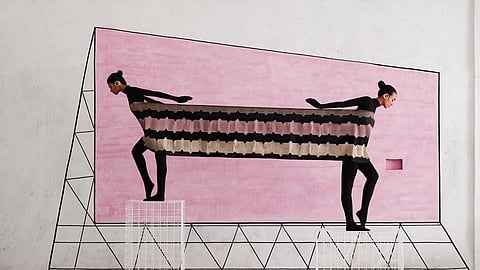
‘Antar Anga’, made around the Kanjivaram weave, was the last project where I held both roles; since then I’ve worked alongside a dedicated art director, which has freed me up considerably to take up creative direction. But authorship has never been confusing for me. I direct on set and build the story either independently or with the brand, depending on what they bring to the table. With Antar Anga, the story was entirely mine.
This works because the people I choose to collaborate with are passionate and respectful of the process. They see presentations, understand the direction, and then step back. Many clients don’t even attend the shoot; I met the client for ‘Antar Anga’ in person four years after our first campaign together. I think of these collaborations as partnerships rather than transactions, where the brand becomes invested in making something worthwhile alongside me.
You’ve said you don’t have a distinct visual style, since your work shifts with each concept. How do you think about what makes an image identifiably yours?
This took me years to come to terms with. Photographers are traditionally considered established once their work becomes instantly recognisable. But I get bored quickly, and I never wanted to chase a signature look just to be identified by it. What keeps me interested is variety, taking on projects that push me to think differently each time.
It took a while to realise that a few foundational instincts remain constant even across very different bodies of work, and that’s ultimately what makes an image mine. I gravitate toward minimalism, symmetry, and a quality I’d call whimsical reality, a contradiction where the fantastical and the real occupy the same frame. I’m drawn to darker, moodier images over lighter ones. And I try to root every story in something Indian, since that’s the landscape I understand best.
Your projects range wildly in scale, from a 56-hour shoot for Torani to the six-month Navarasas series. How does your process shift across these vastly different timelines?
I work across two very different kinds of projects. Brand campaigns and editorials are large, tightly scheduled productions, shot in a single day with sizeable teams, heavy pre-production and comparatively lighter post-production since most of it is shot on film. Then there are book-length documentary projects, done with small teams over repeated short trips that add up to six or eight months.
My recent documentary work, following Anavila’s (Anavila Misra) return to the places and people that shaped her life across Uttar Pradesh and Delhi, falls into that second category, as does a longer-term book I’m developing about Goa’s changing coastal landscape and its relationship with salt. Working across such different timelines at once keeps me from losing interest in any one of them.
You credit designer Rajesh Pratap Singh as an early mentor. As more young image-makers build careers solo through social media, do you think established photographers owe them mentorship?
I think people should follow whatever path suits them, even if convention expects something more structured. I was repeatedly told to assist someone for years before starting on my own, and I didn’t, because I wanted to figure things out my own way; I even avoided technical photography books for the same reason. I don’t believe today’s younger photographers need a prescribed route either. Plenty of talented people are already finding their own way without it.
That said, guidance matters at certain points. I came from a family with no connection to design or fashion, so when I needed help forming and articulating ideas, Rajesh’s mentorship, alongside technical guidance from another mentor, Prabuddha (Dasgupta), shaped how I think and communicate a concept. Whether someone needs that kind of support is entirely individual, and there’s no shortage of strong work coming from people who’ve chosen not to seek it out.
You once spoke of wanting to create a long-form photographic odyssey across India. Are you still actively working on that project?
It’s become more relevant, if anything. My early travel photography felt limiting because I was documenting what already existed rather than building something. That dissatisfaction pushed me toward fashion, where I could construct an image from nothing. Over time, though, I found myself returning to India’s cultural and regional diversity through the very mediums I’d moved into, whether through fashion, documentary work, or art commissions. I don’t think I ever really left that interest behind; I’ve just been approaching it through different forms. Eventually, I expect it all to converge into a single body of work.
Follow @pranoysarkar on Instagram.
If you enjoyed reading this, here’s more from Homegrown:
“Every Photographer Is A Predator”: Soham Gupta On Photography, Power, & ‘Desi Boys’
Sutirtha Chatterjee’s ‘A New World’: Will We Ever Stop Stealing From Our Own People?
Support A Chennai Collective Empowering A Generation Of Marginalised Photojournalists
