
- HOMEGROWN WORLD
- HGCREATORS
- HGEXPLORE
- HGVOICES
- HGSHOP
- CAREERS
- ABOUT US
- CONTACT US

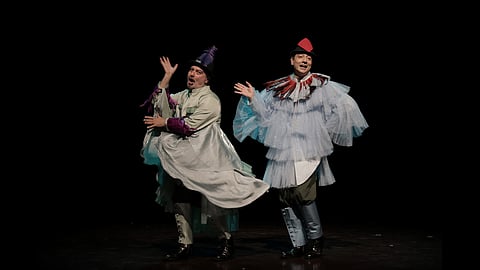
In this conversation, Rajat Kapoor and the cast describe ‘The Thing With Feathers’ as a devised, ensemble-driven production in which the narrative takes a back seat to mood, ideas, and discovery. Developed during rehearsals, the play spans the first half of the 20th century, using improvisation and shared authorship to craft a theatrical experience rooted in emotional truth.
“The story doesn’t matter,” Rajat Kapoor answers bluntly when I ask him about his new play, ‘The Thing With Feathers’. It’s a Monday afternoon, and I am on a Zoom call with Kapoor and the cast members ahead of the encore stagings of the play in Mumbai and New Delhi. He’s somewhere in Europe. The actors are scattered across India. I’m based in Kolkata. I haven’t watched the play yet, and the script is strictly confidential. What could go wrong?
The answer is everything. Everything could go wrong.
Fortunately, nothing does. Kapoor and the actors—Vinay Pathak, Mantra Mugdh, Vidushi Chaddha, and Bhavya Rampal—spend the first few minutes of the call catching up. I feel like a fly on the wall, as if I am eavesdropping on a conversation I shouldn’t be a part of. But as soon as the interview starts, the circle opens, and I’m invited in.
“I’ll tell you how we started,” Kapoor says. “The idea was to do a play about the beginning of the 20th century — that was the original germ, and we developed from there. A narrative kind of emerged, but I don’t think the story matters here. Of course, when you watch the play, it keeps you involved and engaged, and in that sense it’s important — but not for our purpose. It’s more a theatrical vision of something, and we don’t even know what that something is. A play is more like an idea than a story — an idea or a feeling. That’s what’s interesting here.”
His answer makes me curious. “How do you approach making something like that as a writer and director?”
“The writing really happened during rehearsals, with all the actors involved,” Kapoor answers. “We had an idea, and with Chandrachoor and Rabia, the writers, we did some basic work. But it wasn’t the plot; it was more like making a map. Then you share the map with the actors, who are also writers on this piece, and you start developing it. How did it happen? I don’t know. It’s really an organic thing; it almost happened on its own. You arrive at something. Rather than starting with an idea and getting there, it’s more like arriving at something, like finding something on the road while taking a walk.”
Set over the first half of the 20th century, from 1900 to 1950, the play follows ordinary individuals across India and Europe who lived through this tumultuous period in world history. With such a vast timeline and an ensemble cast, was it a challenging production? I ask.
“I’ll let the actors talk,” Kapoor answers. “Go, guys!”
Vidushi and Bhavya, the younger cast members, follow his direction as if it’s second nature. Maybe it is, after two and a half months of working together.
“I had a lot of fun with the cast,” Vidushi says. “It was a very creative room. We were just the right amount of people with the right amount of eccentricity, each with our own quirks and experiences. Very different from each other, like all actors are, but we almost fit together perfectly. It felt like we created this big baby, this piece, together, with all our uniqueness.”
“So I never felt it was a large cast or overwhelming. I always felt it was cool that everyone brought their own uniqueness, because a lot of the work was improvised. Whatever Rajat would throw at us, whatever Rabia had thought of, or CC (Chandrachoor Rai), who’s also the co-writer, would come up with, we’d keep playing with those prompts. We often wouldn’t even know what we were doing, but we went with it day after day, and we learned from each other.”
“The ensemble-building in this play was one of my favourite parts. Sometimes the ensemble comes together and, like Rajat said, explores an idea we’re still trying to find as we grapple with it — and something interesting, something magical, happens. Little sparks were flying, and we’d grab hold of them and try to create something,” she says.
“For a devised play like this, which is built mostly on the floor, I think the obstacles mostly lie with the director,” Bhavya adds. “You’re inside it, exploring anything and everything — technically, there are characters assigned to actors. Still, in improv we do each other’s characters too, so we generate a lot of material daily. Obstacle-wise, I can’t think of anything from the inside. I think it mostly lies with the outside eye. The obstacles are his: what to keep or not keep, what to let go.”
“In a way, he’s right,” Kapoor says. “A lot of it is editing. So much material is generated every day, and the big decision is what to keep. Everything is good, but what truly becomes part of this play is the real question.”
The stage is the oldest arena of acting, and perhaps the purest expression of the craft, going back to Ancient Greece in the 6th century BCE. A lot has changed since then, and classical theatre has gone through cycles of rise and fall in popularity. After decades of dwindling public interest, the medium is currently experiencing a post-pandemic surge in popularity. What is it about the stage that continues to attract young actors and audiences alike, even after all this time?
“Bhavya is the youngest, so I think he should answer this,” Pathak says.
“I haven’t done much screen work, so a stage like this is everything to me,” Bhavya answers. “Specifically in the context of this production, it’s extremely democratising. If I’m improvising a scene with, say, Vinay sir, and I compare my years of experience to his, it’s the polar opposite. That possibility itself is exciting. If I share an idea, he’ll take it and run with it. Once you’re on the stage, on the floor, it democratises everything — all the notions fall away. It’s about what you’re doing there, then, in that moment. That’s what’s appealing to me.”
“Did you get a specific note or piece of advice from Mr Kapoor or Mr Pathak that changed how you think about acting?” I ask.
“Louder! Louder!” Kapoor responds.
Perfect timing. It makes all of us laugh out loud.
“Of course, lots of them,” Bhavya answers when the laughter subsides. “Off the top of my head: it’s been a challenge performing for a large audience. One foundational thing in theatre is that whatever you’re creating in a scene, you have to share it with the audience, because they’ve come to see you. That’s been a challenge for me. So Rajat sir would keep pushing me: share it; don’t just make it bigger, make it bigger and share it with us. Show us what you’re feeling, what you’re saying. It’s for us, not just for you.”
I turn towards Kapoor and Pathak for my next question. They have worked together before, and between them, the two have decades of experience across film and stage. A through-line runs through both their careers: they keep returning to the lives of ordinary people and the beauty of ordinariness in projects such as Dasvidaniya (2008) and Ankhon Dekhi (2013). That extends to this play too, set across decades when a lot of history happened, and the world changed. “What keeps drawing you back to these kinds of characters and stories?” I ask.
“I don’t think we’re drawn towards any particular kind of character or story,” Pathak answers. “I think we’re drawn solely towards the idea of storytelling. In this context, it’s stage, it’s theatre, and however we find a way to make it work, to make sense. In doing that, we also have to entertain, to engage with whoever is watching. From a performance point of view, as an actor, I feel it’s the adrenaline of theatre that’s very addictive — the more you do it, the more you realise everything else is secondary. People do say the adulation of an audience clapping for you, live, is very gratifying, yes. Still, I think it’s the adrenaline of the curtain call, especially, that immediacy: finally, it’s over, we don’t have to worry about making an entry again.”
“On the whole, theatre for me is the adrenaline of creating something in the moment and engaging the person you’re telling the story to. It’s theatrics that could be brand new on a given night — immediate, filled with adrenaline, with scope to improvise at the last moment. It doesn’t matter that you’ve memorised that line for eighteen nights. On the nineteenth, something magical could happen in the exchange with the audience, in that space, that time, that light, that music. Lots of times you’re not thinking; you’re just in the moment, doing it. I don’t find that anywhere else. Even working in cinema — that’s a different medium, more the vision of a director, a writer, an editor. But theatre has something so pure that’s been there since it started, and it still baffles me after 35 years of doing it. I still find something new at the end of the day.”
“Are there fundamentally different ways of approaching a character or a story when you’re working on a film set as opposed to a stage?” I ask.
“There are a million ways,” Pathak answers. “How would you write about an interview you did with five of us today? You’d start with a beginning, middle, and end, or someone else would do it differently. I don’t think it’s about that. For me, theatre is about how truthfully and honestly you can be in the moment, and reach the person you’re telling the story to. I don’t know if it’s a technique—there are so many different techniques; we’ve beaten our heads about Stanislavski and Artaud and Brecht and dance drama endlessly. But at the end of the day, it’s about knowing what you have to do in terms of the verb, and being truthful to the execution of that verb. Doesn’t matter what you’re doing — playing a sitar, playing a flute, doing a monologue, or four of you doing a scene together. Being truthful to your task is what’s attractive on stage.”
As our time comes to an end, I ask all of them about what it means to be an actor today. With the proliferation of social media and short form “content”, an actor’s personal brand and visibility are now seemingly built around screen work and social media presence. In recent years, production houses have reportedly been going for actors with large social media followings as an indicator of how many people they can draw to the stage or the cinema. “How do you feel about the increasing importance of social media presence and branding as actors, and how do you reconcile that with the resurgence classical theatre is experiencing right now?”
“This has plagued me for maybe seven years,” Vidushi answers. “What to do? Should I be more active on Instagram? If I start doing sketches of a particular character, will I get typecast? Will I be seen as an influencer rather than a serious actor? I’ve realised it makes a difference, and it doesn’t — it really depends on the individual. I know people with a modest Instagram presence doing great work, and people who’ve propelled their careers through social media. For me, at this point, I decided just to be authentic to myself. I don’t take up much space in that category, but I do notice and like people who are being authentic to themselves, whatever that means to them. I’ve stopped making it such a big deal in my head. I love the stage more than anything in the world, and that’s always going to be my priority. Everything else is a little appetiser that comes with the main course. Sometimes you get an Instagram brand deal, and that’s dessert. I’ve stopped letting my identity as an artist depend on my following, and I think that’s actually very liberating; it’s helped me embrace it more.”
“It’s true that, at this point, your social media presence and following do dictate a bit about the kind of work you get,” Mantra says. “But there are two people on this panel right now — Rajat sir doesn’t have much of a social media presence, but I was watching ‘RK/RKAY’ clips just two days ago on social media, and I loved it, because I love that film. People will appreciate good work whether or not the person who made it is on social media. In earlier times, people went to parties to be seen because, if you didn’t show up, how would people see you? Nowadays, the party has moved online.
“But that doesn’t mean influencers aren’t good actors. One of the biggest examples in the last decade of someone moving from influencer to mainstream actor is Prajakta Koli. She’s a good actor, and I’ve been happy whenever I’ve seen her work on screen or on stage. That’s a strong transition from social media to the mainstream.”
“On the second part,” he adds, “more people are coming out to watch theatre. A few days back, I was on a podcast with my friend Namit Das, who said that, as people get fed up with AI and digital content, theatre will see more of a resurgence. So much is happening digitally that, after a while, people will crave live performances. A lot of people are coming to theatres because they need to see something beyond — you don’t even know what’s real and what isn’t anymore in what you’re watching.”
“As for me, I do more theatre because I watch more theatre. I’m a viewer first, then a performer. I enjoy watching live theatre more than cinema. No wonder I’m not doing as much of the latter.”
“I’ll add my two cents,” Pathak says. “I think too much has been made of this social media and influencer debate. Before social media, there was the “page three” appearance; if you appeared on page three, people said things. It’s just conspiracy theories, really; gossip magazines sell the most, and for the right reasons, that’s proven. But does that mean that if you don’t have a social media presence, you don’t count? There’s another side to it too. As Mantra said, he was surprised that Prajakta Koli was a good actor. There are many good actors out there; we like to label things. In my own career, I started in Bombay as a VJ. Before that, I did theatre nobody knew about, and it was very difficult to land a job. In those days you had to go and audition, and that’s how you booked a job. So I don’t think it matters. I think it’s just a debate, a lovely one to have. Sometimes you do feel a bit hard done by — “I didn’t get that role because someone else has more of a social media presence” — but I don’t think there’s much water in that argument. So many people want the job; if you don’t get it, sometimes it’s simply because your work wasn’t good enough. I don’t think this debate has much substance, and that’s my opinion.”
Rajat Kapoor’s ‘The Thing With Feathers’ will stage at the Jamshed Bhabha Theatre, NCPA, Mumbai, on September 12 and 13, and the OP Jindal Auditorium, Delhi, on September 26 and 27. Tickets are available on BookMyShow.
If you enjoyed reading this, here’s more from Homegrown:
‘Drunk Bollywood’ Turns Bollywood Nostalgia Into Boozy & Chaotic Live Theatre Magic
Pooja Sivaraman Talks Dramaturgy, Diaspora, & Theatre Making At The Edges Of Culture
Jaan Theatre’s ‘Unshared Childhoods’ Is An Immersive Theatrical Experiment In Empathy
