
- HOMEGROWN WORLD
- HGCREATORS
- HGEXPLORE
- HGVOICES
- HGSHOP
- CAREERS
- ABOUT US
- CONTACT US

Poila Baishakh is always a reason for celebration in Bengal. It is the beginning of the Bengali New Year, and also the beginning of summer in the Ganga-Brahmaputra delta. Traditionally, we mark the occasion with basanti polao, kosha mangsho, and sweet peethay dumplings made with rice flour, condensed milk, grated coconut, and molasses or jaggery. Children celebrate in schools with dances and recitals of Rabindranath Tagore’s ‘Eso Hey Baishakh’, an invocation to the summer to arrive with its bounties, and businesses open their haal khata or accounts for the new year.
This year, however, the Bengali New Year has arrived with anxieties over the upcoming state election. The Special Intensive Revision (SIR) of Bengal’s electoral rolls have disqualified 2.7 million Bengalis from casting their votes in the upcoming election scheduled to take place in two phases on 23 and 29 April, 2026. The process has been mired in controversies over the deletion of voters due to spelling mismatches, and in allegations and counter-allegations against the Election Commission of India, the incumbent Trinamool Congress government led by Mamata Banerjee, and the opposition Bharatiya Janata Party in the state. The New Year’s celebrations, naturally, have been subdued and muted in the shadow of this political turmoil as Bengal heads to the polls.
As a Bengali, my experience of the last few months has been sobering to say the least. I have often found myself asking if there is any point to any of this, in resisting the seemingly inevitable, in speaking out against bigotry, in calling out our institutions for their failure to protect the most vulnerable of us. Call me naïve, but the answer has always been: yes.
As a culture writer for Homegrown, my days consist of examining all that is happening in the domain of contemporary arts and culture in India and the rest of South Asia, and what I see gives me hope about the future. I hope these stories will give you hope, too. From Pune-based singer-songwriter-producer Karshni Nair’s rage-fuelled exploration of lust and its consequences in her debut album ‘Buck Wild’, a bittersweet exploration of modern love during a couple’s second date, and a bold new wave of Indian creators reshaping how we tell our stories online, here’s what we have for you this week:
Storytelling is experiencing a significant transformation driven by decreasing attention spans and the popularity of social media platforms. As audiences engage with content more quickly and in fragmented ways, creators are responding by developing engaging narratives in brief formats such as Instagram Reels and episodic posts. What used to be considered “bite-sized” has become a valid and impactful storytelling method. This shift has led to a new wave of artists who are redefining storytelling. Satvik Soni conveys quiet, reflective moments through simple yet meaningful narratives. Qudrat combines vulnerability with surreal, melancholic imagery to tell deeply personal stories. Neel Soni, meanwhile, explores new forms and movements, producing dreamlike, dystopian visuals that leave a lasting impression. Avani Adiga surveys three Indian creators reshaping social media storytelling here.
Modern love, as imagined by novels and films, is often overleveraged on the meet-cute — the serendipitous first contact, the witty banter, the anxious, tentative choreography of first impressions. But the second date, where desire must come to terms with reality, is often treated as an afterthought. Yet it is here, in the aftermath of initial attraction, that the stakes truly begin to emerge, as people begin the slow, steady work of revealing who they truly are. The second date is where the fantasy either gives way to honesty or dissolves under the weight of insurmountable incompatibility. Popular storytelling rarely lingers in this discomfort. It remains infatuated with beginnings, avoiding the more difficult, less cinematic labour of getting to know a person. Divyanshu Asopa’s directorial debut, ‘Halves’, is a short film that occupies precisely this liminal space. Learn more about ‘Halves’ here.
Karshni Nair’s first album, ‘Buck Wild’, marks a striking departure from the Pune-based singer-songwriter-producer’s acoustic folk beginnings. While her earlier work moved with the unhurried pace of the genre, ‘Buck Wild’ arrives feral and fully formed, combining her confessional lyrics with electronic soundscapes in a way that feels like a rupture in Karshni’s journey. The result is one of the more formally ambitious self-produced debuts to emerge from India’s independent music circuit in recent years. Learn more about the album here.
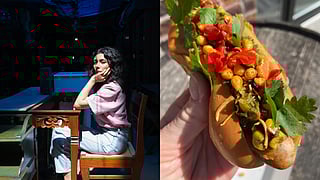
The ‘Chaat Dog’ is a New York-area pop-up food concept created by Pervaiz Shallwani, a journalist and chef of Pakistani descent who grew up in the Chicago suburbs. The premise is exactly what it sounds like, and more. Shallwani’s claim to fame is the eponymous ‘Chaat Dog’ — an all-beef hot dog on a ghee-toasted bun, topped with chaat and finished with cilantro chutney, tamarind-plum chutney, fried onions, sev and boondi crunch, fresh cilantro, and house-made pickled hot wax peppers. Shallwani describes it as a mashup of his Chicago-area upbringing — eating a lot of hot dogs growing up — and his Pakistani heritage. Learn more about ‘Chaat Dog’ here.
Maker’s Asylum’s woodworking workshop in Goa offers a hands-on experience through two-day basic and six-day advanced courses that cover techniques, tool handling, machinery, and large-scale practices. Limited spots focus on mentorship, community, and engagement. Optional shared housing fosters collaboration. More than skill-building, it promotes a slow, intentional approach to creativity, providing a meaningful escape from the fast-paced digital world. Learn more here.
If you enjoyed reading this, here’s more from Homegrown:
Indrajit Khambe’s Photoseries Captures The Gold & Grit Of Harnai’s Fisherwomen
Midival Punditz Give Ghazal, Sufi & Folk A Darker Electronic Edge On Their Comeback LP
Jaan Theatre’s ‘Unshared Childhoods’ Is An Immersive Theatrical Experiment In Empathy
