
- HOMEGROWN WORLD
- HGCREATORS
- HGEXPLORE
- HGVOICES
- HGSHOP
- CAREERS
- ABOUT US
- CONTACT US

I spent the past week reflecting on what it means to have a home, to belong, and to dream in an increasingly hostile world. We are living through an age of frayed certainties. Our institutions no longer inspire trust, our communities are increasingly fractured, and the old promises of stability, progress, and belonging feel hard to believe in when they come at the cost of our rights — to live and love freely, to eat what we want, to practise faith, or not at all — and, ultimately, our freedom. Across the world, people are moving through their lives with a growing sense of precarity — searching for meaning at a time when the social contracts that once held societies together appear to be collapsing in broad daylight. Belonging is no longer something we are born with. It has become something people must constantly negotiate, claim, perform, and defend.
Yet even amid this fragmentation, people continue to build community. They create small worlds through music, cinema, food, art, memory, friendship, ritual, and shared struggle. They gather in temporary spaces — online and offline — seeking recognition and intimacy in cultures that increasingly reward alienation. Perhaps this is what it means to live through the present moment: to keep making meaning despite it all; to keep reaching towards one another even as the world insists on separation; to stubbornly insist on the possibility of human connection in an age defined by isolation.
From restless teenage masculinity and imagined film scores to travelling folk performers, immigrant deli culture, and forest retreats shaped by the land itself — this week’s culture bulletin explores the many ways people are creating worlds in which to survive, belong, and dream. Here’s what we have for you this week:
A culture’s coming-of-age films are effectively a confession — revealing what it fears its young people are becoming and what it hopes for them instead. Kshitij Singh Rawat, aka Urban Buddha’s ‘Guddu Ki Duniya’, is part of this tradition. Echoing the emotional volatility of works like ‘Moonlight’, ‘The 400 Blows’, or ‘City of God’ in its attention to youth shaped by social circumstance, the short film follows Guddu (Rugved Nanavare), who believes that respect and adulthood require becoming an “Independent Adult Mard.” The film’s close third-person omniscient narrator gives us a peek into his psyche as he experiences the quintessential rites of passage — trouble at home between his parents, the awkward first interaction with the opposite sex during adolescence, bullying at school, the first encounters with intoxication, and growing pains — which define young adulthood in India and elsewhere. Learn more here.
Eric Andre is a storm. A ‘surrealist anti-humour’ comedian, actor, and host of the cult-favourite Eric Andre Show on Adult Swim, which parodies public-access talk shows, he is an agent of chaos. But just like those trees that grow to heaven with their roots down in hell, Eric is trained in upright bass with a bachelor’s in music from Berkley, if you can believe it. After his previous noise-heavy, absurdist release ‘Cease & Desist’ through his musical project BLARF, he has now come out with his latest instrumental record ‘Film Scores for Films That Don’t Exist’. For this project, Eric partnered up with Indian artist Prateek Rajagopal, a film composer and producer who’s played in metal bands like Gutslit, Chronic Phobia, Reptilian Death, and The Minerva Conduct before moving into composition. We spoke to Prateek to get a behind-the-scenes look at a project that’s been five years in the making. Learn more here.
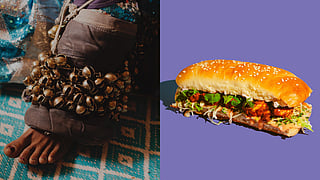
Abhishek Khedekar’s photographic project ‘Tamasha’, opening at the Dilip Piramal Art Gallery at NCPA Mumbai on 8th May, documents the Lokkalawant family, a Tamasha troupe that lives and travels across Maharashtra. Khedekar, a New Delhi-based photographer who first spent six months with the family in 2016 as part of an academic assignment, returned between 2022 and 2023 to deepen his engagement. The result is a docufiction project — part documentary record, part constructed visual narrative — that reframes Tamasha as a lens on Maharashtra’s caste system, visibility, and the social contracts that govern who is celebrated and compensated. Learn more here.
At the centre of Brooklyn Bardez is this idea of ‘appetising’ as a verb. The place is rooted in deli culture — sampling, layering, slicing, curing, smoking, pickling, and assembling — where sandwiches stop being quick lunch food and start feeling like careful works of craft. The joint comes from Meghana Shrivastava and Matt Daniels, the duo behind Verandah in Mandrem and Detroit’s cult sandwich truck Nu Deli. Their history runs through Goa, Bombay, Detroit, pop-ups, dinner parties, and ten years of sandwich experimentation, stuffing Konkan flavours into classic American deli formats, which now show up all over the menu. Learn more here.
Far removed from any trace of road or routine, Koduva is a retreat envisioned by Scandinavian designer Morten Aagren Sveden, working closely with owners Sanju and Emy. Their approach was to reduce the impact of construction on surrounding nature, build with intent, and allow the land to guide their architectural decisions. The structure resembles a boomerang, following the terrain without altering it. With this conceptual plan, the layout opens outward, holding views of the surrounding valley while maintaining a sense of enclosure and privacy. Learn more about Koduva here.
