
- HOMEGROWN WORLD
- HGCREATORS
- HGEXPLORE
- HGVOICES
- HGSHOP
- CAREERS
- ABOUT US
- CONTACT US

Set in Jaipur’s historic City Palace, the Studio Intensive is a month-long mentorship by Jaipur Centre for Art and RMZ Foundation that nurtures 19 young Rajasthani visual artists. Rooted in the city’s royal legacy of patronage, it offers shared studios, critical dialogue, and access to gallerists, curators, and collectors, culminating in an open studio and potential acquisition by RMZ’s collection.
The royal city of Jaipur has a long history as a centre of art and craft. As the wealth and power of the Mughal Empire waned following Nader Shah Afshar’s violent sack of Delhi in 1739, many master miniaturists and artisans from the Mughal ateliers found work in Jaipur’s royal workshops. The Jaipur royals have supported artists and artisans ever since.
“For my family, patronage was never simply about preserving what already existed. It was about creating the conditions for artists, architects and craftspeople to imagine what could come next. I think that is the role we can play today as well. The Jaipur Centre for Art is an extension of that tradition, giving contemporary artists the space to engage with the city, its history and its people, while bringing new ideas into that conversation,” HH Maharaja Sawai Padmanabh Singh, the scion of the former royal family of Jaipur, says.
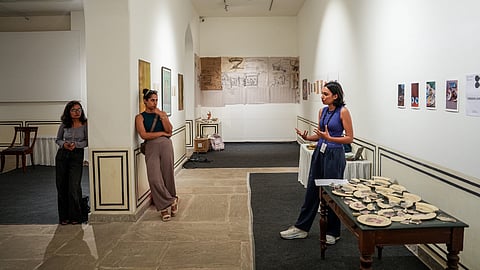
The Studio Intensive, a month-long mentorship programme by the Jaipur Centre for Art (JCA) in collaboration with RMZ Foundation, continues that history. Taking place at JCA premises within the Jaipur City Palace from August 17 to September 17, 2026, the programme brings together 19 young visual artists from Rajasthan. It provides them with resources and dedicated studio space, along with access to gallerists, collectors, curators, writers, and other practitioners. The programme will conclude with an open studio and public display on September 17.
As JCA co-founder Noelle Kadar points out, Jaipur has no shortage of art colleges or talented art students. “What we’re offering is a place for that talent to keep building,” she says. “I think about my own experience at RISD (Rhode Island School of Design), then visiting friends in their shared studios in New York; those experiences shaped me as much as any class did, teaching me to problem-solve, think through my own ideas, and defend a point of view. Those skills are as essential to being an artist.”
The inaugural Studio Intensive combines access to shared physical space with conversations around the structures that shape the contemporary art world: galleries, collections, criticism, and the seemingly opaque art market. Its mentor lineup includes Noelle Kadar, Rajiv Menon, Shilo Shiv Suleman, Wolf, Meera Menezes, Siddharth Somaiya, and Kamna Anand, alongside members of the RMZ Foundation team.
Kadar also draws a line between developing an artistic practice and learning how to operate professionally. “They are not the same thing, but they are both incredibly important for an artist’s success,” she says. “The art comes first: the distinct point of view, the distinguished visual language.”
The programme also raises a larger question: can Jaipur develop a contemporary art ecosystem on its own terms rather than reproducing the structures of Delhi and Mumbai? Kadar’s answer is deliberately open-ended. “We don’t have the answer for this yet,” she says. What Jaipur does have, she says, is “access to craft, materials, skilled artisans, and affordable studio space.”
For Singh, this continuity is even more explicit. He sees contemporary art in Jaipur “less as a departure from our artistic inheritance and more as its natural continuation.” For him, the inheritance is “a way of thinking: to remain curious, to encourage creativity, and to allow Jaipur to keep evolving.”
The programme extends that idea beyond its month-long duration. Three participants will be selected to have their work enter the RMZ Foundation’s collection in Bengaluru, and the programme will close with an open studio and public presentation at JCA, Jaipur City Palace, on September 17, 2026.
Follow @jaipurcentreforart on Instagram.
