
- HOMEGROWN WORLD
- HGCREATORS
- HGEXPLORE
- HGVOICES
- HGSHOP
- CAREERS
- ABOUT US
- CONTACT US

At Kudje in Pune, Swastik Luxury Wellbeing Sanctuary transforms architecture into a tool for healing. Designed by Tao Architecture, the retreat uses organic forms, elemental design principles, and nature-led planning to create immersive spaces that deepen mindfulness, encourage introspection, and harmonise luxury with ecological wellbeing.
American architect Louis Sullivan said: form ever follows function. Located in the natural beauty of the Western Ghats in Kudje, Pune, the Swastik Luxury Wellbeing Sanctuary embodies this ethos: here, architecture functions as a central component of the retreat’s holistic wellness philosophy. Overlooking the Khadakwasla backwaters and nestled within Peacock Valley, the campus is designed to slow the body, soften the senses, and create an atmosphere that encourages introspection. Its organic, curvilinear, and site-responsive design mirrors the retreat’s mission to reconnect residents with the elemental rhythms of earth, water, fire, air, and space.
Designed by Pune-based Tao Architecture, the built areas of the retreat span nearly 50 acres and feature several distinct zones that correspond to different traditional healing methods. Each cluster — Dhyan Vihar, Ayu Vihar, Anand Vihar, and the residential cottages — has its own spatial identity, yet all share a common architectural ethos: gentleness, porosity, and immersion in the site’s natural landscape. The retreat’s design draws inspiration from the Swastik, interpreted here as an organising principle associated with well-being, abundance, and inner harmony.
Dhyan Vihar, envisioned as a sanctuary for deep meditation, offers one of the project’s most elegant spatial experiences. Here, the architecture foregrounds silence: large, uncluttered volumes, soft light, and openings that frame the valley without overwhelming it. Its relationship to the Nakshatra garden reinforces the theme of cosmic alignment, inviting visitors to experience meditation as an attunement to natural cycles rather than an isolated practice.
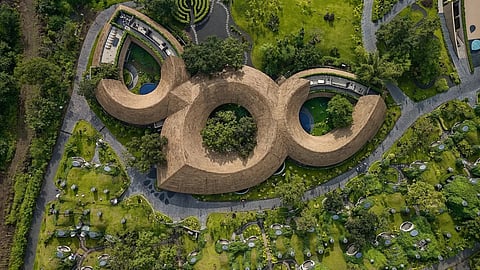
Ayu Vihar, shaped like a peacock feather, embodies the project’s organic design ambitions. Its sweeping curves, earthy palette, and fluid spatial progression create a sense of being gently held like a child in Mother Nature’s arms. The layout encourages slow movement, and its therapy rooms are oriented to maximise natural ventilation, filtered light, and visual privacy. By evoking the softness of a feather, the architecture anchors the therapeutic programmes it houses.
In contrast, Anand Vihar — inspired by the element of fire — embodies vitality. With hydrotherapy pools, sound therapy zones, auditoriums, and yoga studios, it is designed as a space for movement. Terraces rise with the hillside, creating vantage points that expand the interior experience to the natural beauty of the Sahyadri mountain range. The vertical layering ensures that even high-energy spaces remain visually and psychologically connected to nature.
The project’s most understated achievement lies in its cottages: earth-hugging residential structures imagined as contemporary caves. Built into the mountain slope and softened by gardens and creepers, they blur the line between the built and the unbuilt. Their integration into the terrain reinforces the retreat’s belief that luxury and simplicity are not opposing values but complementary ones. By aligning architecture with ecology and emotional well-being, the Swastik Holistic Wellness Center delivers a model of mindful living rooted in architectural design.
