
- HOMEGROWN WORLD
- HGCREATORS
- HGEXPLORE
- HGVOICES
- HGSHOP
- CAREERS
- ABOUT US
- CONTACT US
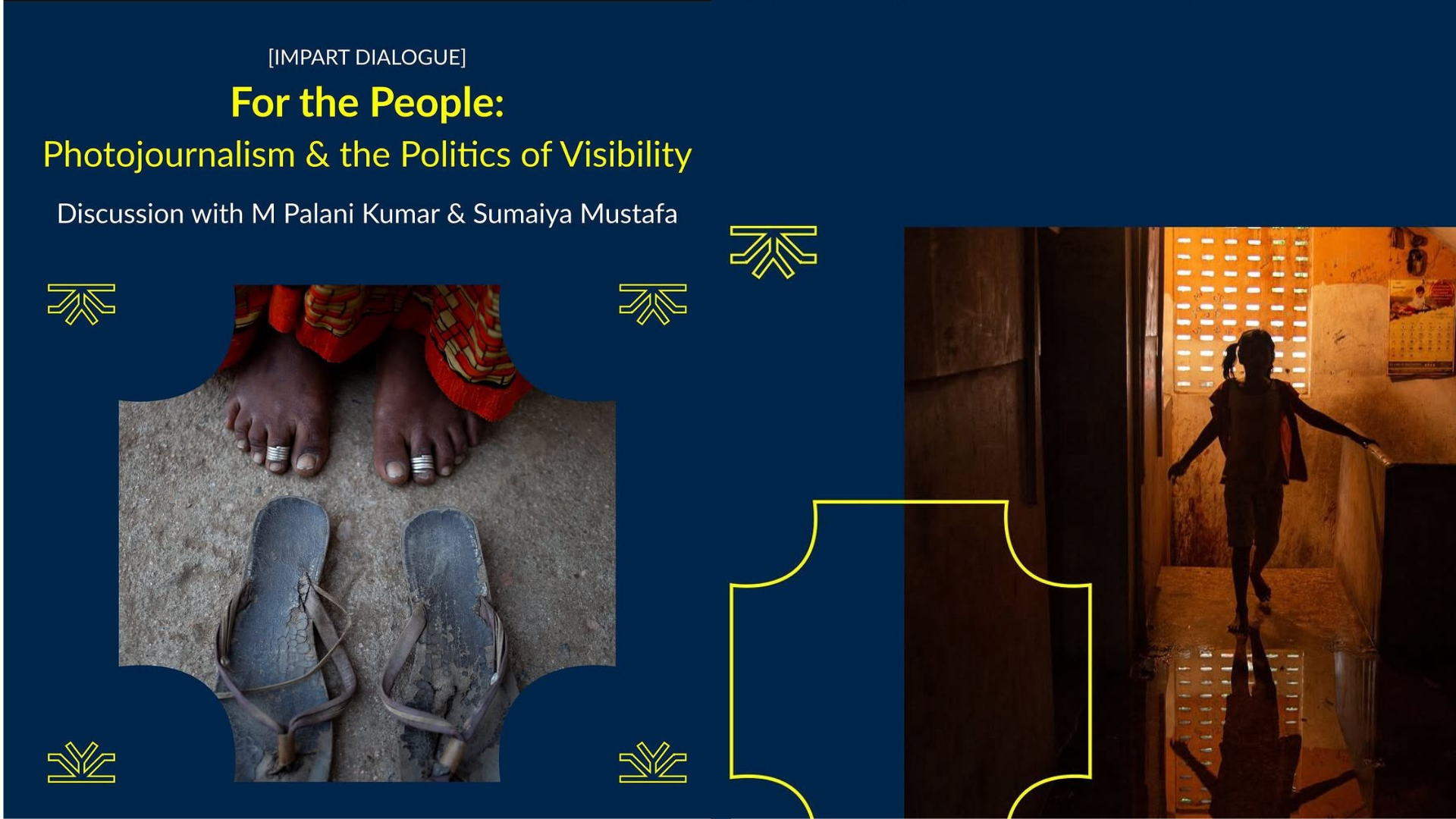
This piece explores how photographers and storytellers act as mediators of reality, carrying the responsibility of representation through their lens. It highlights Impart’s upcoming online dialogue featuring M Palani Kumar and Sumaiya Mustafa, which examines photography not just as an art form but as an ethical practice. Rooted in accountability and long-term engagement, the conversation addresses the politics of looking, the ethics of framing, and the impact of visual storytelling in shaping public understanding.
Visual culture is increasingly shaping how we understand the world. For many of us, especially in an age of constant scrolling, images often precede experience. We view places before we visit them, communities before we encounter them, and lives before we truly understand them. This becomes particularly significant when thinking about representation. For many audiences, especially those removed by geography, class, or social location, images may be their primary, sometimes only, point of access to marginalised communities. In such cases, the photographer, artist, or storyteller is a mediator of reality. The lens becomes a filter through which entire lives are understood, and that translation carries immense weight.
Initiatives like Impart’s, scheduled for 30 April 2026 is an online conversation that brings together photographer M Palani Kumar, photojournalist with the People’s Archive of Rural India and the founder of the People’s Photographers Collective, and writer Sumaiya Mustafa, a recipient of the Food Matters Grant, to reflect on how image-making can enable greater visibility for marginalised voices.
The dialogue is not that much about photography as an art form and more about photography as an ethical act. Kumar’s work, rooted in long-term engagement with working-class communities in Tamil Nadu, goes beyond surface-level documentation. His practice is built on sustained participation, where the act of taking a photograph is inseparable from the responsibility that follows. This perspective challenges the often extractive nature of visual storytelling, instead asking what it means to remain accountable to the people and realities being represented.
This conversation is set to unpack precisely these tensions: the politics of looking, the ethics of framing, and the responsibility of the image-maker in a world saturated with visual content. It pushes viewers to consider not how images shape our understanding of lived realities. It reframes photography as an active force, one that can either reinforce distance or create deeper, more empathetic connections.
This event is part of Impart Dialogues (formerly MAP Academy Live), a series of expert-led talks and discussions designed for its online community. Through workshops, discussions, or exhibitions like this one, Impart consistently emphasises the role of art in fostering empathy and critical thinking. It recognises that creative expression can be a powerful entry point into conversations that might otherwise feel inaccessible or difficult to approach.The focus here, like most of Impart’s work, is on boosting engagement and creating space for audiences to question and reconsider their own ways of seeing.
You can register for the session via Zoom here.
If you enjoyed reading this, here's more from Homegrown:
Pune's 'Art Of Perception' Exhibit Asks Visitors To Step Inside Their Own Mind
Take A Workation At These Homegrown Co-Working Spaces Across India
Indrajit Khambe’s Photoseries Captures The Gold & Grit Of Harnai’s Fisherwomen
