
- HOMEGROWN WORLD
- HGCREATORS
- HGEXPLORE
- HGVOICES
- HGSHOP
- CAREERS
- ABOUT US
- CONTACT US
An exploration of India’s rich and varied butter culture, moving beyond the familiar yellow blocks of modern grocery stores. The piece traces the history of traditional white butter from its cultured, churned origins in domestic kitchens to its regional identities like loni, benne, and vennai. It also examines the industrial standardisation brought by Operation Flood and Amul, and highlights the subtle presence of traditional butter preparations in today's culinary landscape.
In 'Julie & Julia', Julie Powell obsessively cooks her way through French cuisine with a single hedonistic conclusion: you can never have too much butter. Anyone who loves to cook, or simply loves to eat, knows that butter is easily one of the greatest forms of fat in all of existence. It carries flavour, softens aggressive spices, creates silk where there was once just liquid, and turns basic starches into comfort.
If you grew up in India, the yellow, salted, foil-wrapped butter sitting in your fridge door barely scratches the surface of the country's dairy traditions. Long before packaged yellow blocks became an everyday kitchen staple, India built its food culture around fresh, handmade butter that was pale, churned daily at home, and known variously as makhan in the North, loni in Maharashtra, benne in Karnataka, or vennai in Tamil Nadu. The language itself reflects this relationship: ancient Sanskrit texts referred to it as navneet (freshly churned), while the Persian-derived word maska eventually gave rise to the iconic Hindi idiom maska lagaana — literally "to apply butter", or flatter someone.
For generations, butter-making lived at the center of domestic routine. Skimming malai (cream) off boiled milk over days, letting it ferment in clay pots, and churning it with a wooden mathani (churner) until pale fats float up to the surface.
In a country where rich buffalo milk produced an exceptionally creamy white butter, this fresh, unsalted fat behaved nothing like a factory block. It carried a subtle, sour tang from the cultured curd, melted at a lower temperature, and felt remarkably light on the palate. Without modern refrigeration, white butter had to be enjoyed immediately or clarified into long-lasting ghee (clarified butter cooked to nutty golden perfection) before it could turn sour. Climate dictated the routine, and the routine dictated the taste.

Because Indian geography varies across terrain, every region developed its own distinct, emotional relationship with butter and some places skipped it altogether.
In the North, butter carries a sense of domestic generosity. It’s the generous slab melting over a steaming hot aloo paratha, the richness folded into dal makhani, and the stolen treat attached to childhood stories of Lord Krishna reaching into clay pots. In the winter lanes of Old Delhi, this love for fat takes on an unexpected morning form: vendors frothing up gur wali chai (tea with jaggery), or the famous stalls near Jama Masjid serving a silky, high-calorie butter coffee brew meant to fight off the chill.
Step into the old Irani cafes and Parsi bakeries of Mumbai, and butter takes on a completely different urban ritual. A brun maska, centred around fat — a beatiful bun sliced open and smeared with an absurdly thick layer of softened butter— ready to melt into hot, sweet Irani chai.
Across rural Maharashtra, loni belongs to rustic, everyday eating. Freshly churned loni gets dolloped over hot millet bhakri with a garlic-chili thecha, or served alongside sweet puran poli to balance the richness of jaggery and lentils. It’s a counterweight to the intense spices and long hours of physical labour.
Down South, butter becomes a sharp tool for texture. In Davanagere, benne is folded directly into the batter and slapped onto hot iron griddle plates, frying the dosa into a crisp, golden shell with a soft, pillowy center. In Tamil Nadu, vennai takes on sacred weight, applied to deity idols during festivals or folded into temple rice preparations.
Unexpected traditions pop up in travel history too — like Indian Railways' long-standing breakfast culture, where cold, foil-wrapped mini butter chiplets were served alongside warm cutlets or omelets, teaching generations of commuters the precise art of spreading chilled butter onto warm bread on a moving train.
The East and Northeast, however, offer a necessary contrast to the idea that the entire country runs on dairy. Across Bengal, Assam, and Nagaland, mustard oil, pork lard, fermented fish, and crushed seed pastes handle the heavy lifting. Butter steps back, showing that Indian foodways are far too varied to fit into a single story.
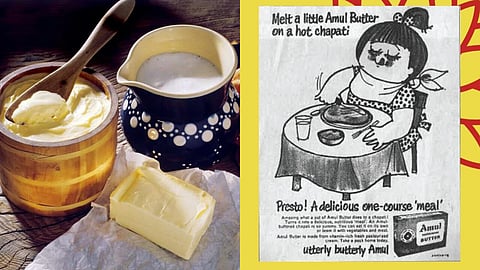
India's butter production transformed in the mid-20th century with Operation Flood, the massive dairy development program spearheaded by the National Dairy Development Board and popularised by the Amul cooperative.
To solve the huge challenge of moving milk across a massive nation without it spoiling, India standardised its national butter supply. Out came pasteurised, salted butter coloured bright yellow with annatto, a natural plant dye, built to last for weeks in family refrigerators.
Almost overnight, the uniform yellow block became the taste of school lunchboxes, morning toast, and street food. In modern street culture, that yellow block has even become a theatrical spectacle: street-food vendors dump entire slabs of butter onto pav bhaji tavas, dosa griddles, and grilled sandwiches, using the sheer volume of melting fat as an eye-catching performance for hungry crowds.
While industrial processing brought convenience and consistency to millions, it slowly pushed traditional fresh butter out of modern urban kitchens and into the background.
While commercial yellow butter remains the undisputed choice across most Indian households and street stalls, traditional butter-making tries to retain a space in the background. In pockets across major cities, a few boutique dairies offer cultured white butter, while select restaurants feature regional specialties like fresh loni or benne on their menus. These moments are proof that India's older, micro-local butter habits continue to exist alongside the modern supermarket slab.
Julie Powell had a point about French cooking, but India's dairy story is a reminder that butter wears many faces, changing its name, texture, and emotional meaning everywhere you go - but it's taste is unmistakably consistent \
If you enjoyed this, here's more from Homegrown:
A Homegrown Guide to India’s Most Essential Regional Chillies
The Origin Story Of The Samosa, And How It May Not Be Indian At All
Mumbai, This Egg Bhurji Trail Is Perfect For Monsoon Munchies!
