
- HOMEGROWN WORLD
- HGCREATORS
- HGEXPLORE
- HGVOICES
- HGSHOP
- CAREERS
- ABOUT US
- CONTACT US

As Jashn-e-Rekhta marks its tenth anniversary, the festival offers a revealing lens into India’s shifting linguistic politics. Urdu — once the subcontinent’s lingua franca — has undergone a striking revival over the past decade, shaped not by state policy but by young Indians who turned to the language during the COVID-19 lockdown. This year’s festival at Baansera Park reflects Urdu’s enduring vitality through a programme that blends classical literature, political discourse, and contemporary performance. Together, they reaffirm Urdu as a living, adaptive language central to India’s plural cultural identity.
Language — like food and religion — is a profoundly political subject in India. From the long-standing prohibition that prohibited Shudras, Dalits, and other oppressed caste groups from accessing Sanskrit to the profiling of Bengali-speaking migrant workers as ‘Bangladeshis’ across India, language has always been a marker of class, caste, regional, and religious identities in the Indian subcontinent. The rise, fall, and revival of Urdu, once the lingua franca of India, is one of the major threads of this fraught cultural history.
Indians’ renewed fascination with Urdu in the last decade was neither mandated by academic institutions nor engineered by state cultural policy, which has predominantly favoured a more Sanskritised form of Hindi since independence. Instead, it emerged from the younger generations’ search for a mode of self-expression that intensified during the long, disorienting months of the COVID-19 pandemic. Confined to their homes and confronted with uncertainty and anxiety about the future, thousands turned to languages that could articulate grief, longing, tenderness, and ambiguity during the lockdown. For many young Indians, Urdu, with its lyrical precision, emotional range, and counter-cultural status in a Hindu- and Hindi-hegemonic India, became a refuge.
Cut off from physical classrooms and cultural spaces, this new wave of learners gravitated toward digital platforms. In this virtual baithak, the Rekhta Foundation became the central catalyst. Founded by industrialist and philanthropist Sanjiv Saraf, Rekhta dismantled one of the most persistent barriers to Urdu literacy: the intimidation of the Nastaliq script. By transliterating vast libraries of poetry and prose into Devanagari and Roman scripts, the platform empowered new learners to engage with Ghalib, Faiz, Parveen Shakir, and countless other Urdu writers and poets without the burden of mastering a new orthography. Detractors decry that this might be detrimental to the language in the long term, which is a valid concern, but the short-term effect is undeniable. In the last ten years, Urdu has undergone a remarkable revival in India.
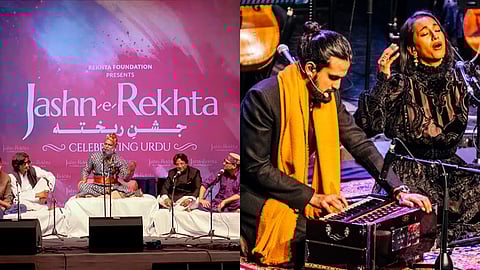
Jashn-e-Rekhta, the Foundation’s annual celebration of Urdu language and culture, embodies this revivalist movement. Over the past ten years, the festival has grown from a niche gathering to an essential fixture of New Delhi’s winter cultural calendar. Moving this year to the expansive riverfront venue of Baansera Park signals its widening appeal and its role as a living archive of the Ganga-Jamuni tehzeeb — the syncretic ethos that once defined North Indian culture.
A decade on, Jashn-e-Rekhta stands as a testament to this new Urdu renaissance. The festival’s tenth edition offers a vivid snapshot of Urdu’s enduring vitality. The programme balances literary gravitas with popular appeal, bridging generations and artistic idioms. Sessions with Gulzar — titled ‘Mehakti Khushbu Ka Safar’ — reinforce the continuity between classical sensibilities and modern storytelling. Conversations with Javed Akhtar underline the language’s relevance in political and cultural discourse. Meanwhile, performances by Sukhwinder Singh, Salim Sulaiman, and the Orchestral Qawwali Project — featuring Abi Sampa — highlight Urdu’s inherently performative nature, rooted in centuries of Sufi musical and dramatic storytelling traditions.
This line-up demonstrates that Urdu today is not only a repository of cultural nostalgia but a living, adaptive language. Its revival, too, is not a sign of post-pandemic sentimental yearning for a bygone era but a reminder that the language once spoken across India’s bazaars, royal courts, and family homes remains integral to the country’s composite cultural inheritance.
The 10th edition of the Jashn-e-Rekhta festival will take place at the Baansera Park in New Delhi from 5 to 7 December 2025. Learn more about the festival line-up here.
