
- HOMEGROWN WORLD
- HGCREATORS
- HGEXPLORE
- HGVOICES
- HGSHOP
- CAREERS
- ABOUT US
- CONTACT US

The article examines the protests in Goa against Section 39A of the Town & Country Planning Act, which allows individual land parcels to be rezoned for settlement use through a faster, plot-by-plot approval process. It outlines residents’ concerns that this provision accelerates land conversion without meaningful village-level consultation, enabling construction on hills, orchards and agricultural land. The piece connects these anxieties to broader themes of tourism-driven development, environmental strain on water systems and infrastructure, and the erosion of long-standing community land practices.
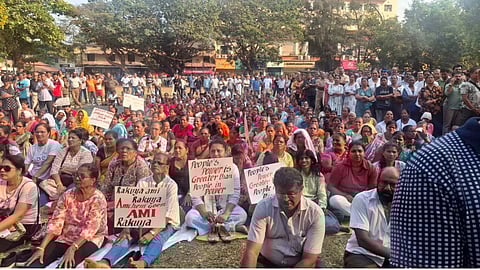
A few days ago, thousands of Goans took to the streets and marched all the way to the residences of state leaders like Vishwajit Rane and Pratapsingh Rane in Dona Paula and Panaji, chanting “No more 39A”, demanding the repeal of a controversial land-use provision in the Goa Town & Country Planning (TCP) Act that was introduced as 'Section 39A' in 2024. Villagers from places like Palem-Siridao in North Goa had walked down to Panaji to protest that large tracts of their hills, orchards, and no-development land were being converted into settlement zones — legally paving the way for construction — without proper consent or wider community process.
Anxieties around land in Goa have been long-standing issue. In the late 1960s and 70s, tourism began reshaping the state’s economy, accelerating in the 1990s, and intensifying over the past decade with higher disposable incomes and short-haul domestic travel. Coastal belts that once had scattered homes and agricultural fields now carried clusters of resorts, gated villas, rental properties, and second homes owned by people from outside the state. Property prices in parts of North Goa also multiplied several times over in two decades. Land that once had primarily agricultural or ecological value now had a massive investment value.
Today, Shack owners, restaurant workers, taxi drivers, musicians, small guesthouse operators and boatmen earn their living from the seasonal visitors. Entire stretches of the state’s service economy are tied to tourism revenue. At the same time, tourism drives demand for more built infrastructure like rooms, villas, private rentals, and leisure spaces. Investors and developers look for plots with views, proximity to beaches, or hilltop locations. As land categories shift toward settlement use, construction accelerates to meet that demand.
Many residents feel Section 39A has made land conversion faster and easier. Earlier, if the government wanted to change land use in the Regional Plan, it usually required a larger revision process. Those revisions involved wider public hearings and more visible discussion. Now, under Section 39A, individual landowners can apply to have just their specific parcel reclassified. In practice, this means land zoned for orchards, forests, slopes, agricultural use or other protected classes can be rezoned to settlement, which opens it up for housing, resorts, large buildings, or other development. The application is reviewed within the department, and after a 30-day notice period, it can be approved. That shift — from large, structured revisions to plot-by-plot approvals — is what people are worried about. On paper, there is still a notice period. But villagers say that in practice, most people at the gram sabha level don’t even realise changes are being processed until they are well underway.
Local Panchayats, which should be the first place such decisions are discussed, are often not meaningfully involved. So while the procedure may technically exist, many residents feel the actual decision-making has moved further away from the village and closer to bureaucratic and political circles. Notices are often buried in paperwork, not widely understood, and don’t necessarily reach people in a way that allows them to respond in time. By the time objections surface, the administrative process is already moving ahead. In a state like Goa, where villages are closely knit, and environmental systems overlap, changing one plot is never just about one plot; it affects the entire landscape and public life as a whole.
What's more, hillsides in Goa act as catchments for rainwater and help recharge wells that villages depend on through the dry months. When slopes are cut and flattened for buildings, water flow patterns shift. Concrete changes how the land absorbs rain. Borewells drilled for large homes or villa clusters draw from deeper aquifers, often lowering the water table for neighbouring houses that rely on older, shallow wells. Paddy fields and orchards regulate runoff during the monsoon; when they are filled, levelled or paved over, flooding intensifies in nearby areas. Village roads, originally designed for light local traffic, begin to handle heavy construction vehicles and constant movement tied to new developments. Waste management systems and sewage infrastructure rarely expand at the same speed as private construction. These changes show up in water shortages during summer, damaged roads, drainage problems during monsoon, and rising maintenance costs that entire communities end up grappling with.
Goa is a small state, and the land here is connected to the people in ways that don’t show up on a zoning map. Many villages still operate within older land systems like the communidades, where land historically belonged to a community. Agricultural fields are tied to specific families and seasonal cycles that run year after year. This includes Catholic and Hindu village feasts, fishing communities, agricultural cycles, and neighbourhood networks that extend back generations. Goe's fields, orchards and hills are part of that social and cultural memory. When land is converted plot by plot through administrative approval, those shared arrangements start fracturing irreversibly.
To outsiders, it may look like there are two Goas. One is of beachside escapades, parties, rental villas, weekend homes, and high-season traffic. The other is the Goa of village feasts, fishing schedules, agricultural cycles, and neighbourhood networks that have existed for generations. But in reality, there is only one Goa. The native Goans are the ones running the shacks, driving the taxis, cooking in the restaurants, managing the guesthouses, maintaining the boats, and keeping the tourism industry moving. Tourism is not separate from local life; it depends on it. And it works because those communities are still intact.
When development starts disrupting the very communities that sustain an ecosystem, it's lost sight of who and what it's for. If land conversion continues without meaningful consultation, the impact does not stop at village boundaries. It impacts the community-based bedrock that tourism rests on. As much as we love our summer retreats in a place that has given a lots of us our best memories, it cannot come at the cost of people’s social lives, their culture, and the place they call home.
Right now, many residents feel they are not even being included in decisions that directly reshape their surroundings. What they are asking for is simple: a say in what their environment looks like. They want to talk about what development means for water, agriculture, and everyday life, which is in no way a hindrance to the demands of the industry. They still want tourists, but they don’t want to wake up one day and not recognise the place they grew up in.
If you enjoyed reading this, here's more from Homegrown:
Beedi Wars: How The Humble Beedi Sparked Decades Of Bloody Conflict In Kerala & Karnataka
The Colonial Roots Of Captive Labour: From Prison Carpets To The Modern Gig Economy
What Jaspal Bhatti’s Flop Show Says About India’s Lost Culture Of Public Criticism
