
- HOMEGROWN WORLD
- HGCREATORS
- HGEXPLORE
- HGVOICES
- HGSHOP
- CAREERS
- ABOUT US
- CONTACT US
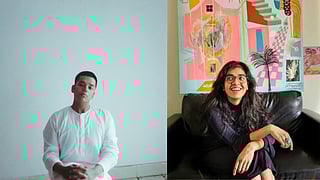
The human body has long been a subject of artistic exploration, from anatomical precision to cultural reinterpretation. Today, artists like Vikalp Durga Mishra, Rithika Pandey, and Aditi Bagiecha push this exploration further, reimagining the body through surreal, emotive, and whimsical perspectives. Their work moves beyond realism, using distortion, abstraction, and symbolism to reflect inner worlds, societal pressures, and subconscious states. In doing so, they challenge conventional ideas of beauty, anatomy, and identity — offering a refreshed, deeply personal way of seeing the human form.
The human body is a strange and mysterious place to inhabit. It’s mind-boggling what it is capable of doing and holding for us. Beyond simply being the reason we exist, our bodies are the vessels through which we experience life. For time immemorial, artists have attempted to depict the body in absurd and imaginative ways. From Michelangelo and Leonardo da Vinci striving for anatomical precision, to Raja Ravi Varma and M. F. Husain interpreting Indian bodies within their own cultural contexts, the human form has long been a site of artistic exploration.
Today, in a world where we are hyper-aware of every detail, from the way our teeth look when we smile to whether our eyebrows are perfectly symmetrical, our bodies are under constant scrutiny, as if placed beneath a microscope. Perhaps that is why these artists stand out. They approach the body as something almost absurd: creatures placed on an equally absurd planet, simply designed to survive. From bird-like bodies with expressive, human faces to figures that use the body as a starting point for deconstruction, these artists pull the human form apart and reassemble it with a whimsical imagination, recalibrating how we see ourselves when we look in the mirror.
Reminiscent of Jamini Roy’s work, Vikalp Durga Mishra is a watercolour artist from Kanpur. His practice features recurring motifs of birds and flowers, with a distinct emphasis on the eyes: wide, oval-shaped, and often gazing upward or directly at the viewer. At times, their expression feels almost disinterested, as though you are momentarily interrupting the orbit they inhabit. While his palette is rich and saturated, there is a lightness to the work that lends it a whimsical, almost airy quality. Mishra also undertakes commissioned family portraits, beginning with personal stories and memories before translating them into his visual language. The result is a deeply interpretive rendering, an intimate, stylised blueprint of what a family can look like, shaped as much by emotion and narrative as by form.
Follow him here.
Rithika Pandey approaches the human body as something fluid, symbolic, and almost otherworldly. Her figures exist within surreal, dreamlike spaces, often distorted, or theatrical, reflecting inner emotional states rather than an individual's physical reality. The body then becomes a narrative device, shaped by mood and the subconscious tension instead of anatomy. Her colours of grey, yellow, purple give her work a grave disposition peering into the viewer’s inner consciousness, sometimes even unsettling you. There is something almost scientific about her work, reminding me of the body diagrams in our biology textbooks, except her work is a snapshot of the cross section of the body as a free spirit running amuck in the fields of our minds.
Find them on Instagram here.
Bagiecha’s work approaches the anatomical body as something soft and deeply emotive. Figures often feel suspended between reality and memory, stretched, simplified, or abstracted to hold meaning rather than form. There’s an intimacy to the way bodies exist in their compositions, where gesture and posture speak louder, transforming the body, and the work itself, into a distinct emotional landscape. Their practice feels unburdened by strict anatomical precision, allowing for a more instinctive, expressive rendering of form. One series, in particular, highlights a range of female facial expressions, placing specific emphasis on the visibility of teeth, how we smile, speak, and perform emotion, subtly reflecting the pressure on women to appear pleasant, polished, and perpetually “perfect.”
Find their Instagram here.
