
- HOMEGROWN WORLD
- HGCREATORS
- HGEXPLORE
- HGVOICES
- HGSHOP
- CAREERS
- ABOUT US
- CONTACT US
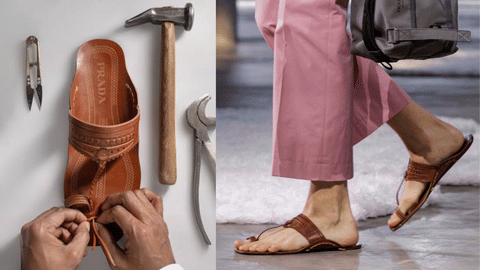
In June 2025, Prada faced widespread backlash after showcasing footwear at Milan Fashion Week that closely resembled Kolhapuri chappals without crediting their origins. The controversy sparked a larger conversation about cultural appropriation and the lack of recognition for South Asian crafts within global fashion. A year later, the brand has introduced a ‘Made in India’ collection officially inspired by Kolhapuri chappals, manufactured by artisans in Karnataka and Maharashtra, alongside a training programme in collaboration with Indian institutions. While the initiative offers visibility and economic opportunities for artisans, it also raises critical questions about timing, intent, and authorship.
In June of 2025, Prada had its models walk down the Milan Fashion Week Runway with shoes that looked eerily similar to the Indian Kolhapuri Chappal. Of course, like every other time a western brand has taken something from the many subcultures that exist in South Asian fashion, there was no credit given to the original item of clothing. They of course expected to just get away with it and think that either people wouldn’t notice and if they did, they wouldn’t care.
Guess what?
People cared. A lot. All of South Asian social media blew up asking Prada to take accountability and raising the larger question of why the West thinks that it can continue to steal our culture without giving us the recognition we deserve? For years we have ridden the post-colonial wave, hoping that one day white people will realise that we are not just an eternal supply for unsolicited inspiration. But this time around, we didn’t keep quiet. The outrage was real and raw and could be felt in thrashing waves across the world, from the eight districts of Maharashtra and Karnataka that indigenously design and create the Kolhapuri Chappal all the way to Prada headquarters in Milan.
It is also tangibly clear that the 113-year-old fashion house realised that they majorly fucked up.
Just two days ago, Prada announced its latest limited-edition collection of sandals inspired by (guess what?) Kolhapuri chappals (officially, this time), manufactured in India by mochis based in Karnataka and Maharashtra.
This also comes alongside a training programme funded by Prada, developed in collaboration with LIDCOM & LIIDKAR, Indian government corporations that support leather artisans and industries in Karnataka and Maharashtra, along with Indian design institutes such as the National Institute of Fashion Technology (NIFT) and the Karnataka Institute of Leather & Fashion Technology (KILFT). The programme is supported through proceeds from the collection’s sales and is aimed at artisans across the eight districts where these chappals are traditionally crafted. Its goal is to help these artisans remain relevant in an evolving market while preserving their traditional craft.The three year training program will involve 180 artisans being trained in six month modules.
While all of this is undoubtedly a positive step towards supporting and championing local crafts, it is difficult to ignore the possibility that this initiative also serves as an overcorrection to the backlash the brand faced a year ago. Under the collection’s announcement reel, one of the comments stated that this campaign is proof that "bullying works". Even though the campaign will benefit crafts people and artisans based, it is difficult to not see it as a desperate attempt to course correct.
There is also the issue of calling this collection Inspired by Kolhapuri Chappals, when they are actually the original Kolhapuri Chappals made by the artisans of India. It seems like the west has a Goliath-sized problem with giving the actual indigenous craft people their credit and dues. Kolhapuri chappals are not an abstract design reference that anybody can just pick up one day and work around, they are a living tradition, geographically and culturally specific, shaped by generations of artisans. When the original is softened into “inspiration”, it risks diluting authorship, turning something owned and embodied by communities into something that can be more easily absorbed into a global fashion narrative.
Craft traditions from the Global South have often been mined for ideas aka 'inspiration' while the recognition, and more importantly, the value, accrues elsewhere. Even when collaborations are initiated, they can sometimes retain an imbalance, where the global brand remains the primary storyteller and the artisan becomes a secondary presence within their own narrative. The West will always remain the Goliath of the story, and the Davids across the Global South have to scramble to accumulate resources and networks to ensure that they are not erased.
And yes, the visibility and economic opportunities that such initiatives can create are not insignificant. Increased demand, institutional support, and structured programmes can contribute to sustaining crafts that are otherwise at risk of fading. But the final question is not just whether artisans benefit, it is how they are positioned within the story.
Are they collaborators with agency and authorship, or are they framed as mere contributors or "inspiration" for a larger brand-led vision?

