
- HOMEGROWN WORLD
- HGCREATORS
- HGEXPLORE
- HGVOICES
- HGSHOP
- CAREERS
- ABOUT US
- CONTACT US

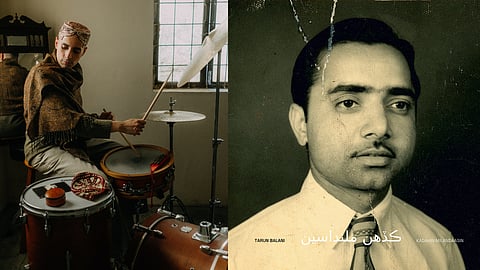
This article covers 'Kadahin Milandaasin', Tarun Balani’s album rooted in his Sindhi heritage and his grandfather’s migration after the Partition, blending Sindhi folk material with contemporary jazz compositions. It details the Tarun Balani Quartet India tour, listing the February dates across Mumbai (NMACC), Delhi (Oddbird Theatre), Kolkata (Goethe-Institut / Max Mueller Bhavan), and two Bangalore venues (Middle Room and Bangalore International Centre), outlining the touring line-up and positioning the concerts as the live return of the album to Indian stages.
Drummer and composer Tarun Balani, known for blending modern jazz with electronic textures, grew up in Delhi surrounded by his grandfather’s photographs, paintings and an old Yashica camera. His grandfather had moved from Sindh to Delhi after Partition, and traces of that history were present in his house in very tangible ways. Taun speaks about staring at those images as a child and imagining the lives inside them. Years later, that early fascination turned into Kadahin Milandaasin — a record that digs into his Sindhi roots, his grandfather’s migration, and the feeling of being connected to a place you haven’t physically known.
The artist describes the album as a way of stepping into a history that shaped him but unfolded before he was born. The title that translates to ‘When will we meet?’ is a question of migration and inheritance that runs through the record as something addressed to his grandfather, to Sindh, and to a version of home that exists across borders and generations.
Released in May last year via BERTHOLD Records, Kadahin Milandaasin features seven tracks and brings Sindhi folk material into Balani’s contemporary jazz language. The writing moves between tightly structured sections and open stretches where the quartet expands the material in real time, keeping the folk source intact while pushing it forward. The opening track, ‘Lajpat Nagar Sometimes,’ references the Delhi neighbourhood that became home to many Sindhi refugees after 1947, including Tarun’s family. The composition carries a reflective melodic line that keeps returning, almost like a memory you can’t shake. The title track draws from a line by Sindhi poet Shaikh Ayaz, and for the first time on record, Tarun sings in Sindhi himself.
The record was tracked at The Bunker Studio in Brooklyn with his quartet Dharma: Adam O’Farrill on trumpet, Olli Hirvonen on guitar, Sharik Hasan on piano, and Tarun on drums and synth. You can hear how harmoniously the group works with each other. O’Farrill’s trumpet lines carry long, searching phrases; Hirvonen’s guitar shifts between spacious chords and sharper, more angular passages; Hasan’s piano moves from sparse motifs to dense harmonic clusters. While Tarun’s drumming stays eclectic, shaping the direction of each piece.
Tracks like ‘Sailaab and ‘Locusts Are Descending’ stretch out and build gradually, circling themes of environmental anxiety alongside personal loss. Some earlier compositions reappear here in revised form, folded into the larger arc of the album so that everything feels connected to this central inquiry into heritage. Tarun rewrote and rearranged these earlier compositions so they aligned with the album’s focus on displacement and inheritance. This Brooklyn line-up has been central to the record’s development over time, shaping the arrangements through live performances before they were captured in the studio.
Kadahin Milandaasin has been widely recognised as a defining release in Tarun’s catalogue, with All About Jazz, JazzTimes, Rolling Stone India and The Hindu praising his buoyant drumming and imaginative writing, noting how the record processes personal grief through a contemporary jazz vocabulary, and calling it “a sonic love letter to Sindh.” Across India and abroad, the album has been positioned as a significant moment for contemporary jazz coming out of the country.
This month, the artist brings his album to India with the Tarun Balani Quartet tour. The line-up features Balani on drums, Sonja Ott on trumpet, Siddharth Gautam on guitar and electronics, and Luke Marantz on piano and synthesisers. The concerts are scheduled for February 20 at Mumbai’s Nita Mukesh Ambani Cultural Centre, February 22 at Oddbird Theatre in New Delhi, February 24 at Goethe-Institut / Max Mueller Bhavan in Kolkata, February 26 at Middle Room in Bangalore (vinyl set), and February 28 at Bangalore International Centre.
Through these concerts, the artist brings Kadahin Milandaasin back into the space of live performance, where the album first materialised. Returning the music to Indian stages places it in direct conversation with the history and geography that shaped it; the tour marks a homecoming.
Follow Tarun here and watch the music video for Kadahin Milandaasin below:
If you enjoyed reading this, here's more from Homegrown:
After A Decade At Alsisar, Magnetic Fields Becomes Nomads
Homegrown Handpicked: A Playlist Of Our Favourite Tracks From January 2026
USA's Slingshot Festival Brings Its Artist-Led Electronic Music Model To Mumbai
