
- HOMEGROWN WORLD
- HGCREATORS
- HGEXPLORE
- HGVOICES
- HGSHOP
- CAREERS
- ABOUT US
- CONTACT US

The last couple of weeks have given all of us in the Homegrown newsroom plenty to think about. Understatement of the fucking century, I know.
As journalists of different backgrounds, identities and perspectives, we didn’t always agree on the minutiae of everything that unfolded, but what makes me most proud is the fact we’re bound together by a drive to speak truth to power and to act as a voice for those on the periphery, irrespective of the circumstances, and even the consequences. The culture we cover is inseparable from the emancipatory movements that allow it to exist and evolve. You can’t have edgy music festivals and vinyl pop-ups or bar lectures in a culture that punishes dissent. Unless all of us are free, none of us are free.
The Cockroach Janta Party-led protests against former Education Minister Dharmendra Pradhan lit a flame that, despite having its ideological flaws, united a nation against the tyranny and incompetence that’s becoming all too commonplace. That flame appears to be waning under the illusion of a temporary victory, but we cannot and should not forget those singular moments, big and small, that have spoken and stirred something within each of us over the last two weeks.
You don’t need us to tell you how short people’s attention spans are in the modern world. What’s a watershed moment on one day is left in the dust of the next 50 Reels the algorithm decides to show you. Public memory is flakey and fickle. Everyone moves on, but literal lives depend on us remembering what has transpired and what will continue to transpire.
While the CJP struck the initial match, remember that this movement is and always will be bigger than one singular cause. Paper leaks are a symptom of a larger malaise. This is a fight against the apathy, hate, bigotry, and blind subservience that we’ve seen become part of the status quo over the last decade. It’s important to remember that while many of you are still getting your first real taste of the cold indifference of tyranny, minority communities and those on the periphery have had to put up with all of this and worse for decades, and even centuries. The road to this movement was paved by the blood, sweat, tears, and lives of the marginalised, and it is for them that we continue to remember and fight for the life, liberty and the pursuit of happiness that is guaranteed to all in a civil society.
These are the moments of resistance that defined the last two weeks for the Homegrown editorial team. Do not go quietly into that good night. Rage and remember.
An Intersectional Awakening (Mikhail Khan, Editor)
As a half-Muslim, half-Parsi minority who’s been screaming himself hoarse about the dangers of authoritarianism and the slippery slope we’ve been on since 2014, I’ve watched family, friends, colleagues, and strangers completely dismiss the warning signs and try to gaslight me into believing everything is fine and that I’m overreacting. The majority don’t always do it out of hate or animosity; they just aren’t able to empathise with anything that doesn’t affect them directly. Even those that do empathise feel powerless or are unwilling to actually do anything, so they just shut it out entirely and pretend this particularly bloodthirsty elephant isn’t in the room anymore. There’s been a consistent and persistent dehumanisation of minority issues for far too long, and for the last few weeks, I’ve been feeling this peculiar combination of rage and cynicism at everything that’s unfolded.
To be clear, every single death is a tragedy. Every single student that has died as a result of negligence, malice, or sheer incompetence should get the justice they deserve. Every person’s life matters. But that’s just it. I’ve found myself asking why the lives of some people seem to matter more than others in the mainstream public consciousness. Why have the deaths of students sitting for a medical exam caused a major uprising against the status quo, but students being detained, hurt and even murdered in places like Kashmir or the Northeast elicit nothing but silence from the majority? It’s awful that we even have to ask this question, but virtually every minority in the country has felt what you're feeeling right now and the fact that it had to come to this for you to see it is always going to feel a little like betrayal. Nontheless, we’ve come out in numbers to stand with and support this movement, despite the fact that we know all of you could very well forget about this; about us, in just a few short weeks.
Despite these worrying double standards, the NEET protests have at the very least cleared some of the fog that so many of you have found yourselves blinded by. It has underlined the need for an intersectional nation that treats all of its people equally; that understands that an attack or act of oppression against one of us is an attack against all of us. Decades of collective apathy is finally thawing thanks to a new generation that is as fearless as it is irreverent. Thanks to their effort and tenacity, it’s finally acceptable to give a fuck. It’s a tentative first step and there are miles to go before we sleep, but it underlines that there is still hope for a better world for us all.
And yet, as Janta Mantar lies abandoned and cleared out, we're already seeing the same thing we always do; specific minorities being targeted. It indicates that we're already going back to business as usual. Even allies, who fought in spite of knowing what it could cost them, are now left to face the 'consequences' of daring to fight for a better world for themselves and their loved ones. Instead of celebrating a singlular potentially inconsequential victory, it would behoove all of us, including the CJP, to remember:
None of us are free until all of us are free.
The Fearless & The Furious (Avani Adiga, Staff Writer)
Gen Z has often been labelled lazy, unmotivated, unbothered, careless, selfish, and almost every other adjective used to describe insolence or indifference. But over the last month, the country, and indeed the world, has witnessed an entire generation come together, mobilising people across regions and uniting them irrespective of class, caste, or language in shared rage and frustration over the failure to fulfil a basic right: access to a good, well-rounded education.
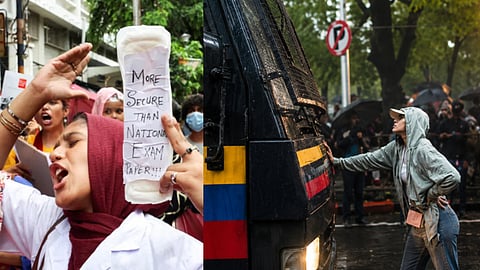
And in a way, they proved everyone right. Because yes, we are unbothered, insolent, and we don't give a fuck about your caveats or your excuses. We are inheriting a world stretched to its limits, one where unemployment continues to rise, glaciers continue to melt, and societies grow increasingly polarised. And this ‘you have entirely fucked with the wrong generation’ was seen throughout the protest, whether it was the absolutely unhinged and out-of-the-box posters or the sheer bravery and courage of young people like Riya Ahir, a protester in Mumbai who stopped a police van carrying detained citizens by standing directly in front of it and blocking its path.
One of the most inspiring parts of this month has been seeing the young children who were showing up every day with the same, if not greater determination as the other protesters. Their ability to understand what is at stake here, even before some grown individuals in power, was a symbol of great strength, and also highlighted how important it is to raise children in an environment where they are politically conscious and striving to be empathetic citizens.
A Brave New World (?) (Drishya, Staff Writer)
Two things stood out to me during the course of the Cockroach Janta Party (CJP) protests across the country. First: the way this protest was able to mobilise India’s “apolitical” middle class, which rarely interferes with politics outside of elections. Despite these protests’ student and youth-led nature, they were able to bring together a surprisingly broad coalition of supporters and allies from left-leaning student and youth organisations to opposition parties and farmers’ unions. The protest cut across caste, class, and communal divides and even included groups which are traditionally considered to be the BJP’s core voter base. Secondly: the protesters were able to completely circumvent the mainstream television news media, rendering one of the BJP’s most powerful tools largely ineffective against the movement. Reporters from pro-government media outlets were mocked, ridiculed, occasionally attacked, and shut out from the protest sites while independent and alternative voices like Samdish Bhatia, Priyanshi Sharma (PeekTV), and former Homegrown staff writer Anahita Ahluwalia (reporting for The Polis Project) were welcomed by the protesters and given unrestricted access to the Jantar Mantar protest site. The dichotomy signalled a shift in how younger generations perceive the news media and pointed toward traditional TV journalists' lack of credibility among younger audiences.
Joy As An Act Of Resistance (Disha Bijolia, Staff Writer)
From the formation of the CJP to mobilising the crowd, this protest was built on the ‘gram’. The misleading narratives of mainstream media couldn’t breach the digital grounds upon which the message of solidarity towards students spread across the nation.
From independent journalists and creators giving on-site updates to all the memes, reels and skits; social media was the backbone of this movement. It was both the medium and often the message — biting satirical and ironic remarks about the government in the language of the chronically online. The heart of the protests, beyond the guts and grit of the youth, was its joy — an ‘unserious’ approach to confronting power and making itself heard. Sure, we lost the plot sometimes by pookie-fying the cops who were out for blood, and being myopic about the intersectionality of the dissent; the grip the last week at Jantar Mantar had on us made us go through FOMO for not bearing the brunt of the lathi charges.
The spirit of resistance that reached us through edits and viral trends signalled a whole new digital cultural arena where this generation made sense of their grief, their rage, and their hope, articulated their democratic and autonomous liberties, exposed the hypocrisies of our leaders, subverted state intimidations, and united, through the niche microcultures of the internet, into one roaring voice.
A Decentralised Community Of Allies (Rhea Budhraja, Editorial Intern)
While the protests at Jantar Mantar made headlines for public outrage, the ground reality was defined by a sustained ecosystem of mutual care. Beyond the speeches and slogans, a functional support structure materialised on the pavement. Strangers routed meals and supplies through delivery apps from cities across India, while non-attendees in the global diaspora chipped in to fund essential logistics from afar. On site, volunteers organised makeshift distribution hubs for drinking water, hot meals, basic medicines, ORS, sanitary pads, and masks. Medical desks actively treated heat exhaustion, people fanned one another under the brutal Delhi sun, and volunteer crews routinely swept the asphalt clear of trash. Instead of relying on a political party or central figurehead, participants operated on a shared, decentralised sense of responsibility. On-site demonstrators and off-site supporters distributed the physical and logistical load together. The protest site functioned like a self-governing community, held together by small, unglamorous acts of labour that hardly ever get captured on camera, proving that movements rely as much on feeding, cleaning, and protecting one another as they do on the outrage that brought them there.
