
- HOMEGROWN WORLD
- HGCREATORS
- HGEXPLORE
- HGVOICES
- HGSHOP
- CAREERS
- ABOUT US
- CONTACT US

Jantar Mantar in New Delhi was built to observe the movement of celestial bodies. Today, it observes the distance between citizens and power. Tracing its journey from Maharaja Jai Singh II’s 18th-century observatory to India’s most recognisable protest ground, this article explores how the Delhi landmark became the heart of public dissent in India.
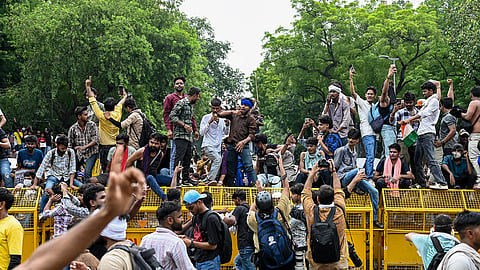
On 25 July 2026, the Cockroach Janta Party (CJP) called off its agitation against after Dharmendra Pradhan, the former Union Minister of Education, resigned from his post. It was the culmination of months of online mobilization and five weeks of widespread protests across the country over the alleged leak of the NEET exam paper. It was the latest display of public dissent and democratic protest to occupy the Jantar Mantar — an 18th-century pre-modern observatory at the heart of New Delhi. Constructed by Maharaja Jai Singh II of Amber (later Jaipur) in 1724, the site has become India’s most iconic public square of dissent since the 1990s.
Before 1990s, political demonstrations in New Delhi took place at the Boat Club lawns near India Gate. Its close proximity to Parliament, Rashtrapati Bhavan, and key government ministries meant protesters could directly command the attention of the incumbent government and speak to those in power. But after a massive Farmers’ Rally in October 1988 led by Mahendra Singh Tikait brought central Delhi to a standstill, the scale of the protest led the authorities to rethink how to control and regulate public demonstrations in New Delhi. Citing security and traffic concerns, government phased out protests at the Boat Club after the 1988 Farmers’ Rally. By the early 1990s, the tree-lined premises of the Jantar Mantar became the ground zero of political mobilisations in India.
The government’s decision to designate Jantar Mantar as Delhi’s primary protest site was as much about managing dissent as accommodating it. Unlike the vast, open Boat Club lawns near India Gate, Jantar Mantar’s narrow, linear layout offered the authorities a more controlled environment with limited points of entry and exit, making it easier for the Delhi Police to regulate crowds, erect barricades, and monitor demonstrations. Its location also struck a strategic balance by being close enough to the Parliament, government ministries, and the national media to preserve the appearance of democratic access, yet sufficiently removed from the immediate corridors of power to shield lawmakers and government offices from the physical and symbolic pressure of large-scale mobilisations. In effect, Jantar Mantar became a carefully calibrated space where the constitutional right to protest could be exercised, but within boundaries defined by the state.
Over the years, the Jantar Mantar has witnessed several major protests and public demonstrations against the ruling governments of the time. The 2011 India Against Corruption Movement led by Anna Hazare’s indefinite hunger strike demanding the Jan Lokpal Bill snowballed at Jantar Mantar, altering the country's political trajectory. The subsequent 2012 Nirbhaya Protests, sparked by the brutal gang rape of a 23-year-old medical student in New Delhi, also turned the Jantar Mantar into a focal point for intense, visceral public outrage demanding systemic reforms regarding women’s safety. Both of these protests led to the fall of the Dr Manmohan Singh led United Progressive Alliance (UPA) II government in 2014.
Jantar Mantar has continued to witness significant public demonstrations through the mid-to-late 2010s and 2020s, including the anti-CAA (Citizenship Amendment Act) protests; agitation by India’s elite wrestlers over federation leadership and allegations of sexual harrasment against Brij Bhushan Sharan Singh; the veteran-led ‘One Rank, One Pension’ agitations; recurring farmer distress marches from various states; major youth-led mobilizations; and annual Pride marches. The 2026 student and youth-led Cockroach protests at the Jantar Mantar built on the legacy of these historic protests to once again transform Jantar Mantar into the beating heart of Indian Democracy.
The recent protests have once again ruffled feathers in New Delhi’s corridors of power and the viability of Jantar Mantar as a protest venue has faced existential threats in recent years. The site’s future as a protest venue faced a major threat in 2017 when the National Green Tribunal (NGT) ordered a halt to all demonstrations at Jantar Mantar, citing noise, garbage, and environmental degradation, and attempted to shift protests to Ramlila Maidan. However, the Supreme Court struck down the blanket ban in 2018, reaffirming the constitutional right to peaceful assembly and restoring Jantar Mantar’s status.
Today, Jantar Mantar embodies a profound paradox. Surrounded by iron barricades, heavy police deployment, and strict state oversight, it remains a space where citizens gather precisely because it forces the incumbent government to look outward and listen, preserving a vital, albeit heavily contested, avenue for India’s beseiged democracy.
